Part 8: Newton Gregory Backward Interpolation for UPSC ISS: Predicting the End
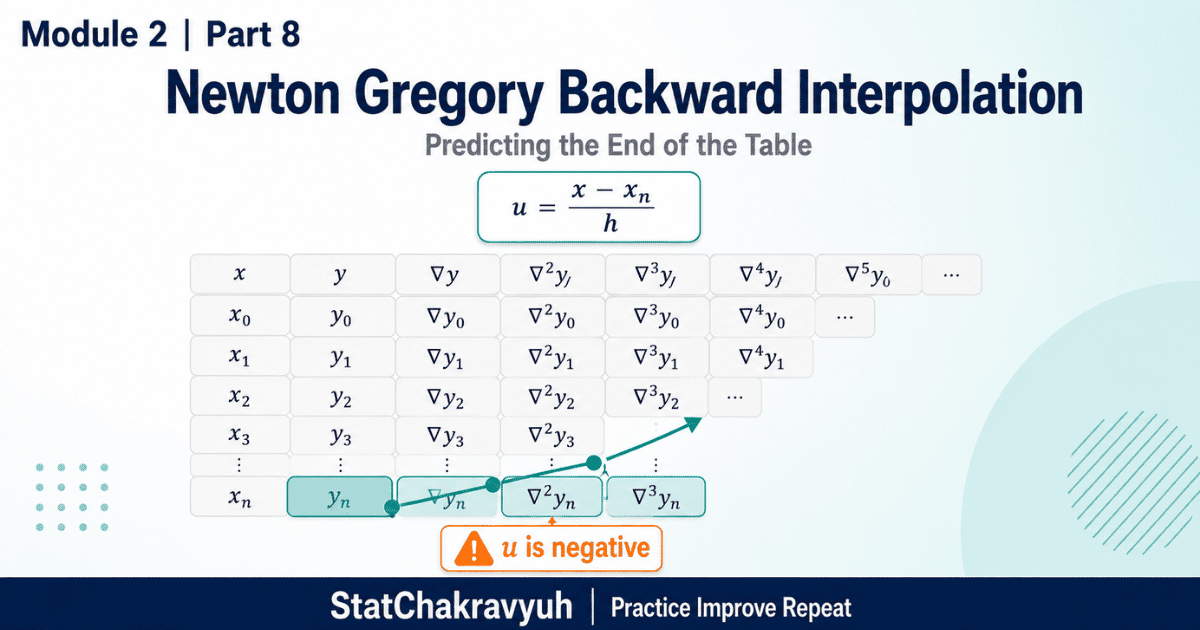
Newton Gregory Backward Interpolation formula using bottom diagonal differences near the end of a data table for UPSC ISS Part 8

Welcome back to Part 8 of Module 2, updated for the UPSC ISS 2026 to 2027 cycle. In Part 7 we predicted values near the beginning of a table. Today the examiner flips the situation: the target sits near the end of the data. Use the forward formula there and your truncated series carries a … Read more
Part 7: Newton Gregory Forward Interpolation for UPSC ISS: Predicting the Beginning

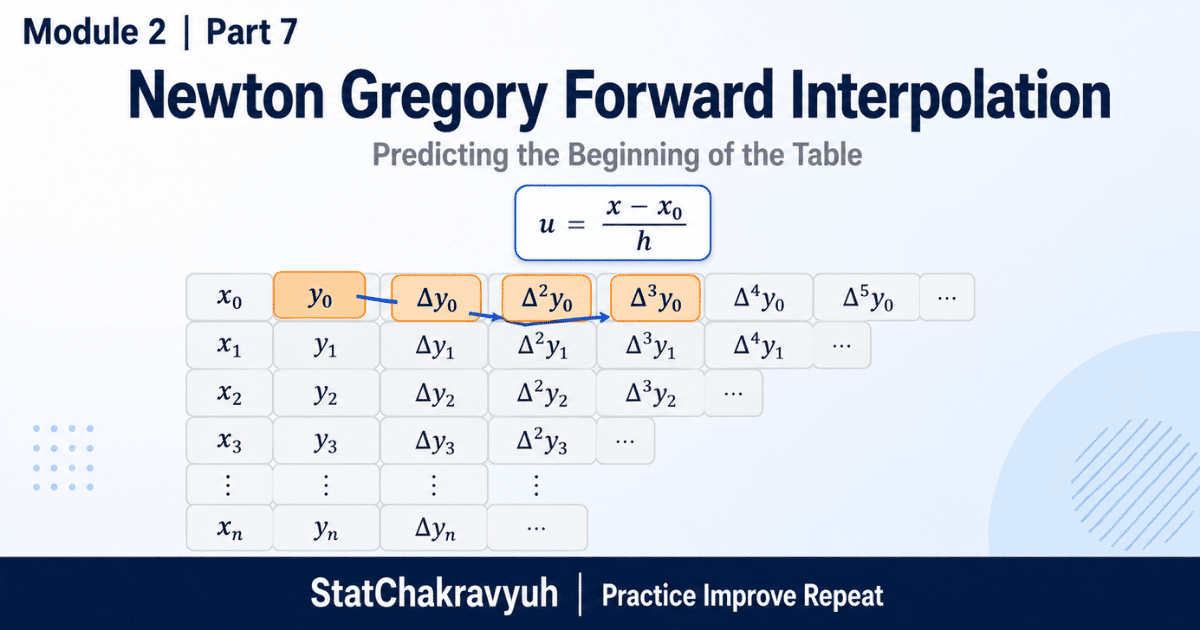
Newton Gregory Forward Interpolation formula using leading differences near the beginning of a data table for UPSC ISS Part 7

Welcome to Part 7 and the opening of Module 2, updated for the UPSC ISS 2026 to 2027 cycle. In Part 6 we understood what interpolation is, its assumptions, and the error term. Now it is time for the most famous weapon in your arsenal: the Newton Gregory Forward Interpolation Formula. The formula estimates the … Read more

Part 6: Concept of Interpolation for UPSC ISS: Assumptions and the Error Term R_n(x)

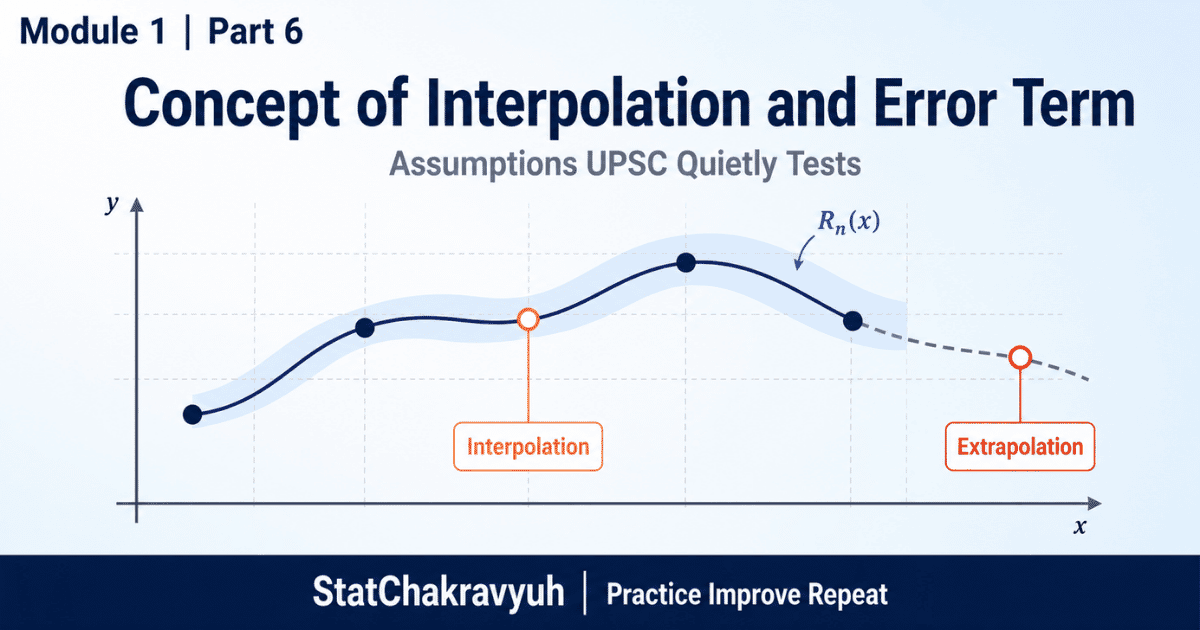
Interpolation inside data range versus extrapolation outside range with error term for UPSC ISS Part 6

Welcome to Part 6, the final part of Module 1, updated for the UPSC ISS 2026 to 2027 cycle. With operators, factorial polynomials, and differences of zero behind us, we now step into the heart of Numerical Analysis: Interpolation. Interpolation is the technique of estimating the value of a function for an intermediate value of … Read more

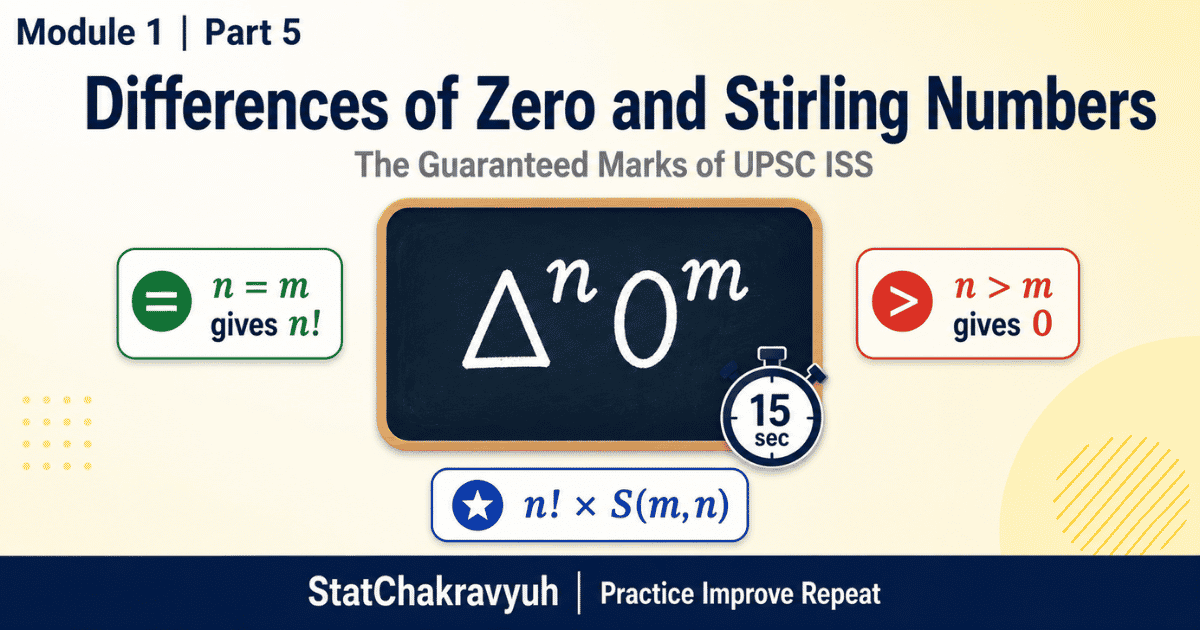
Part 5: Differences of Zero for UPSC ISS: Solve Δ^n 0^m in 15 Seconds

Differences of zero Delta n 0 m rules and Stirling numbers for UPSC ISS Numerical Analysis Part 5

Welcome back to Part 5 of Module 1, updated for the UPSC ISS 2026 to 2027 cycle. You now know operator algebra, separation of symbols, and factorial polynomials. Today we unlock one of the most intimidating yet highest scoring topics in the syllabus: Differences of Zero and Stirling Numbers. The difference of zero, written Δn0m\Delta^n … Read more

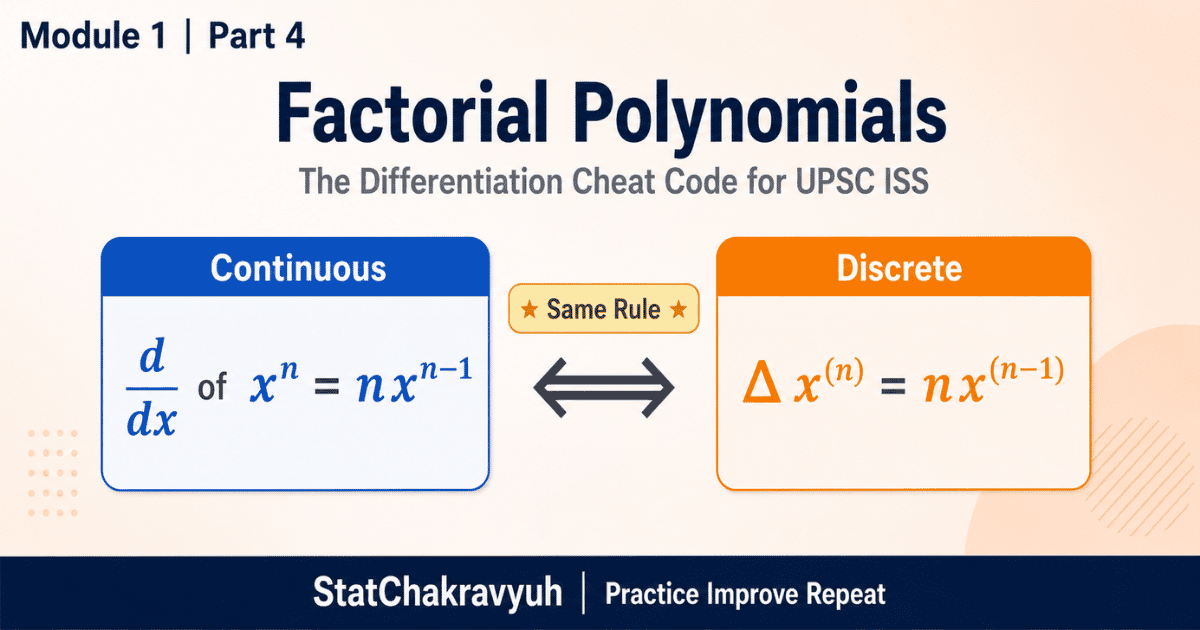
Part 4: Factorial Polynomials for UPSC ISS: The Discrete Differentiation Cheat Code

Factorial polynomial x power n bracket notation with Delta acting like differentiation for UPSC ISS Part 4

Welcome back to Part 4 of Module 1, updated for the UPSC ISS 2026 to 2027 cycle. After operator algebra and separation of symbols, today we tackle a concept that works like an absolute cheat code in Paper 1: the Factorial Representation of a Polynomial. A factorial polynomial, written x(n)x^{(n)}, is the product x(x−h)(x−2h)⋯[x−(n−1)h]x(x-h)(x-2h)\cdots[x-(n-1)h] of … Read more

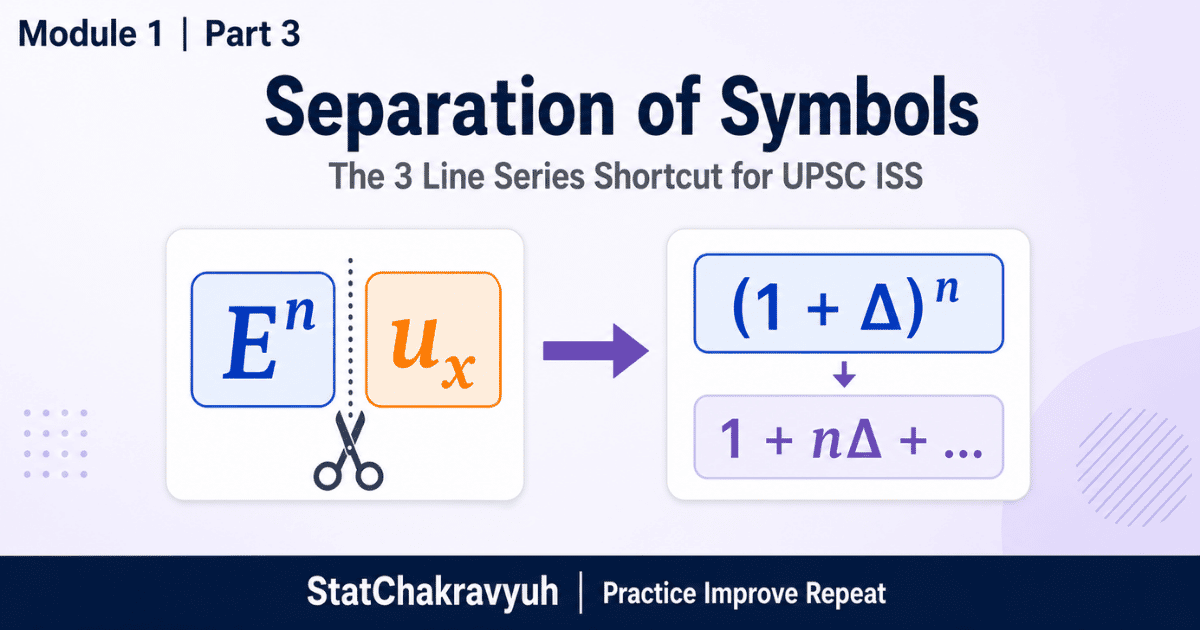
Part 3: Separation of Symbols for UPSC ISS: Solve Series Questions in 3 Lines

Separation of symbols technique treating operators E and Delta as algebra for UPSC ISS Numerical Analysis Part 3

Welcome back to Part 3 of Module 1, updated for the UPSC ISS 2026 to 2027 cycle. In Part 2 we learned the magic relations between EE, Δ\Delta, ∇\nabla, and DD. Today we unlock the most powerful time saver in the syllabus: Separation of Symbols. Separation of Symbols is a technique where operators such as … Read more

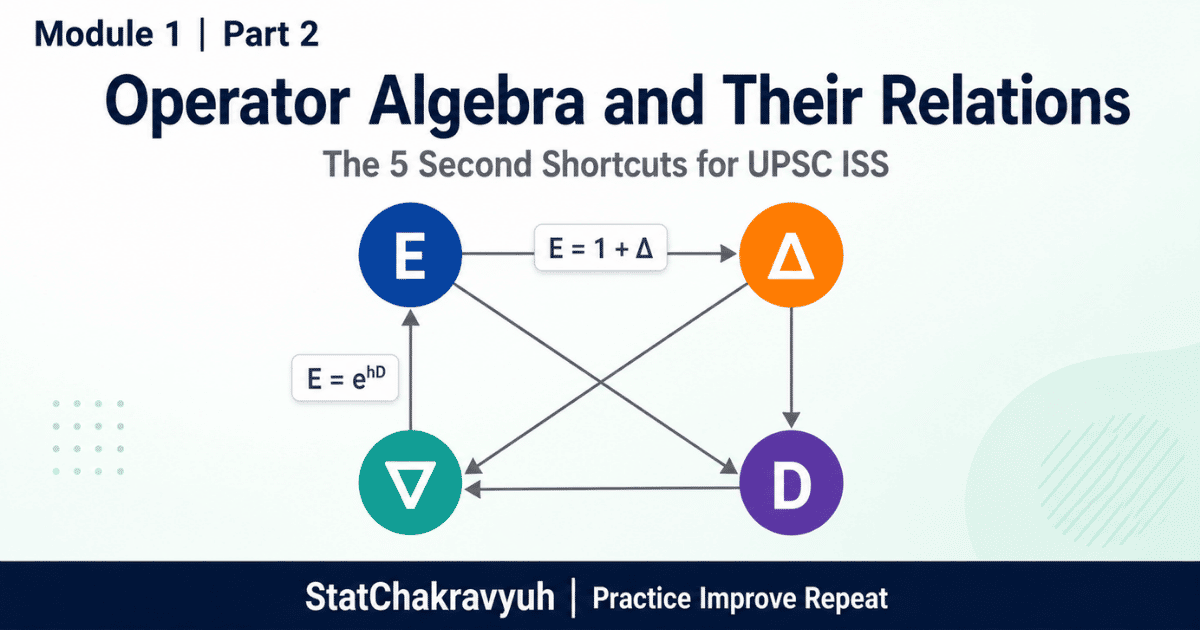
Part 2: Operator Algebra for UPSC ISS: E, Delta, Nabla, D Relations Made Simple

Operator algebra relations between E Delta Nabla and D for UPSC ISS Numerical Analysis Part 2

Welcome back to Part 2 of Module 1, updated for the UPSC ISS 2026 to 2027 cycle. In Part 1 we mastered the forward (Δ\Delta) and backward (∇\nabla) difference operators. Today we perform pure magic with them. Operator algebra links the shift operator EE, the forward difference Δ\Delta, the backward difference ∇\nabla, the central difference … Read more

Part 1: The Basics of Finite Differences (Forward & Backward) | UPSC ISS Numerical Analysis

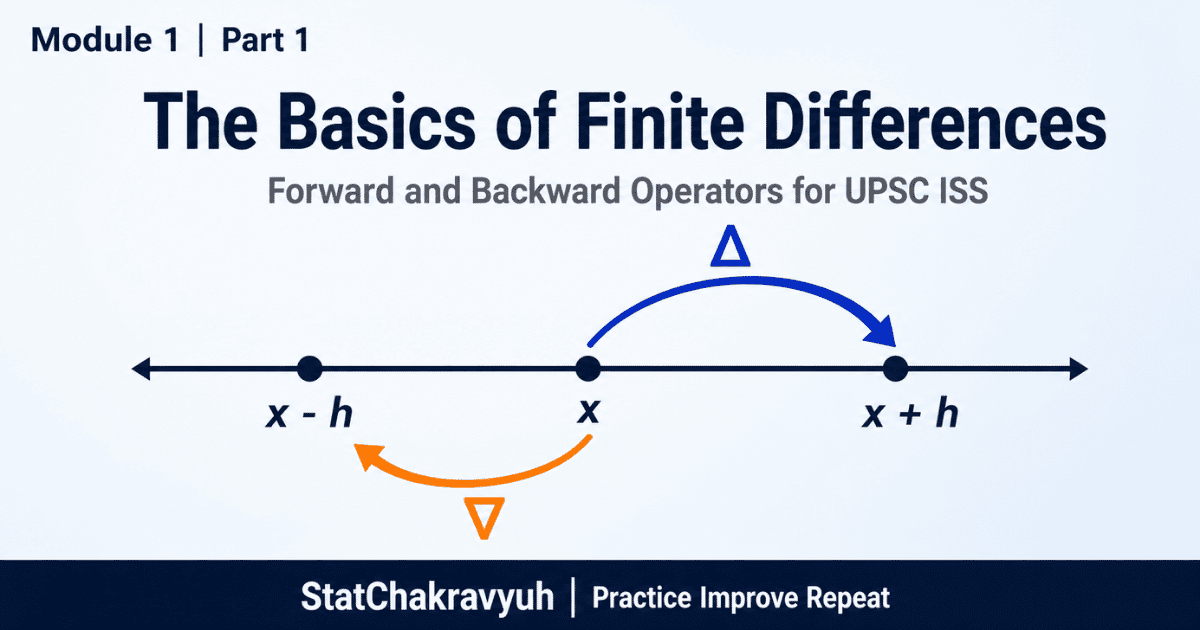
Forward and backward difference operators Delta and Nabla explained for UPSC ISS Numerical Analysis Part 1

Welcome to Part 1 of Module 1 of the StatChakravyuh Numerical Analysis series, updated for the UPSC ISS 2026 to 2027 cycle. If you have read our complete UPSC ISS preparation hub, you already know that Numerical Analysis contributes close to 20 questions in Statistics Paper 1, and scientific calculators are strictly banned. To conquer … Read more

UPSC ISS General English Essay Writing Guide 2027: Topic Selection, Structure, And Examiner Tips

UPSC ISS essay writing guide 2027 showing aspirant selecting the right topic in five minutes.

The first five minutes of the UPSC ISS General English paper can decide your final score in the essay. Five topics are given. You have to pick one. You will write 800 words on it. It carries 30 marks out of 100. And most aspirants choose the topic in under a minute, without thinking through … Read more