
Welcome to Part 1 of Module 1 of the StatChakravyuh Numerical Analysis series, updated for the UPSC ISS 2026 to 2027 cycle. If you have read our complete UPSC ISS preparation hub, you already know that Numerical Analysis contributes close to 20 questions in Statistics Paper 1, and scientific calculators are strictly banned. To conquer that section, we first need a rock solid foundation, and that foundation is the Calculus of Finite Differences.
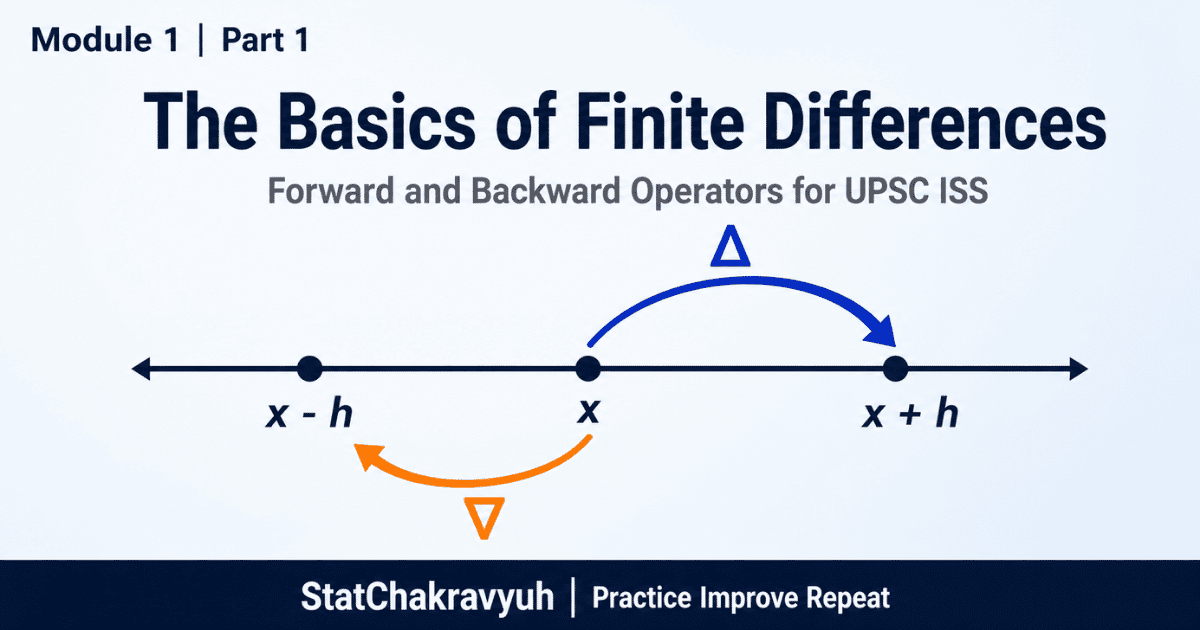
The Calculus of Finite Differences studies how a function changes when its independent variable jumps by a fixed finite step h, instead of an infinitesimally small step. The forward difference operator is defined as and the backward difference operator as . Every formula you will meet later, from Newton Gregory interpolation to Runge Kutta methods, is built on these two definitions.
This post is Part 1 of the Finite Differences Foundation Guide (Module 1), which sits inside our UPSC ISS Numerical Analysis Complete Guide.
The Story of Ramesh and the Census Data
Imagine a statistician named Ramesh working for the Government of India. He is handed the population census data for a city. The Indian census is decennial, so Ramesh has figures for 1991, 2001, 2011, and 2021.
His boss asks a simple question: “Ramesh, what was the population in 2005?”
If Ramesh tries standard continuous calculus, where the difference tends to zero, he will fail. Population data is not recorded every second. It jumps in discrete steps of 10 years, so . He cannot shrink that gap to zero.
Ramesh needs a mathematics of finite, measurable jumps. That branch is the Calculus of Finite Differences. It studies the relations between the values of a function when the independent variable changes by finite jumps, equal or unequal.
The Vocabulary: Arguments, Entries, and Interval
Before formulas, learn the standard vocabulary that UPSC ISS papers use, following the notation of H.C. Saxena.
Suppose we have a function .
Argument (x): The value of the independent variable. In the census example, the years 1991, 2001, 2011 are the arguments.
Entry (y): The corresponding value of the dependent variable. The population figure for a year is the entry.
Interval of Differencing (h): The constant gap between two consecutive arguments, for example years.
The Forward Difference Operator ()
The most famous operator in your UPSC ISS paper is the Forward Difference Operator, denoted by the capital Greek letter Delta.
For arguments the first forward differences are and .
Higher order differences: The difference of a difference is the second order forward difference.
Note carefully that is not the square of any quantity. It means the operator applied twice.
In a forward difference table, the very first entry is the Leading Term, and the differences built from it, namely , are the Leading Differences.
The Backward Difference Operator ()
When we need values near the end of a data table, we look backward. The Backward Difference Operator is denoted by the inverted Delta, called Nabla.
The second backward difference is .
The subtle distinction: forward differences use points to the right of , backward differences use points to the left of . Also remember the bridge between the two, which UPSC loves: . Both equal , they simply carry different labels.
StatChakravyuh Pro Tips: Properties That Fetch Direct Marks
UPSC tests conceptual clarity on operator properties far more than long arithmetic. Memorize these five rules.
- Difference of a constant is zero. If , then .
- Commutative with constants. .
- Distributive over addition. . So is a linear operator.
- Law of indices holds. .
- The exam trap. is commutative with constants but never with variables. . This single trap eliminates one wrong option in almost every operator question.
One more high value fact for the objective paper: the th forward difference of a polynomial of degree is constant, and every difference of order higher than is exactly zero. We will exploit this fully in Part 4 and Part 5.
Solved PYQ Masterclass
PYQ Pattern (asked repeatedly in UPSC ISS Paper 1, including the 2018 and 2021 cycles): If and the interval of differencing is , find .
Zero Calculator Solution:
- Write the definition: .
- Substitute: .
- Expand: .
- Simplify: .
Final Answer: .
The 10 Second Shortcut: For any polynomial with , . For this instantly gives , and for it gives . Add them mentally: . Linearity lets you difference term by term without touching a rough sheet.
Classic ISS PYQ (conceptual): The tenth difference of the product with is a UPSC favourite. The product is a polynomial of degree with leading coefficient . So the answer is simply , written in 10 seconds. The complete logic behind this shortcut arrives in Part 4 of this module.
Common Traps to Avoid
Trap 1: Reading as the square of . It is the operator applied twice, never a square.
Trap 2: Forgetting that and are the same number. Options are often written in the unfamiliar notation to confuse you.
Trap 3: Assuming when the question clearly gives another interval. Always circle the value of before solving.
Frequently Asked Questions (FAQs)
-
What is the main difference between forward (Δ) and backward (∇) difference operators?
Forward difference calculates the change using the current point and the next point to the right: . Backward difference calculates the change using the current point and the previous point to the left: .
-
Why are finite differences important for the UPSC ISS exam?
They are the foundation of the Numerical Analysis unit in Statistics Paper 1, which carries close to 20 questions. Interpolation, numerical differentiation, integration, and difference equations all rest on these operators.
-
Can I use a calculator for Numerical Analysis in UPSC ISS Paper 1?
No. Scientific calculators are banned in the objective Paper 1. You must rely on operator properties and mental math shortcuts, which is exactly what this series trains.
-
What is the “Leading Term” in a finite difference table?
The very first entry in the table, typically denoted as or , is called the leading term. The differences calculated directly from it are called leading differences.
-
Will we need to draw large difference tables in the UPSC ISS Exam?
Generally, no. UPSC questions are framed to test your conceptual knowledge and properties of operator algebra rather than your ability to do lengthy arithmetic. If you know the formula rules, you can bypass the table entirely.
Take the Next Step with StatChakravyuh
Join the Free UPSC ISS WhatsApp Community. Every part of this series, plus the free Module 1 Practice PDF with 50 MCQs, is delivered directly in the community. Serious aspirants do not prepare in isolation. 👉 Join the WhatsApp Community now
Enroll in the Free UPSC ISS Course. Structured mocks, practice sets, and revision support built on the same Practice Improve Repeat system, at zero cost. 👉 Enroll in the Free Course
Coming up in Part 2: Operator Algebra and the magic relations between , , , and that turn 5 minute derivations into 5 second answers.
[…] back to Part 2 of Module 1, updated for the UPSC ISS 2026 to 2027 cycle. In Part 1 we mastered the forward (ΔDelta) and backward (∇nabla) difference operators. Today we perform […]