Part 34: Top 25 Most Repeated PYQs in UPSC ISS Numerical Analysis: The Rapid Fire Finale
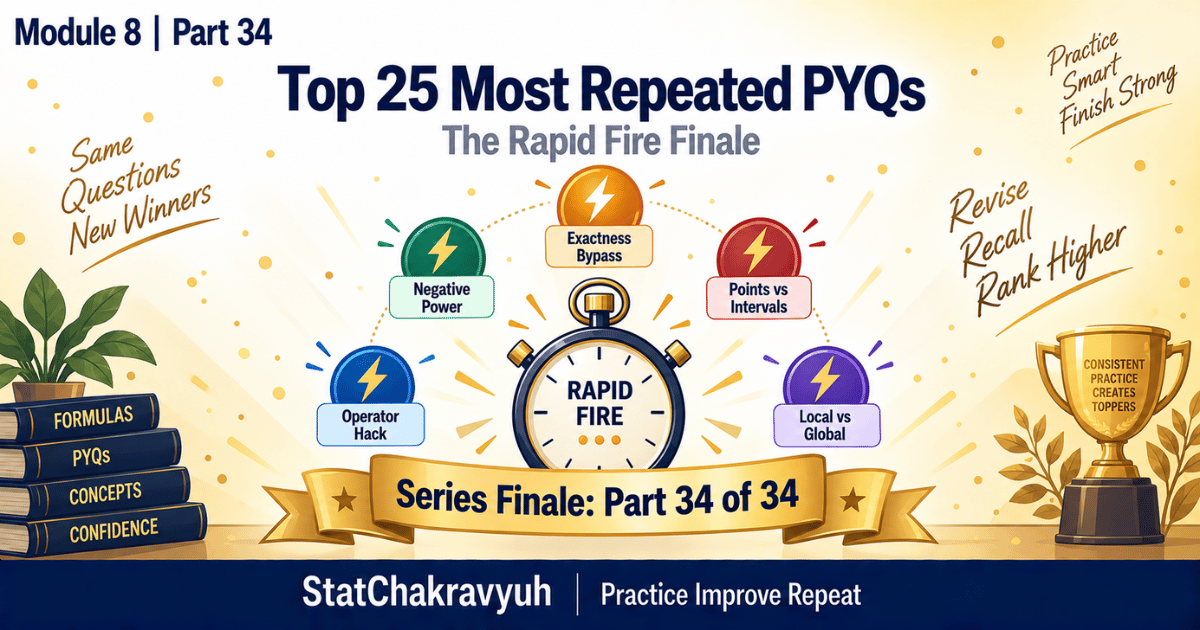
Rapid fire drill of the most repeated numerical analysis PYQ themes with one line shortcuts for UPSC ISS Part 34 series finale

Welcome to Part 34, the grand finale of the entire StatChakravyuh Numerical Analysis series, updated for the UPSC ISS 2026 to 2027 cycle. The concepts are mastered, the cheat sheet is pinned, the master tables are memorized, and the decision tree is hardwired. What remains is the ultimate test of reflexes. Across the past decade, … Read more

Part 33: The Formula Decision Tree for UPSC ISS: Pick the Right Method in Seconds

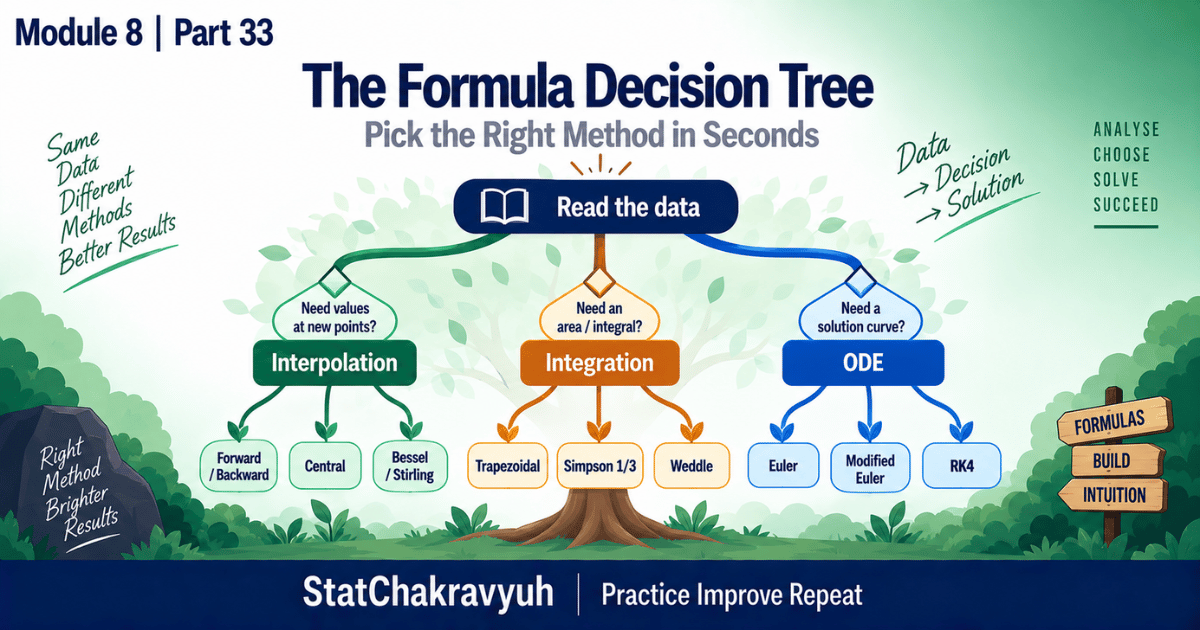
Decision tree flowchart selecting interpolation integration and ODE formulas for UPSC ISS Part 33

Welcome back to Part 33 of Module 8, updated for the UPSC ISS 2026 to 2027 cycle. The formula sheet armed you, the master tables sharpened you, but a weapon is useless if you do not know when to draw it. With roughly 90 seconds per question and no calculator, choosing the wrong formula means … Read more

Part 32: Common Silly Mistakes in UPSC ISS Numerical Analysis: The 5 Traps That Cost Ranks

Five common exam traps in numerical analysis with warning signs and fixes for UPSC ISS Part 32

Welcome back to Part 32 of Module 8, updated for the UPSC ISS 2026 to 2027 cycle. You have memorized the formula sheet and the master tables. You feel ready. Then the hall doors close: 80 questions, 120 minutes, no calculator, about 90 seconds per question, 2.5 marks gained per correct answer and about 0.83 … Read more

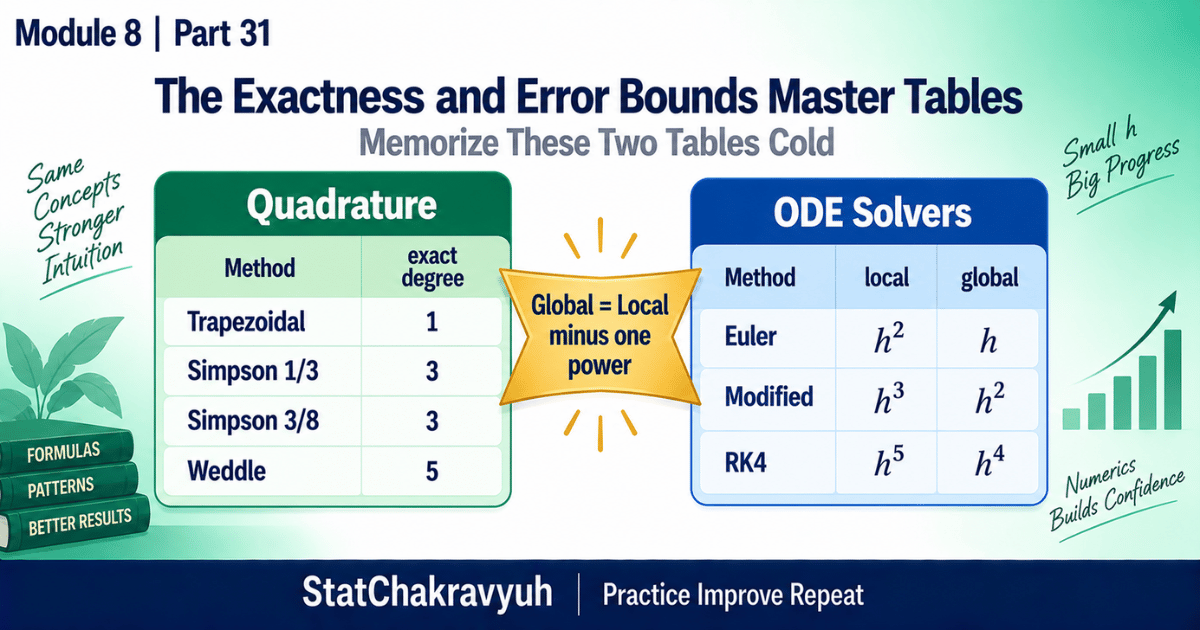
Part 31: Exactness and Error Bounds for UPSC ISS: The Two Master Tables

Master tables of exactness degrees and local versus global error orders for quadrature rules and ODE solvers for UPSC ISS Part 31

Welcome back to Part 31 of Module 8, updated for the UPSC ISS 2026 to 2027 cycle. Part 30 gave you the formulas, which tell you how to solve a problem. Today’s tables tell you something more valuable: whether you need the formula at all. With calculators banned, examiners embed cheat codes into their questions … Read more

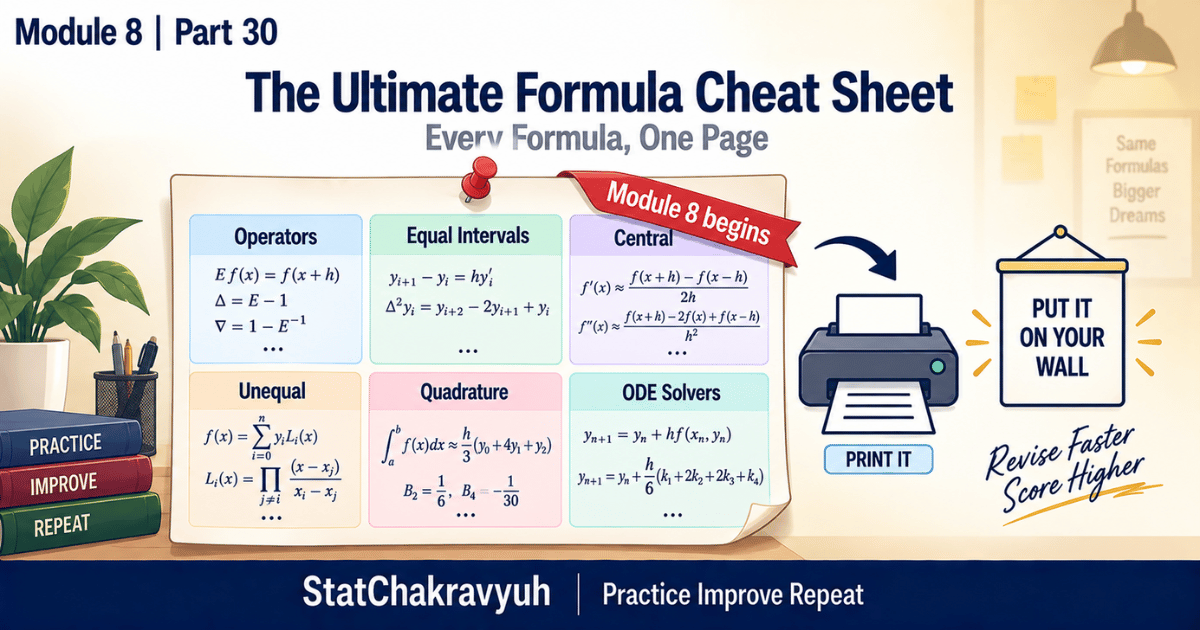
Part 30: UPSC ISS Numerical Analysis Formula Sheet: The Ultimate Cheat Sheet

Ultimate formula cheat sheet covering operators interpolation quadrature and ODE solvers for UPSC ISS Part 30

Welcome to Part 30 and the opening of Module 8, the Last Minute Revision module, updated for the UPSC ISS 2026 to 2027 cycle. Twenty nine parts of theory sit behind you. With the exam approaching, flipping through hundreds of pages is no longer an option; you need one centralized, rapid fire memory aid. This … Read more

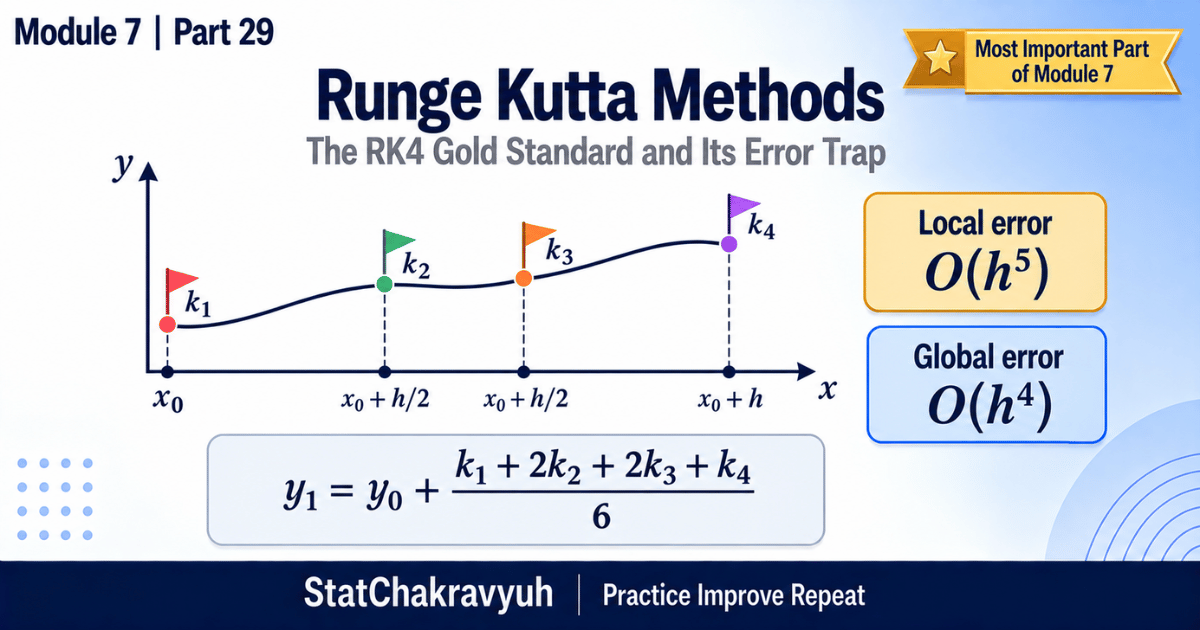
Part 29: Runge Kutta Methods for UPSC ISS: RK4 and the O(h5) Error Trap

Fourth order Runge Kutta method with four slopes k1 to k4 and local error order h5 for UPSC ISS Part 29

Welcome to Part 29, the most important part of Module 7 and the final method of the teaching series, updated for the UPSC ISS 2026 to 2027 cycle. Modified Euler repaired the drift, but sensitive applications demand still more accuracy, and the Taylor series route demands painful higher derivatives. The resolution is the gold standard … Read more

Part 28: Modified Euler’s Method for UPSC ISS: The Predictor Corrector Upgrade

Welcome back to Part 28 of Module 7, updated for the UPSC ISS 2026 to 2027 cycle. Euler’s method is wonderfully simple and disappointingly inaccurate: a single tangent drawn at the start of each step lets the solution drift, leaving a global error of only O(h)O(h). The repair is a two step feedback loop, the … Read more

Part 27: Euler’s Method for UPSC ISS: The Tangent March and Its Error Bounds

Welcome back to Part 27 of Module 7, updated for the UPSC ISS 2026 to 2027 cycle. Picard’s method is elegant, but it dies the moment the integration turns impossible. When analytical routes close, we march numerically, step by step, and the oldest marching method of all is Euler’s Method. It is delightfully simple to … Read more

Part 26: Picard’s Method for UPSC ISS: The Integration Loop Explained

Welcome to Part 26 and the opening of Module 7, updated for the UPSC ISS 2026 to 2027 cycle. Interpolation, numerical calculus, and difference equations are behind you. We now arrive at the pinnacle of the Numerical Analysis unit: Numerical Solutions of Ordinary Differential Equations. The goal changes fundamentally: given only a derivative dydx\dfrac{dy}{dx}​ and … Read more

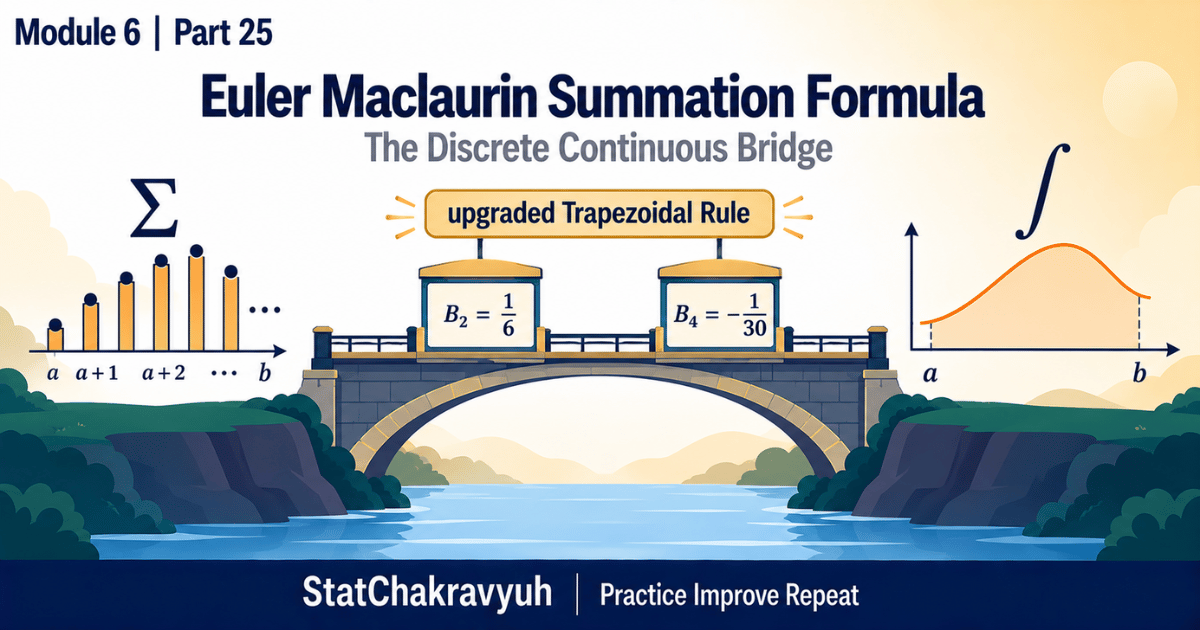
Part 25: Euler Maclaurin Summation Formula for UPSC ISS: The Discrete Continuous Bridge

Euler Maclaurin summation formula bridging discrete sums and continuous integrals with Bernoulli numbers for UPSC ISS Part 25

Welcome to Part 25, the grand finale of Module 6, updated for the UPSC ISS 2026 to 2027 cycle. Parts 23 and 24 lived in the purely discrete world, while Module 5 lived in the continuous one. Today the two worlds shake hands across the most elegant bridge in the syllabus: the Euler Maclaurin Summation … Read more