
Welcome back to Part 31 of Module 8, updated for the UPSC ISS 2026 to 2027 cycle. Part 30 gave you the formulas, which tell you how to solve a problem. Today’s tables tell you something more valuable: whether you need the formula at all. With calculators banned, examiners embed cheat codes into their questions through exactness degrees and error bounds, and knowing these properties by heart converts ten minute fractional grinds into two second ticks.
Picture the classic setup: a question asks for the error when is computed by Simpson’s 1/3 rule. The average aspirant builds a table and divides fractions for ten minutes. You read the integrand, see degree 3, recall that Simpson’s 1/3 is exact up to degree 3, and tick zero. Print both tables below and stick them above your desk.
This post is Part 31 of the Last Minute Revision Guide (Module 8), inside our UPSC ISS Numerical Analysis Complete Guide. Roadmap at the UPSC ISS hub.
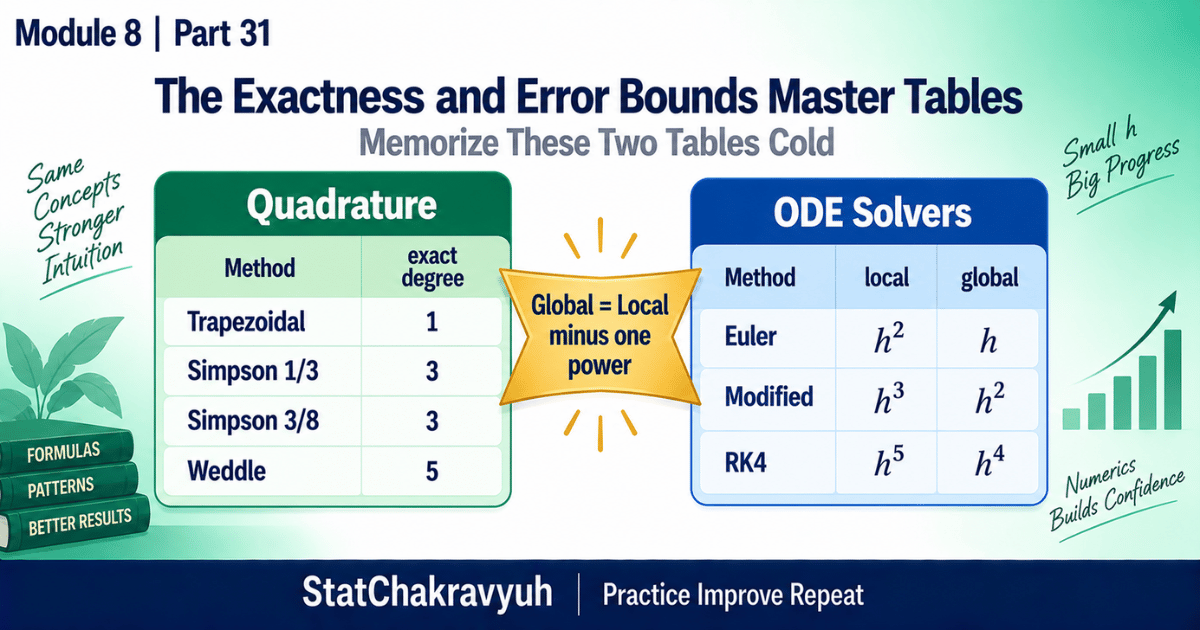
Master Table 1: Numerical Integration (Quadrature)
Watch the distinction between the assumed curve degree, the geometry used to build the rule, and the degree of exactness, the magical ceiling below which the error completely vanishes.
| Rule | Interval Constraint | Assumed Curve Degree | Degree of Exactness | Local Error | Global Error |
|---|---|---|---|---|---|
| Trapezoidal Rule | Any integer | 1 (straight line) | Exactly 1 | O(h3) | O(h2) |
| Simpson’s 1/3 Rule | Multiple of 2 (even) | 2 (parabola) | Exactly 3 | O(h5) | O(h4) |
| Simpson’s 3/8 Rule | Multiple of 3 | 3 (cubic) | Exactly 3 | O(h5) | O(h4) |
| Weddle’s Rule | Multiple of 6 | 6 | Exactly 5 | O(h7) | O(h6) |
Key quadrature takeaways. First, the global truncation error is always one degree lower than the local error, because the number of strips is proportional to . Second, the Weddle trap: multiples of 6 intervals mean a minimum of 7 consecutive data points, through . Third, Weddle’s rule is the precision champion of the syllabus, with a global error of only and exactness up to degree 5.
Master Table 2: ODE Solvers
The Runge Kutta family from Module 7, with the error limits the examiners test most heavily.
| Method | Equivalent RK Order | Local Error | Global Error |
|---|---|---|---|
| Euler’s Method | First order (RK1) | O(h2) | O(h) |
| Modified Euler’s Method | Second order (RK2) | O(h3) | O(h2) |
| Runge Kutta Fourth Order | Fourth order (RK4) | O(h5) | O(h4) |
Key ODE takeaways. First, the trap: RK4 matches the Taylor series up to , so its local error starts at the very next power, , the single most repeated theory question of the module. Second, the predictor corrector upgrade tightens Euler’s drifting global to the Modified Euler’s . Third, the integration bridge: when is independent of , RK4 collapses exactly into Simpson’s 1/3 Rule.
StatChakravyuh Pro Tips
- Read the prefix before the word error. Both and will sit among the RK4 options. “Local” points to the higher power ; “global”, “total”, or “accumulated” points to the lower power .
- The bypass drill. Asked for by Simpson’s 3/8 rule, do not touch the formula. Degree 3 is within the exactness ceiling of 3, so plain calculus finishes it: .
- The difference framing. Given an exact integral A and its numerical value B, the quantity is simply the error. For a degree 2 integrand under Simpson’s 1/3 rule, that error is instantly zero.
Frequently Asked Questions
Why is the global error always one power below the local error?
The number of steps covering a fixed range is proportional to , so summing the per step local errors multiplies by and drops one power of .
Are Simpson’s 1/3 and 3/8 rules equally exact?
Yes. Both cap at degree 3 with local and global errors. They differ only in the interval constraint, even versus multiples of 3.
When does the exactness bypass fail?
When the integrand is not a polynomial, such as or , or when its degree exceeds the rule’s ceiling. In those cases the formula must genuinely be applied.
Take the Next Step with StatChakravyuh
Join the Free UPSC ISS WhatsApp Community. The Module 8 PDF, with both master tables in printable form plus the Top 100 PYQ mix, releases in the community. 👉 Join the WhatsApp Community now
Enroll in the Free UPSC ISS Course. Structured lessons and practice sets on the Practice Improve Repeat system, at zero cost. 👉 Enroll in the Free Course
Coming up in Part 32: the traps that cost ranks. The top five silly mistakes of Numerical Analysis and exactly how to avoid each one.