
Welcome to Part 29, the most important part of Module 7 and the final method of the teaching series, updated for the UPSC ISS 2026 to 2027 cycle. Modified Euler repaired the drift, but sensitive applications demand still more accuracy, and the Taylor series route demands painful higher derivatives. The resolution is the gold standard of ODE solvers: the Runge Kutta methods, crowned by the Fourth Order Runge Kutta (RK4) method.
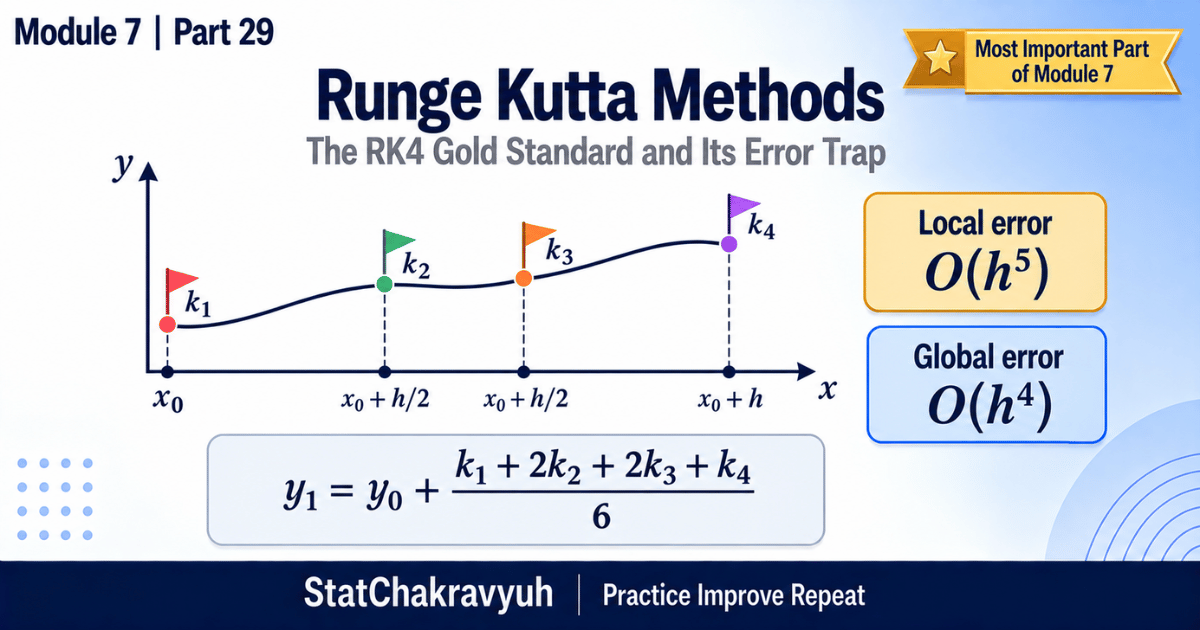
The genius of the family: achieve high order Taylor accuracy without computing a single derivative, by evaluating the plain slope function at chosen points and taking a weighted average. RK4 uses four slopes and the weights one, two, two, one over six. It matches the Taylor series through the term, so its local error is of order and its global error .
Exam context: 80 questions, 200 marks, 2 hours, 2.5 marks per question, about 0.83 deducted per wrong answer. A full RK4 table is rarely demanded without calculators; the error orders and family identities are what the paper actually tests, including the 2021 cycle question solved below.
This post is Part 29 of the Differential Equations Guide (Module 7), inside our UPSC ISS Numerical Analysis Complete Guide. Roadmap at the UPSC ISS hub.
The Story of Vikram and the Missile Trajectory
Vikram, an ISS officer deputed to the Defence Research and Development Organisation, programs the flight path of a new ballistic missile governed by a complex equation . Basic Euler is far too crude. The Taylor route needs the second, third, and fourth derivatives of the flight equation, overloading the onboard computer.
RK4 is his answer: evaluate the original function at four carefully chosen points inside each step, average with the weights one, two, two, one, and collect fourth order Taylor accuracy with zero differentiation. Pinpoint precision, successful launch.
The Runge Kutta Family
Second Order Runge Kutta (RK2). Already met in Part 28: the Modified Euler’s method is mathematically identical to RK2.
Local error of order .
Fourth Order Runge Kutta (RK4). The most widely used ODE solver in the world. Four slopes, then a weighted average:
One slope at the start, two at the midpoint, one at the end, weighted one, two, two, one.
The Ultimate Exam Trap: The Truncation Error
RK4 matches the Taylor series up to the term in . Therefore:
Local truncation error, one step:
Global truncation error, accumulated over many steps, drops one degree:
The exam hack: the word “local” points to ; the words “global” or “total” point to . The name “fourth order” describes the Taylor agreement and the global error, never the local power, and that mismatch is precisely the planted trap.
StatChakravyuh Pro Tips
- The method hierarchy, permanently memorized. First order Runge Kutta equals Euler’s method. Second order Runge Kutta equals Modified Euler’s method. Matching questions on this pairing recur across cycles.
- The Simpson’s 1/3 bridge, the hidden gem. If the equation happens to be independent of y, reducing to , the RK4 formula collapses exactly into Simpson’s 1/3 Rule for numerical integration. The one, two, two, one weights over six are Simpson’s one, four, one in disguise.
- Why RK beats Taylor. Both reach high accuracy, but Taylor demands analytical higher order derivatives, often impossible for messy functions. RK needs only values of itself.
Solved PYQ Masterclass
PYQ (UPSC ISS 2021 cycle, as recorded in our PYQ archive): The Runge Kutta method of fourth order means that its local truncation error, denoted by , is:
(a) (b) (c) (d)
The 2 second logic. The question asks for the local error of the fourth order method. RK4 agrees with the Taylor series through the term, so the first surviving error term begins at the next power, . Option (a) is the trap for anyone who equates the name “fourth order” with the local error power.
Final Answer: (b) . Pure conceptual clarity, zero computation.
Common Traps to Avoid
Trap 1: Reading “fourth order” as a local error. Local is ; the name refers to the Taylor agreement and the global error.
Trap 2: Mixing the k value recipe. and both live at the midpoint , but uses and uses .
Trap 3: Forgetting the weights. The average is ; equal weights of one fourth each is a planted wrong option.
Frequently Asked Questions
Why prefer Runge Kutta over the Taylor series method?
Both reach high accuracy, but Taylor requires analytical computation of higher order derivatives, often difficult or impossible. Runge Kutta achieves the same accuracy using only values of the function at selected points.
How do RK2 and RK4 differ?
RK2, identical to Modified Euler, averages two slopes with a local error of . RK4 weights four slopes, one at the start, two at the midpoint, one at the end, with a vastly superior local error of .
What does e=c h5+O(h6) mean?
In a single RK4 step, the dominant error term is proportional to the fifth power of the step size, with the smaller remaining errors gathered in the tail.
When does RK4 become Simpson’s 1/3 Rule?
When the function is independent of , the RK4 formula simplifies exactly to Simpson’s 1/3 integration rule.
Is RK4 a single step or multi step method?
Single step. It needs only the immediately previous point to compute the next one, unlike multi step methods that require several past points.
Take the Next Step with StatChakravyuh
Join the Free UPSC ISS WhatsApp Community. The Module 7 Practice PDF with 60 MCQs, covering all four methods and the complete error ladder, releases in the community this Sunday. 👉 Join the WhatsApp Community now
Enroll in the Free UPSC ISS Course. Structured lessons and practice sets on the Practice Improve Repeat system, at zero cost. 👉 Enroll in the Free Course
Module 7 is complete, and with it every method of the syllabus. Next stop, Module 8, the closer: last minute revision, the ultimate formula cheat sheet, and the most repeated PYQs of the decade.