
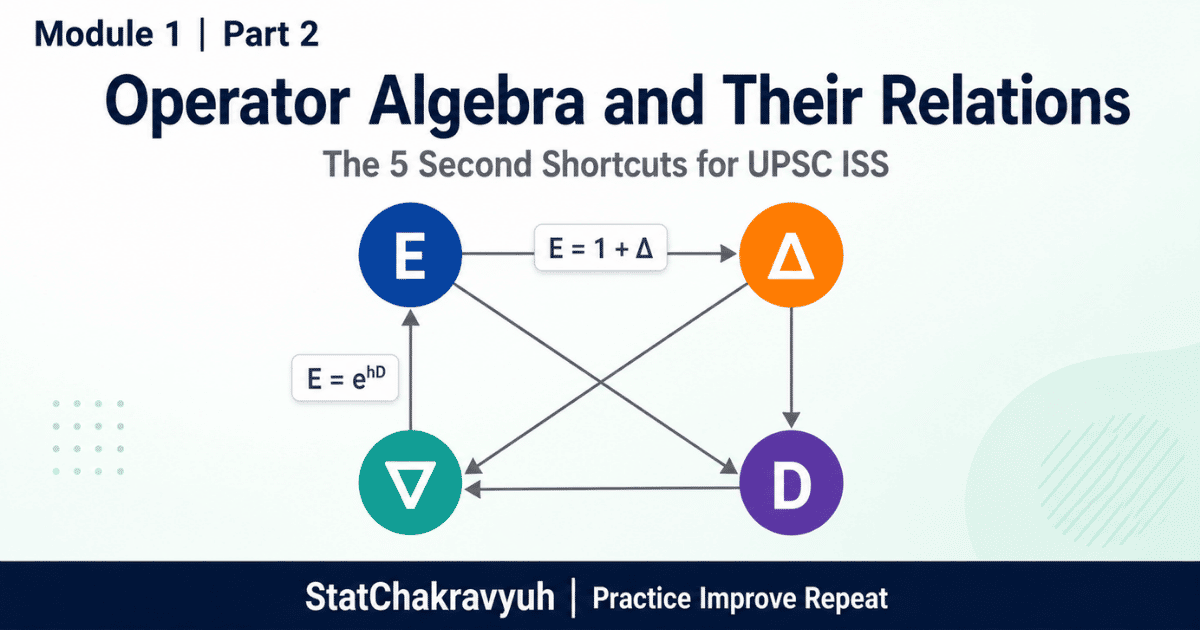
Welcome back to Part 2 of Module 1, updated for the UPSC ISS 2026 to 2027 cycle. In Part 1 we mastered the forward () and backward () difference operators. Today we perform pure magic with them.
Operator algebra links the shift operator , the forward difference , the backward difference , the central difference , the averaging operator μ, and the differential operator D. The fundamental identities are , , , , and . In UPSC ISS Paper 1 you will rarely build long difference tables. The examiner tests whether you know how these operators interact.
This post is Part 2 of the Finite Differences Foundation Guide (Module 1), part of our UPSC ISS Numerical Analysis Complete Guide. New to the exam? Start at the UPSC ISS hub.
The Story of Neha and the 5 Minute Question
Neha, a dedicated aspirant from the 2024 batch, met a 2 mark question in a mock test: express the differential operator in terms of the backward difference operator .
Being brilliant in calculus, Neha derived the relation from scratch using Taylor series. She spent 5 precious minutes. Students who knew the operator relations ticked the correct option, , in 5 seconds and moved on.
That is the power of operator algebra. It turns a 5 minute derivation into a 5 second mental tick.
Meet the Operators
| Operator | Symbol | Definition |
|---|---|---|
| Forward Difference | ||
| Backward Difference | ||
| Shift Operator | , and | |
| Differential Operator | ||
| Central Difference | ||
| Averaging Operator |
The Magic Relations (Must Memorize)
Write these on a sticky note and paste it on your study desk.
Relation 1 (The Golden Rule): , so .
Relation 2 (Backward Link): , so .
Relation 3 (The Commutative Trick): .
Relation 4 (Central Connections): and .
Relation 5 (Calculus Bridge): . Taking logarithms on both sides gives the ultimate shortcut:
Two bonus identities that appear as direct one markers: and .
StatChakravyuh Pro Tips
- Rule of indices. Operators multiply like algebraic variables: .
- The variables trap. and are commutative with constants, never with variables. .
- Expansion hack. Expand relations with the Binomial Theorem:
- Option elimination. In “which of the following is correct” questions, first test each option on the golden rule . Wrong options usually break it.
Solved PYQ Masterclass
PYQ 1 (proof pattern, framed repeatedly in ISS papers): Prove that .
Solution:−∇f(x). Hence proved.
5 Second Version: Separate symbols. . One line, no function needed.
PYQ 2 (evaluation pattern): Evaluate with interval of differencing .
Solution:. Since is constant with respect to , .
Shortcut worth memorizing: . UPSC has asked this general form directly.
PYQ 3 (identity pattern): Show that .
Solution: . Similarly .
Common Traps to Avoid
Trap 1: Writing and forgetting the negative sign. The correct relation is .
Trap 2: Treating δ (small delta, central) and (capital Delta, forward) as the same operator. They differ by a half shift: .
Trap 3: Applying operator algebra on variable coefficients. The algebra holds only for constant coefficients.
Frequently Asked Questions
-
What is the shift operator E?
advances the argument of a function by one interval: . Repeated application gives .
-
How are E and Δ related?
Through the fundamental identity . Shifting a function one step equals the function plus its first forward difference.
-
What connects the differential operator D with finite differences?
The relation , which gives . It bridges discrete differences with continuous derivatives.
-
Can the Binomial Theorem be applied to these operators?
Yes. , , and obey the distributive law and the law of indices, so binomial and exponential expansions apply, provided coefficients are constants.
-
Why does UPSC ISS test operator algebra so heavily?
Because calculators are banned in Paper 1. Operator relations let you bypass long tables and solve questions mentally in seconds.
Take the Next Step with StatChakravyuh
Join the Free UPSC ISS WhatsApp Community. All parts of this series and the free Module 1 Practice PDF with 50 MCQs are shared there first. 👉 Join the WhatsApp Community now
Enroll in the Free UPSC ISS Course. Structured lessons and practice sets built on the Practice Improve Repeat system, completely free. 👉 Enroll in the Free Course
Coming up in Part 3: Separation of Symbols, the technique that solves scary looking series questions in 3 lines.
[…] back to Part 3 of Module 1, updated for the UPSC ISS 2026 to 2027 cycle. In Part 2 we learned the magic relations between EE, ΔDelta, ∇nabla, and DD. Today we unlock the most […]
[…] back to Part 4 of Module 1, updated for the UPSC ISS 2026 to 2027 cycle. After operator algebra and separation of symbols, today we tackle a concept that works like an absolute cheat code in […]
[…] back to Part 5 of Module 1, updated for the UPSC ISS 2026 to 2027 cycle. You now know operator algebra, separation of symbols, and factorial polynomials. Today we unlock one of the most intimidating yet […]
[…] of Euyn=(1−∇)−uynE^u y_n = (1-nabla)^{-u} y_n. If you trust the operator algebra of Part 2, you can rebuild the formula in the exam hall instead of recalling it […]