
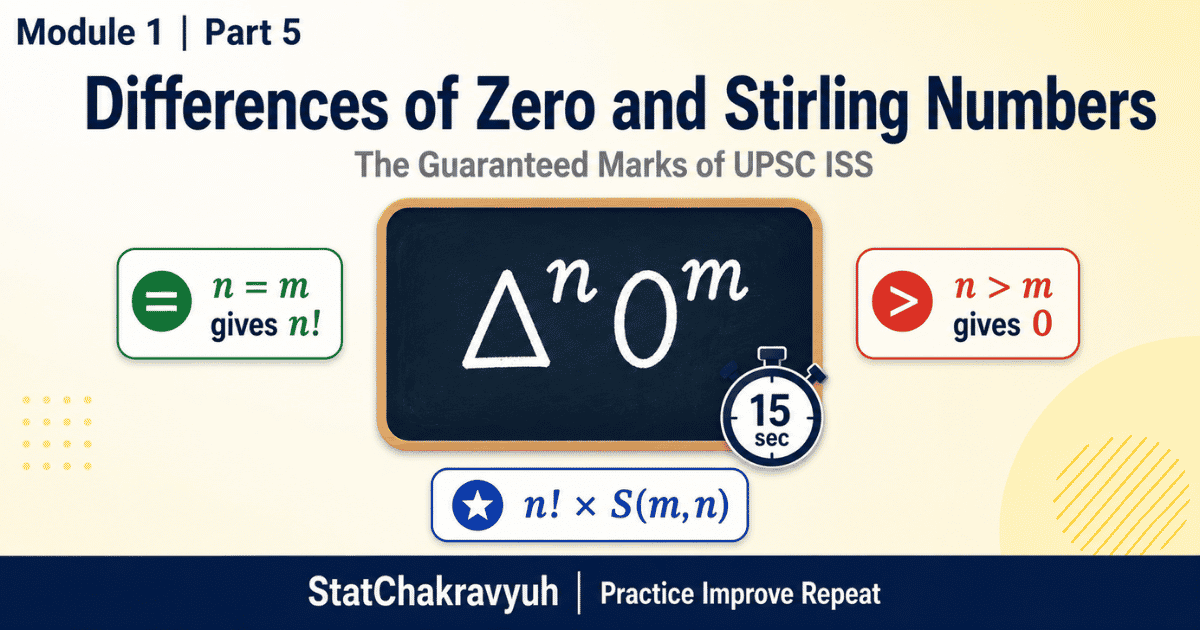
Welcome back to Part 5 of Module 1, updated for the UPSC ISS 2026 to 2027 cycle. You now know operator algebra, separation of symbols, and factorial polynomials. Today we unlock one of the most intimidating yet highest scoring topics in the syllabus: Differences of Zero and Stirling Numbers.
The difference of zero, written , is the th forward difference of the function evaluated at . Three boundary rules solve most UPSC ISS questions instantly: if then ; if then ; and the values connect to Stirling numbers of the second kind through .
This post is Part 5 of the Finite Differences Foundation Guide (Module 1), inside our UPSC ISS Numerical Analysis Complete Guide. For strategy and the full roadmap, visit the UPSC ISS hub.
The Story of Rohan and the Negative Marking
In the 2022 cycle, Rohan met a 2 mark question: evaluate .
Confused by the superscripts and the zero, he defined , built a full forward difference table, and substituted at the end. Seven minutes gone, and a small slip in computing handed him negative marking.
A StatChakravyuh student applied the direct expansion, computed mentally, marked the option in 30 seconds, and moved on. This post makes you that student.
What Are the Differences of Zero
We often need the th forward difference of exactly at the origin. The shorthand for is . It is called a difference of zero because the leading term of its expansion evaluates at zero.
The Master Formula (for positive integers and , ):
One line, no tables.
StatChakravyuh Pro Tips: The Three Boundary Rules
- The greater than rule. If , then . Example: . Reason: is a degree polynomial, and any difference of order above the degree vanishes, exactly as proved in Part 4.
- The equal to rule. If , then . Example: . Reason: the th difference of is the constant everywhere, including at zero.
- The recurrence relation (exam favourite). . UPSC frames match the following type questions directly on this identity.
Enter Stirling Numbers
Stirling numbers are the bridge between ordinary powers and factorial polynomials .
Stirling Numbers of the First Kind: convert a factorial polynomial back to ordinary powers.
Stirling Numbers of the Second Kind: convert an ordinary power into factorial polynomials, the direction that makes discrete differentiation easy.
The connection UPSC loves:
where is the Stirling number of the second kind. So a table of differences of zero is secretly a table of Stirling numbers.
Solved PYQ Masterclass
PYQ 1 (Rohan’s question, 2022 cycle pattern): Evaluate .
Solution:Here , . Apply the master formula:
Final Answer: 36, in 30 seconds, fully mental.
PYQ 2 (boundary rule pattern): Evaluate and .
Solution: For the first, , so the answer is 0 by the greater than rule. For the second, , so the answer is by the equal to rule. Two answers, five seconds total.
PYQ 3 (Stirling connection pattern): Given , find the Stirling number of the second kind .
Solution: From we get , so . This value means the set can be split into 2 non empty groups in exactly 3 ways, a neat cross check.
Common Traps to Avoid
Trap 1: Swapping and . The order of the difference is (the power on ) and the power of the function is (the power on ). The two are not interchangeable: , but because there is greater than . Examiners place both values among the options to catch students who swap the roles.
Trap 2: Sign slips in the alternating expansion. Terms alternate strictly: plus, minus, plus, minus.
Trap 3: Confusing first kind and second kind Stirling numbers. Second kind connects to differences of zero. First kind goes from factorial form back to powers.
Frequently Asked Questions
-
What does Δn0m mean?
It is shorthand for the nth forward difference of evaluated at , that is .
-
Why is it called a difference of zero?
Because when the forward differences of are expanded and is substituted, the leading term of the series evaluates at zero
-
What is the fastest way to evaluate Δ503?
Notice is greater than . By the boundary rule, whenever . Answer: 0
-
What are Stirling numbers of the second kind used for?
They express an ordinary power as a combination of factorial polynomials, which makes discrete differentiation and summation easy.
-
How are Stirling numbers and differences of zero connected?
Through the identity , where is the Stirling number of the second kind.
Take the Next Step with StatChakravyuh
Join the Free UPSC ISS WhatsApp Community. All parts of this series plus the free Module 1 Practice PDF with 50 MCQs are delivered there first. 👉 Join the WhatsApp Community now
Enroll in the Free UPSC ISS Course. Structured lessons and practice sets on the Practice Improve Repeat system, at zero cost. 👉 Enroll in the Free Course
Coming up in Part 6, the final part of Module 1: the Concept of Interpolation, its hidden assumptions, and the error term that UPSC quietly tests every year.
[…] Module 1, updated for the UPSC ISS 2026 to 2027 cycle. With operators, factorial polynomials, and differences of zero behind us, we now step into the heart of Numerical Analysis: […]