
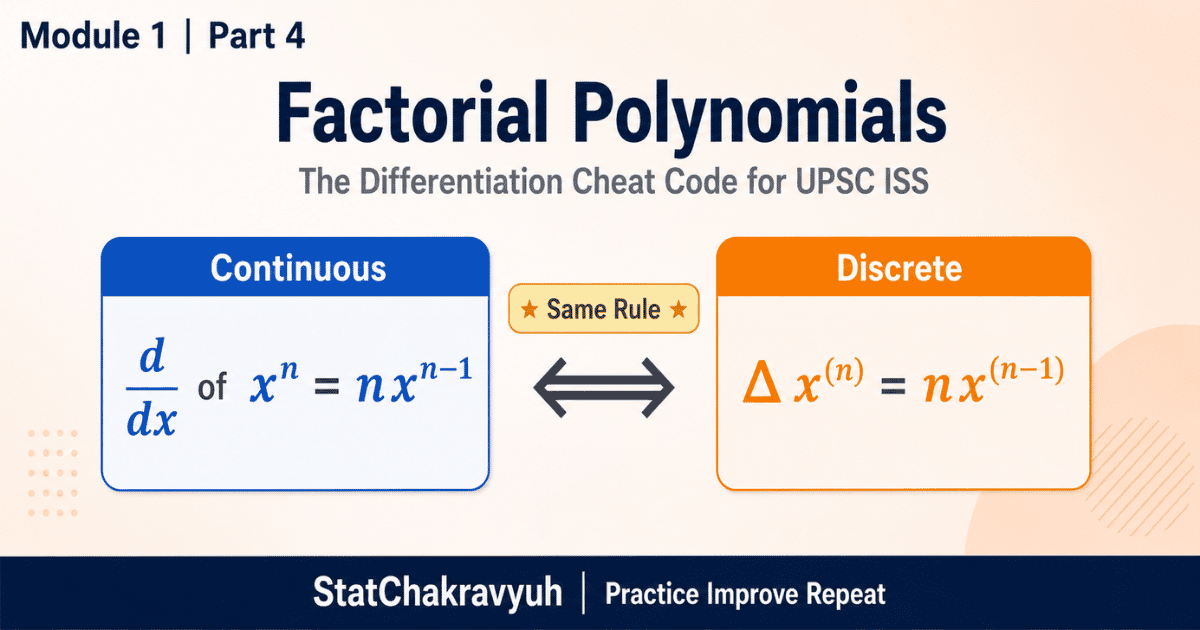
Welcome back to Part 4 of Module 1, updated for the UPSC ISS 2026 to 2027 cycle. After operator algebra and separation of symbols, today we tackle a concept that works like an absolute cheat code in Paper 1: the Factorial Representation of a Polynomial.
A factorial polynomial, written , is the product of factors decreasing by the interval of differencing . Its key property: the forward difference operator acts on it exactly like differentiation, , which gives and .
This post is Part 4 of the Finite Differences Foundation Guide (Module 1), inside our UPSC ISS Numerical Analysis Complete Guide. New here? Start at the UPSC ISS hub.
The Story of Priya and the Messy Rough Sheet
During her ISS attempt, Priya met a 2 mark question: evaluate .
She started from the definition, expanding , then , subtracting the original function. By the second difference her rough sheet was a mess of and terms and sign errors. Six minutes gone, wrong answer marked.
A StatChakravyuh student looks at the same question and writes in 5 seconds. This post teaches you exactly how.
What Is a Factorial Polynomial
In continuous calculus, differentiation of is easy. In finite differences, applying to a plain is messy because leaves a long binomial expansion.
The fix is the factorial polynomial, denoted and read as “ raised to the power factorial”.
Exam favourite special case, h=1:
For example, , , and .
The Magic: Delta Behaves Like d/dx
Here is why examiners love this notation. Applying to a factorial polynomial mirrors ordinary differentiation.
Keep differencing until order n and every x disappears:
StatChakravyuh Pro Tips
- The exactness shortcut. For any polynomial of degree , the th difference is the constant , and every higher order difference is exactly zero. This one rule settles several PYQs per paper.
- Conversion rule. Any polynomial of degree n can be written in factorial form of the same degree, and the leading coefficient stays unchanged. The lower coefficients are best found by synthetic division by , then , then , and so on.
- Reciprocal factorials. Negative indices are defined as , and the inverse operator then behaves like integration. This becomes valuable in the summation module.
Solved PYQ Masterclass
PYQ 1 (Priya’s question, a recurring ISS pattern): Evaluate with .
Solution:
- Degree of the polynomial is 4, leading coefficient is 1.
- Exactness rule: .
- The remaining terms all have degree below 4, so their fourth differences are zero.
Final Answer: 24, in 5 seconds.
PYQ 2 (the famous product question, a UPSC ISS classic): With , evaluate .
Solution:The product is a polynomial of degree . Its highest degree term is , so the leading coefficient is abcd.
No expansion, no table. Recognize degree, catch the leading coefficient, apply .
PYQ 3 (conversion pattern): Find for , , using factorial form.
Solution:Since , we get . So . Differentiate discretely: . This matches the direct computation from Part 1.
Common Traps to Avoid
Trap 1: Forgetting h. The rule is . When , the fourth difference of is , not 24.
Trap 2: Applying the exactness rule to non polynomial functions like or . It is a polynomial only rule.
Trap 3: Changing the leading coefficient during factorial conversion. It never changes; only lower order coefficients do.
Frequently Asked Questions
-
What is a factorial polynomial?
It is the product of factors decreasing by the interval . For it becomes .
-
Why use factorial notation in Numerical Analysis?
Because acts on factorial polynomials exactly like acts on ordinary powers, so discrete differentiation becomes a one line operation.
-
What is the nth difference of a degree n polynomial?
It is the constant , where is the leading coefficient and is the interval of differencing.
-
What happens at the (n+1)th difference?
It is exactly zero, since the th difference is already a constant and the difference of a constant is zero.
-
Do negative factorial powers exist?
Yes. Reciprocal factorials are defined as , and on factorials behaves like integration.
Take the Next Step with StatChakravyuh
Join the Free UPSC ISS WhatsApp Community. All parts of this series plus the free Module 1 Practice PDF with 50 MCQs arrive there first. 👉 Join the WhatsApp Community now
Enroll in the Free UPSC ISS Course. Structured lessons and practice sets on the Practice Improve Repeat system, completely free. 👉 Enroll in the Free Course
Coming up in Part 5: Differences of Zero, , and Stirling Numbers, the guaranteed 15 second marks of every ISS paper.