
Welcome back to Part 11 of Module 3, updated for the UPSC ISS 2026 to 2027 cycle. In Part 10 we met the central operators and . Today we put them to work with the two foundational pillars of central interpolation: Gauss’s Forward and Backward formulas.
Both formulas measure the step value from a central origin chosen in the middle of the table. Gauss Forward serves and Gauss Backward serves . Their average produces Stirling’s formula, which is why UPSC tests them heavily at the conceptual level.
The exam context stays constant: 80 questions worth 200 marks in 2 hours, 2.5 marks per correct answer, about 0.83 deducted per wrong one, and close to 20 questions from Numerical Analysis. Formula identification questions from this exact topic are regular visitors in the paper.
This post is Part 11 of the Central Differences Guide (Module 3), inside our UPSC ISS Numerical Analysis Complete Guide. Full roadmap at the UPSC ISS hub.
The Story of Neha and the Two Timings
Neha, an ISS officer in the Meteorological Department, records the noon temperature every day from Monday to Friday. Her director asks for two estimates: the temperature on Wednesday at 3 PM, and on Wednesday at 9 AM.
Wednesday is the exact middle of her data, so Neha sets it as her central origin. For 3 PM, the time has just crossed the middle point, so her step value is slightly positive, between 0 and 1. She looks slightly downward in the table and uses Gauss Forward. For 9 AM, the time falls just before the middle point, so is slightly negative, between minus 1 and 0. She looks slightly upward and uses Gauss Backward.
The Core Idea: Shifting the Origin to the Center
In central difference formulas, the counting does not start from the top or the bottom of the table. A central value becomes the origin , and the arguments are relabeled as around it. The step value is:
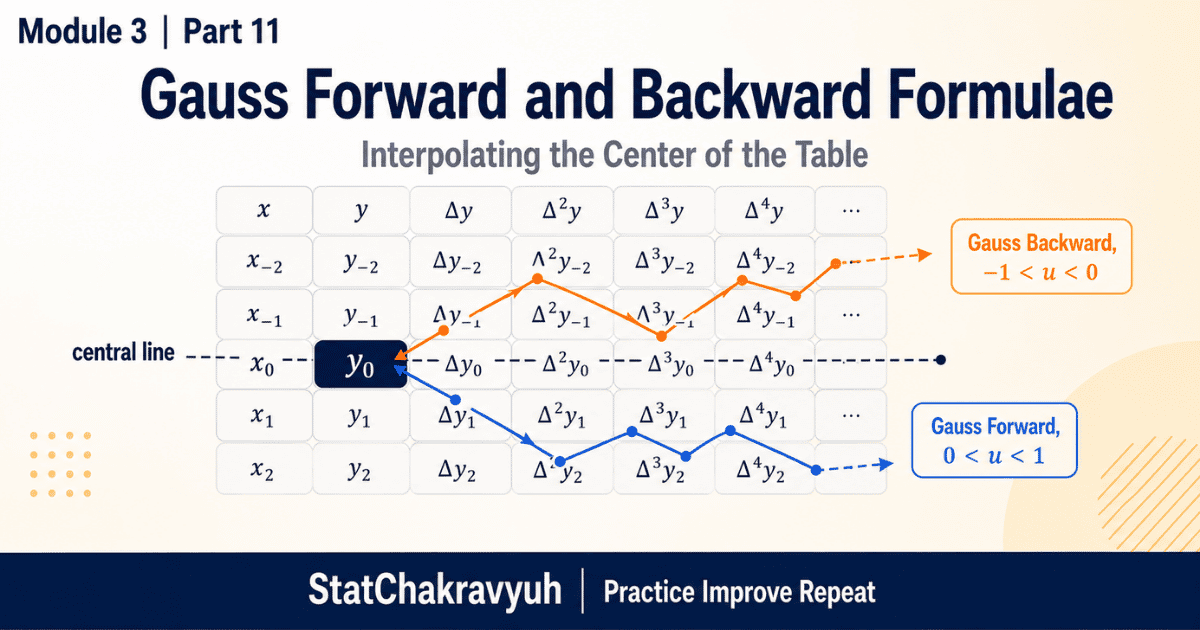
The difference table now has a central horizontal line through the row of , and both Gauss formulas travel in zig zag paths around this line.
Gauss’s Forward Interpolation Formula
Used when . Think of it as a zig zag path that starts downward: from step down to , up to , down to , up to , and so on. It uses odd differences just below the central line and even differences on the central line.
Gauss’s Backward Interpolation Formula
Used when . This is the zig zag path that starts upward: from step up to , down to , up to , and so on. It uses odd differences just above the central line and even differences on the central line.
StatChakravyuh Pro Tips
- The u constraint is everything. If , use Gauss Forward. If , use Gauss Backward. Choosing wrongly ruins the rapid convergence that makes central formulas worth using.
- The subscript hack. Forward subscripts run while Backward subscripts run Recognizing the pattern lets you identify a formula from a single printed term.
- Parent formulas. You will rarely grind a full Gauss calculation in the objective paper. UPSC instead tests the theory, because averaging the two Gauss formulas gives Stirling’s formula and averaging with a shifted origin gives Bessel’s formula, both arriving in Part 12.
- The convergence logic. Central formulas beat Newton’s edge formulas in the middle because successive terms shrink faster when the data is drawn evenly from both sides of the target.
Solved PYQ Masterclass
PYQ pattern (formula identification type, a regular one liner in ISS Paper 1): A central difference table is built for . You need at . Which formula applies, and what is ?
Mental solution.
- The middle argument is 30, so set with .
- Compute .
- Since , the correct choice is Gauss’s Forward formula.
- Had the target been , then , which lies between minus 1 and 0, calling for Gauss’s Backward formula.
No pen required. The entire decision happens in the head, and the question is worth the same 2.5 marks as the hardest calculation on the paper.
Common Traps to Avoid
Trap 1: Measuring from the first argument of the table instead of the central origin. In Module 3, the origin always sits in the middle.
Trap 2: Mixing the first difference terms. Forward begins with below the line; Backward begins with above the line.
Trap 3: Attempting a full Gauss computation when the question only asks which formula applies. Read the question before reaching for the formula.
Frequently Asked Questions
-
Why use Gauss’s formulas instead of Newton’s formulas?
Newton’s Forward and Backward formulas converge slowly near the middle of a table. Gauss’s central formulas draw data from both sides of the origin equally, giving faster convergence and higher accuracy there.
-
How do I remember the zig zag path for Gauss Forward?
Start at the central origin , take the first step diagonally downward to , then upward to , and keep alternating down and up.
-
When exactly is Gauss Backward the right choice?
Strictly when the target falls just before the central origin, so that lies between minus 1 and 0.
-
Do Gauss formulas work for unequal intervals?
No. All central difference formulas, including Gauss, Stirling, and Bessel, require strictly equal intervals.
-
Are full Gauss calculations common in the objective paper?
Rarely. The formulas are tested theoretically as parent formulas, because their averages produce Stirling’s and Bessel’s formulas which handle the practical calculations.
Take the Next Step with StatChakravyuh
Join the Free UPSC ISS WhatsApp Community. All parts of this series plus the Module 3 Practice PDF with 40 MCQs, releasing this Sunday, arrive there first. 👉 Join the WhatsApp Community now
Enroll in the Free UPSC ISS Course. Structured lessons and practice sets on the Practice Improve Repeat system, completely free. 👉 Enroll in the Free Course
Coming up in Part 12, the final part of Module 3: Stirling’s and Bessel’s formulas, and the u based decision rule that separates toppers from the crowd.
[…] to Part 12, the final part of Module 3, updated for the UPSC ISS 2026 to 2027 cycle. In Part 11 we met the Gauss Forward and Backward formulas. They work, but their zig zag paths are clumsy for […]