
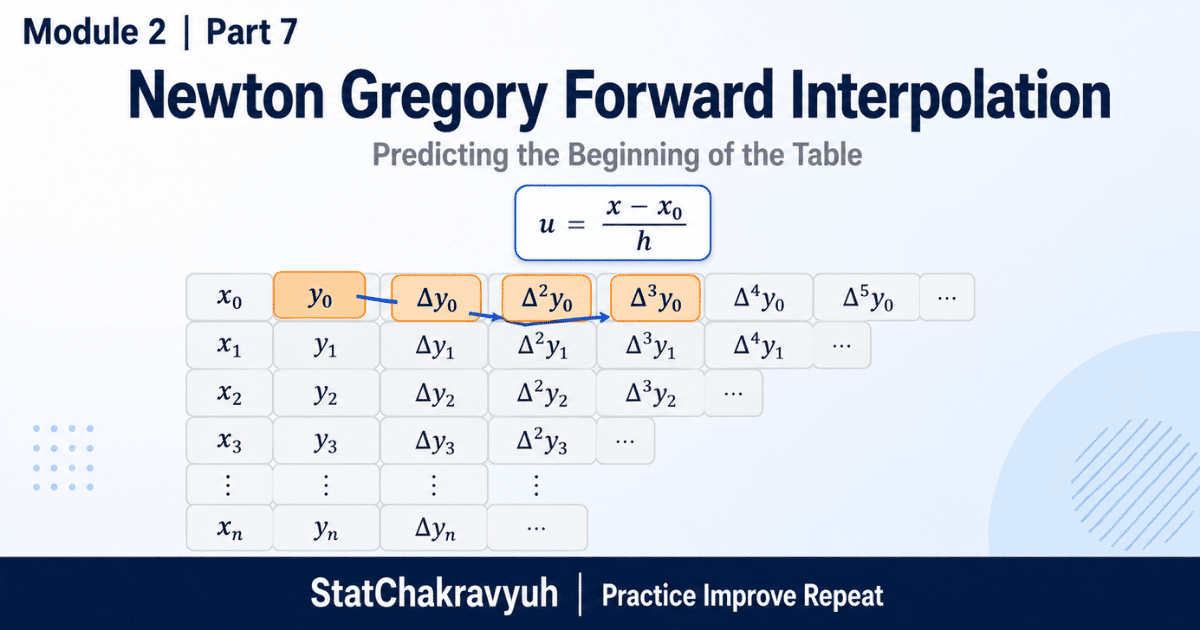
Welcome to Part 7 and the opening of Module 2, updated for the UPSC ISS 2026 to 2027 cycle. In Part 6 we understood what interpolation is, its assumptions, and the error term. Now it is time for the most famous weapon in your arsenal: the Newton Gregory Forward Interpolation Formula.
The formula estimates the value of a function near the beginning of a table of equally spaced arguments. With step value , it reads and is mathematically the binomial expansion of .
A quick word on stakes. Statistics Paper 1 is an objective paper of 80 questions worth 200 marks in 2 hours, so every question carries 2.5 marks, and each wrong answer deducts one third of that, about 0.83 marks. Numerical Analysis contributes close to 20 of those 80 questions, worth about 50 marks, and interpolation with equal intervals is its most directly tested topic. That is why Module 2 deserves your sharpest attention.
This post is Part 7 of the Interpolation with Equal Intervals Guide (Module 2), inside our UPSC ISS Numerical Analysis Complete Guide. New to the exam? Start at the UPSC ISS hub.
The Story of Amit and the Wheat Yield
Amit is a newly recruited ISS officer in the Ministry of Agriculture. He has wheat yield data for the years 2010, 2015, 2020, and 2025. His senior asks for the estimated yield of 2012 for a presentation.
Amit observes two things. The years are equally spaced, so . And 2012 lies close to the beginning of the table, right after 2010. A value near the start of an equally spaced table calls for a formula built on the top entries of the difference table. That formula is Newton Gregory Forward.
Why Is It Called Forward
The formula uses the values of the tabulated function from the leading term onward to the right, and nothing to its left. In the forward difference table, you read only the upper diagonal, the leading differences , and so on.
The two condition decision rule: use Newton Gregory Forward when the arguments have equal intervals and the target value lies near the beginning of the table. Both conditions must hold.
The Master Formula
Let take the values at the equidistant arguments with interval . First compute the step value:
Then:
StatChakravyuh Pro Tips
- The binomial shortcut. The formula is exactly the expansion of , which is . If you remember the operator relation from Part 2, you never need to memorize the formula blindly. The coefficients are simply , and so on.
- The degree check. Given data points, the fitted polynomial has degree , so is constant and higher differences vanish. The moment a difference column becomes constant, stop building the table.
- The u check. For fast convergence, your should lie between 0 and 1. If your computed is large, you have picked the wrong origin or the wrong formula.
- The negative marking angle. At 2.5 marks per question with a deduction of about 0.83 for each wrong answer, one avoided sign error is worth more than one extra attempted question. Slow down exactly at the bracket, which is where most sign slips happen.
Solved PYQ Masterclass
PYQ pattern (a recurring direct evaluation type in ISS Paper 1): Given the points find using Newton’s Forward formula.
Step 1: Parameters. Arguments 0, 1, 2 with and . So .
Step 2: Leading differences by mental math. Entries 1, 3, 7. First differences: 2 and 4, so . Second difference: , so .
Step 3: Apply the formula.
Final Answer: 1.75, solved in about 30 seconds with no rough work.
Speed cross check: the data fits , and . When small data sets clearly follow a simple polynomial, verifying through the pattern is the fastest confidence boost available in the exam hall.
Common Traps to Avoid
Trap 1: Using the forward formula for a target near the end of the table. The truncated series then carries a large error, and the options are set to punish exactly that mistake.
Trap 2: Computing u from the wrong origin. In the forward formula, is always the first tabulated argument.
Trap 3: Mixing the bracket signs. Forward uses with minus signs. The plus sign version belongs to the backward formula of Part 8.
Frequently Asked Questions
-
When exactly should I use the Newton Gregory Forward formula?
Strictly when the arguments have equal intervals and the value to be estimated lies near the beginning of the tabulated data.
-
What does uu u represent in the formula?
The scaled step distance from the origin, , where is the first argument and is the interval of differencing.
-
Can this formula handle unequal intervals?
No. Newton Gregory Forward and Backward are strictly for equidistant arguments. Unequal intervals need divided differences or Lagrange’s formula, which arrive in Module 4.
-
Why does the formula stop at the nth difference?
Because points fit a polynomial of degree , and by the fundamental result of finite differences the th difference of that polynomial is zero.
-
How is the formula related to the shift operator EE E?
The whole formula is the algebraic expansion of by the Binomial Theorem.
Take the Next Step with StatChakravyuh
Join the Free UPSC ISS WhatsApp Community. Every part of this series, plus the Module 2 Practice PDF with 50 MCQs releasing this Sunday, is delivered there first. 👉 Join the WhatsApp Community now
Enroll in the Free UPSC ISS Course. Structured lessons and practice sets built on the Practice Improve Repeat system, at zero cost. 👉 Enroll in the Free Course
Coming up in Part 8: we flip the table. The Newton Gregory Backward formula for values near the end, and the negative u trap that catches thousands of aspirants.
[…] to Part 9, the final part of Module 2, updated for the UPSC ISS 2026 to 2027 cycle. The forward and backward formulas need a full difference table. But when a question asks for one missing value […]
[…] of Module 3, updated for the UPSC ISS 2026 to 2027 cycle. In Module 2 we predicted values near the beginning and the end of a table. But when the missing value sits exactly in the middle, both Newton Gregory […]