
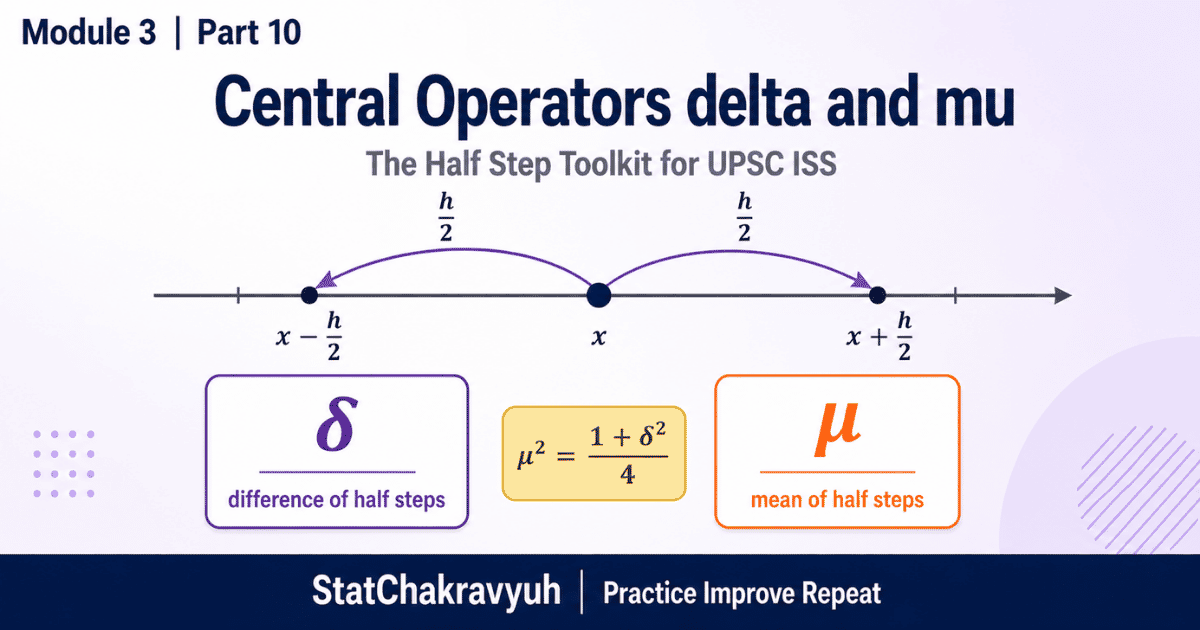
Welcome to Part 10 and the opening of Module 3, updated for the UPSC ISS 2026 to 2027 cycle. In Module 2 we predicted values near the beginning and the end of a table. But when the missing value sits exactly in the middle, both Newton Gregory formulas converge slowly. The accurate tools for the middle are the central difference formulas, and before Gauss, Stirling, and Bessel, we must meet the two operators that power them.
The central difference operator is , in operator form . The averaging operator is , in operator form .
The stakes remain the same. Statistics Paper 1 gives 80 questions worth 200 marks in 2 hours, 2.5 marks per correct answer and about 0.83 deducted per wrong answer, with close to 20 questions coming from Numerical Analysis. Direct one liner identities from this very post appear regularly among those questions.
This post is Part 10 of the Central Differences Guide (Module 3), inside our UPSC ISS Numerical Analysis Complete Guide. New to the exam? Start at the UPSC ISS hub.
The Story of Pooja and the Mid April Estimate
Pooja is a young officer at the Reserve Bank of India analyzing a bi monthly inflation index. She has exact data for January, March, May, July, and September. In a meeting, her senior asks for the estimated value for the exact middle of April.
Mid April lies at the very center of her data, between March and May. Newton’s formulas lean heavily on the top or the bottom of the difference table, so they are not the sharpest tools here. Pooja needs a method that uses values on both sides of the origin equally. That method begins with half steps from the center, and half steps are exactly what the operator takes.
The Central Difference Operator (δ)
The shift operator moves data by one full interval. To operate from the exact center, we use the half step shift , which moves the function by .
Definition. The first central difference of is the difference between the value half a step forward and half a step backward:
Writing the half steps through the shift operator gives the most important relation of this module:
A useful consequence for tables: . The central differences sit between the rows of the previous column, which is why the table carries fractional subscripts.
The Averaging Operator (μ)
Half steps are mathematically neat, but Pooja only has data at full months. To balance the half steps against real data, we use the averaging or mean operator.
Definition. The operator takes the arithmetic mean of the values half a step forward and half a step backward:
StatChakravyuh Pro Tips: The Examinable Identities
Direct identity questions from this list appear regularly in Paper 1. Memorize all five.
- Connecting δ to Δ and ∇: and . Think of δ as a forward difference pulled half a step back, or a backward difference pushed half a step forward.
- The square trick: . This is among the most repeated identity questions in the entire unit.
- The product trick: .
- The half step decomposition: and . Adding the two recovers , subtracting recovers , a quick self check in the hall.
- The second difference bridge: , since . This expression later powers numerical differentiation in Module 5.
Solved PYQ Masterclass
PYQ pattern (identity proof type, repeatedly framed in ISS Paper 1): Prove that .
4 line mental solution.
- Start from the definition: .
- Square it: .
- Use the identity with and , noting . So .
- The bracket is exactly δ, giving .
Hence proved, purely by operator algebra, with no numbers and no calculator.
Quick evaluation pattern: for the entries and , the central difference equals . One subtraction, one mark banked.
Common Traps to Avoid
Trap 1: Confusing lowercase (central) with capital (forward). They differ by a half shift: .
Trap 2: Writing . The sign is plus, and the wrong sign version always appears among the options.
Trap 3: Assuming a central difference table contains new numbers. The entries are identical to the forward table; only the labels and alignment change.
Frequently Asked Questions
-
Why use central difference operators instead of forward or backward ones?
Central difference formulas converge much faster near the middle of a table because they draw on data from both sides of the origin equally, giving higher accuracy with fewer terms.
-
What does E^{1/2} mean?
shifts the function forward by one full interval . The fractional operator shifts it forward by exactly half an interval, .
-
Do δ and u work on unequally spaced data?
No. Like all Newton Gregory and central formulas, they strictly require equally spaced arguments.
-
How does a central difference table differ from a forward difference table?
The numbers are exactly the same. Only the notation and alignment change, with differences like sitting between the rows of the previous column.
-
How are mu , δ, and E connected?
Through and , along with the identity .
Take the Next Step with StatChakravyuh
Join the Free UPSC ISS WhatsApp Community. Every part of this series, plus the Module 3 Practice PDF with 40 MCQs releasing this Sunday, is delivered there first. 👉 Join the WhatsApp Community now
Enroll in the Free UPSC ISS Course. Structured lessons and practice sets built on the Practice Improve Repeat system, at zero cost. 👉 Enroll in the Free Course
Coming up in Part 11: we put these operators to work with the Gauss Forward and Backward formulas, and the zig zag paths through the difference table.
[…] back to Part 11 of Module 3, updated for the UPSC ISS 2026 to 2027 cycle. In Part 10 we met the central operators δdelta and μmu. Today we put them to work with the two […]