
Welcome to Part 6, the final part of Module 1, updated for the UPSC ISS 2026 to 2027 cycle. With operators, factorial polynomials, and differences of zero behind us, we now step into the heart of Numerical Analysis: Interpolation.
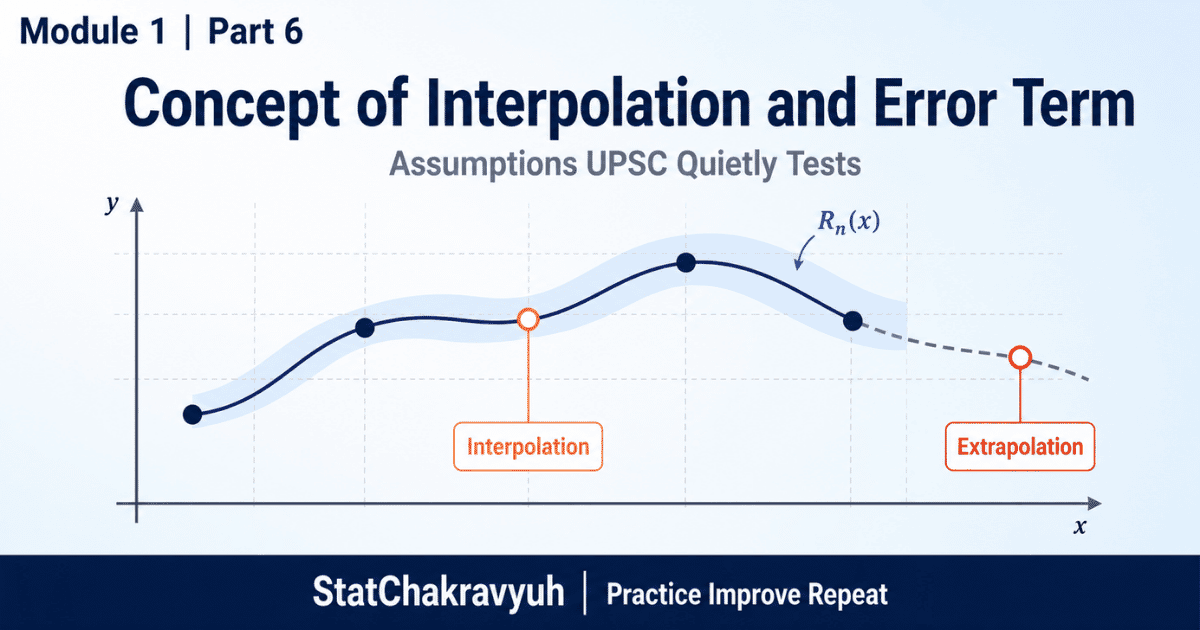
Interpolation is the technique of estimating the value of a function for an intermediate value of the argument within the given range of data, while extrapolation estimates values outside that range. Before heavy formulas like Newton Gregory or Lagrange, you must understand what interpolation assumes and what the error term Rn(x) really measures. UPSC loves theoretical questions on both.
This post is Part 6 of the Finite Differences Foundation Guide (Module 1), inside our UPSC ISS Numerical Analysis Complete Guide. For books, strategy, and the full roadmap, visit the UPSC ISS hub.
The Story of Suresh and the Two Questions
Suresh, a statistician at the Registrar General’s office, has decennial census figures for 1991, 2001, 2011, and 2021. His seniors ask two questions.
First, what was the population in 2005? Suresh has no data for 2005, so he must estimate a value inside the given range. That art of reading between the lines of a data table is interpolation.
Second, what will the population be in 2031? Now he must project outside the range. That is extrapolation, and it is riskier, because the polynomial that fits the past has no obligation to describe the future.
The Core Definitions
Interpolation: estimating the value of the dependent variable for an intermediate value of the argument that lies within the given range of arguments.
Extrapolation: computing the value of the function outside the range of the given arguments.
The Hidden Assumptions UPSC Quietly Tests
Most students apply formulas blindly. UPSC knows this and frames “consider the following statements” questions on the assumptions. Interpolation is valid only when both conditions hold.
- No sudden jumps or falls. The function must rise or fall smoothly across the range. If Suresh’s city suffered an epidemic or a war in 1995, the population would drop abnormally, and no smooth polynomial can represent that data honestly.
- Polynomial representability. We assume the data can be represented by a polynomial. Given distinct data points, exactly one polynomial of degree or less passes through all of them. This uniqueness is the backbone of every interpolation formula in Modules 2 to 4.
The Error Term
An interpolated value is an approximation, not the truth. The gap between the true value and the fitted polynomial is the truncation error or remainder term.
Here is the th derivative of the true function, and is some unknown point lying strictly between the smallest and largest of the arguments . If the structure reminds you of the Lagrange remainder in Taylor’s theorem, your instinct is correct; the two are close cousins.
StatChakravyuh Pro Tips
- The zero error exactness trick. The error term carries the th derivative. If the true function is itself a polynomial of degree or less, that derivative is identically zero, so and the interpolation formula returns the exact value. This single observation answers several conceptual PYQs.
- Missing term shortcut. Given 5 values of with one missing, assume a degree 4 polynomial, so , that is . Expand by the Binomial Theorem, substitute the known entries, and a simple linear equation reveals the missing term. Full practice on this arrives in Module 2.
- Extrapolation caution. The further moves outside the data range, the larger the product grows, so the error inflates rapidly. This is why extrapolation is treated as unreliable in statements based questions.
Solved PYQ Masterclass
PYQ (conceptual pattern, framed in ISS papers on error terms): A student fits a Newton Gregory polynomial through 4 equally spaced data points of the function . What is the truncation error ?
10 Second Mental Solution:
- Four data points means the fitted polynomial has degree .
- The error term needs the th derivative, that is the 4th derivative of .
- The true function is a cubic, and the 4th derivative of any cubic is exactly zero.
- Therefore . The fit is perfect.
Bonus check: how many data points uniquely fix a polynomial of degree ? Exactly . A straight line needs 2 points, a cubic needs 4. UPSC has asked this as a direct one liner.
Common Traps to Avoid
Trap 1: Treating interpolation and extrapolation as equally reliable. Options claiming extrapolation is “as accurate as interpolation” are false.
Trap 2: Ignoring the location of . It lies strictly inside the interval spanned by the arguments; it is not a value you choose.
Trap 3: Applying interpolation on data with structural breaks, such as market crashes or pandemic years. The smoothness assumption fails there.
Frequently Asked Questions
-
What is the difference between interpolation and extrapolation?
Interpolation predicts a missing value inside the range of the known arguments. Extrapolation predicts a value outside that range, which carries a larger and less controllable error.
-
What are the assumptions of interpolation?
Two assumptions: the data must not have sudden jumps or falls, and the data must be representable by a polynomial, with exactly one polynomial of degree or less passing through distinct points.
-
What does ξxi represent in the error formula?
An unknown point lying strictly between the minimum and maximum of the given arguments, at which the th derivative is evaluated.
-
Why do we approximate functions by polynomials?
Polynomials are easy to evaluate, differentiate, and integrate, and by the Weierstrass approximation theorem any continuous function on a closed interval can be approximated by a polynomial to any desired accuracy.
-
How many data points are needed to fit a polynomial of degree nn n?
Exactly distinct points determine a unique polynomial of degree or less.
Take the Next Step with StatChakravyuh
Join the Free UPSC ISS WhatsApp Community. The Module 1 Practice PDF with 50 MCQs, a formula sheet, and a PYQ collection releases in the community this Sunday. 👉 Join the WhatsApp Community now
Enroll in the Free UPSC ISS Course. Structured lessons and practice sets on the Practice Improve Repeat system, at zero cost. 👉 Enroll in the Free Course
Module 1 is complete. Next stop, Module 2: the Newton Gregory Forward Interpolation Formula, the single most tested tool in UPSC ISS Numerical Analysis.
[…] to Part 7 and the opening of Module 2, updated for the UPSC ISS 2026 to 2027 cycle. In Part 6 we understood what interpolation is, its assumptions, and the error term. Now it is time for the […]