
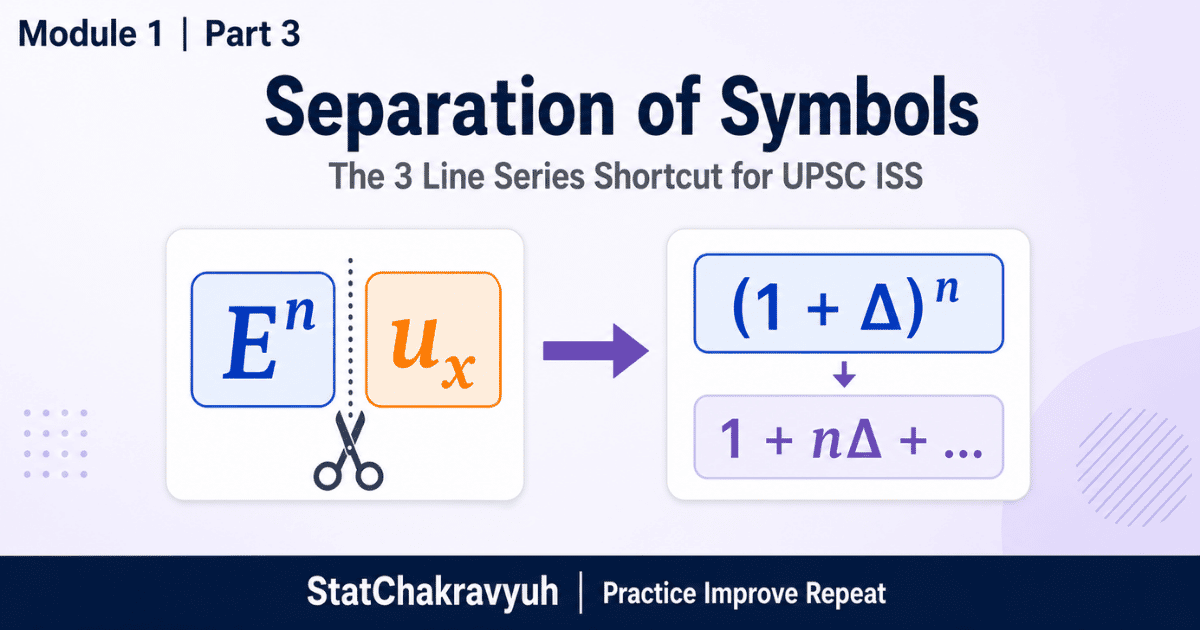
Welcome back to Part 3 of Module 1, updated for the UPSC ISS 2026 to 2027 cycle. In Part 2 we learned the magic relations between , , , and . Today we unlock the most powerful time saver in the syllabus: Separation of Symbols.
Separation of Symbols is a technique where operators such as and are temporarily detached from the function they act on and treated as ordinary algebraic quantities. Standard algebraic tools, including the Binomial Theorem, geometric progression sums, and exponential expansions, are then applied to the operators alone, and the function is reattached at the end. The topic is explicitly named in the official UPSC ISS Statistics Paper 1 syllabus, right next to factorial polynomials and differences of zero.
This post is Part 3 of the Finite Differences Foundation Guide (Module 1), inside our UPSC ISS Numerical Analysis Complete Guide. For the full exam roadmap, visit the UPSC ISS hub.
The Story of Vikram and the 12 Minute Blank
In an earlier ISS paper, Vikram faced a question asking him to evaluate the sum in terms of differences.
Calculators are banned, so Vikram panicked. He expanded each term manually and tried building a giant difference table on his rough sheet. Twelve minutes later, tangled in his own arithmetic, he left the question blank.
A StatChakravyuh student saw the same question, smiled, and finished it in 3 lines by treating the operators as simple algebraic variables.
What Exactly Is Separation of Symbols
Operators like and are instructions applied on a function such as . The method lets you do three things.
Step 1: Detach. Pull the operator away from the operand. becomes , and the now stands alone.
Step 2: Apply algebra. Since the detached operators obey the law of indices and the distributive law, you may use the Binomial Theorem, geometric progression sums, and Taylor or exponential expansions on them.
Step 3: Reattach. Once simplified, apply the resulting operator expression back on the function.
It feels like cheating, but it is one hundred percent mathematically valid for constant coefficients.
StatChakravyuh Pro Tips
- Constants only. The method works when operators act with constant coefficients. Never separate symbols when the coefficient itself is a variable.
- Indices law is your best friend. and .
- The shift trick. The moment you see , mentally rewrite it as . This single habit unlocks most PYQs.
- Recognize the disguise. A bracket like is just a geometric progression of operators. Sum it with .
Solved PYQ Masterclass
PYQ 1 (the foundation of Newton’s formula, asked in ISS conceptual questions): Express un in terms of u0 and its leading forward differences.
Solution:. Expand by the Binomial Theorem:
This 2 line derivation is exactly Newton Gregory Forward Interpolation in disguise, which you will meet formally in Module 2.
PYQ 2 (series summation, Vikram’s nightmare): Express in terms of and its differences.
Solution: Sum .
Expand the numerator by the Binomial Theorem, cancel the ones, divide by :
Three lines, zero tables, zero calculator.
PYQ 3 (identity proof pattern): Prove that .
Solution sketch: Left side . Factorize with where . The first bracket becomes , since . Distribute through the second bracket and reattach to obtain the right side term by term.
Common Traps to Avoid
Trap 1: Separating symbols with variable coefficients. .
Trap 2: Forgetting that . This tiny identity collapses many messy brackets instantly.
Trap 3: Expanding a binomial fully when only the first two or three terms decide the answer among the given options.
Frequently Asked Questions
-
What is Separation of Symbols in Numerical Analysis?
It is a technique where finite difference operators like and are detached from their functions and treated as ordinary algebraic variables, so binomial, geometric, and exponential expansions can simplify them quickly.
-
Is Separation of Symbols in the official UPSC ISS syllabus?
Yes. The UPSC ISS Statistics Paper 1 syllabus names it explicitly in the Numerical Analysis unit, alongside factorial polynomials and differences of zero.
-
When should I use this shortcut in the exam?
Whenever a question asks for the summation of a series like , or asks you to prove a relation between terms with shifted subscripts such as .
-
Can geometric progression and binomial formulas really be applied to operators?
Yes, because and obey the law of indices and are commutative with constants, all such algebraic formulas apply cleanly.
-
What is the biggest mistake students make with this method?
Using it with variable coefficients. The operators are not commutative with variables, so the separation is valid only when the coefficients are constants.
Take the Next Step with StatChakravyuh
Join the Free UPSC ISS WhatsApp Community. Every part of this series and the free Module 1 Practice PDF with 50 MCQs land there first. 👉 Join the WhatsApp Community now
Enroll in the Free UPSC ISS Course. Structured lessons and practice sets on the Practice Improve Repeat system, at zero cost. 👉 Enroll in the Free Course
Coming up in Part 4: Factorial Polynomials, the cheat code that differentiates discrete data as easily as continuous calculus.
[…] back to Part 4 of Module 1, updated for the UPSC ISS 2026 to 2027 cycle. After operator algebra and separation of symbols, today we tackle a concept that works like an absolute cheat code in Paper 1: the Factorial […]