
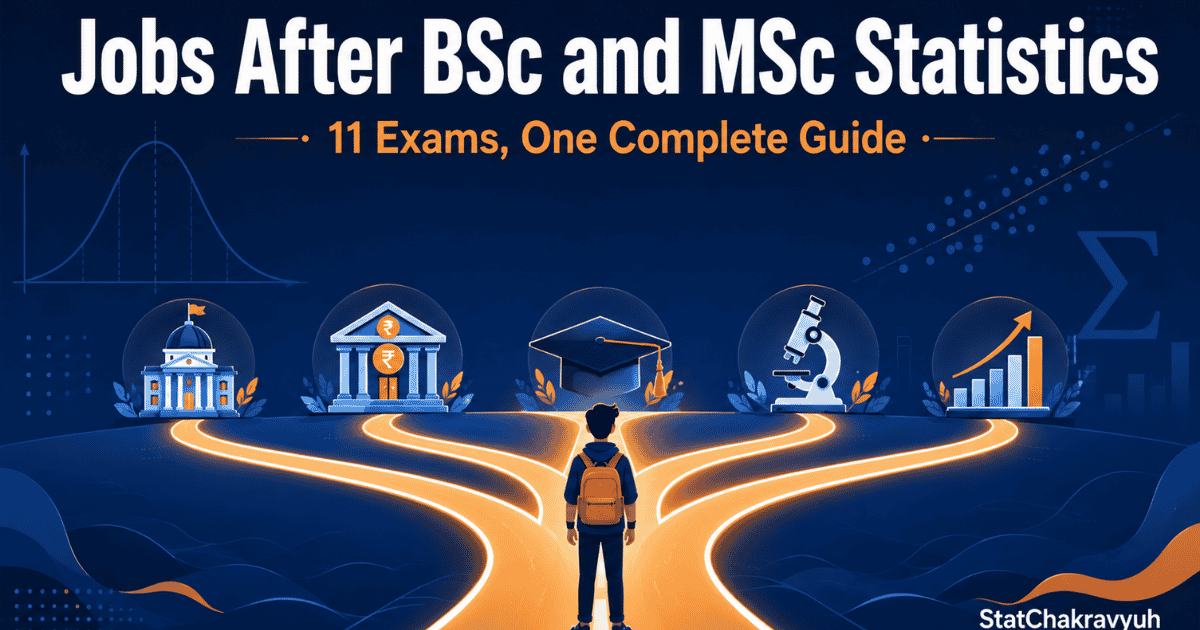
If you are studying Statistics, you have probably asked this question at least once. “What jobs after BSc Statistics are actually available for me, and what changes after MSc?”
Here is the honest answer. Statistics is one of the few subjects in India with its own dedicated recruitment exams, from the prestigious Indian Statistical Service to some of the highest paying regulatory jobs in the country. The real problem is not a lack of options. The real problem is that the information is scattered across notifications, websites and hearsay.
So we have collected everything in one place. Read this overview, bookmark it, and then tell us in the comments which exam you want us to research and explain in complete detail. This page will keep growing as we publish detailed guides for each exam.
Category 1: Central Government Exams
UPSC Indian Statistical Service (ISS)
Conducted by the Union Public Service Commission, this is the most prestigious exam in the Statistics field. Selected candidates become Group A officers who work on national surveys, official data systems and policy support.
Graduates who studied Statistics, Mathematical Statistics or Applied Statistics as a subject can apply, and so can candidates with a Master’s degree in these subjects. The age window is generally 21 to 30 years, with relaxation as per government rules. The best part is that the written examination itself is built around Statistics papers, so your degree is your biggest advantage here.
SSC CGL Junior Statistical Officer (JSO)
The Staff Selection Commission recruits Junior Statistical Officers through the Combined Graduate Level examination. Graduates from any discipline can apply if they scored at least 60 percent in Mathematics in Class 12, and graduates who studied Statistics as a subject in their degree are also eligible. Most postings are under the Ministry of Statistics and Programme Implementation, which means genuine statistical work.
Category 2: Regulatory Body Exams
RBI Grade B DSIM
The Department of Statistics and Information Management of the Reserve Bank of India offers one of the highest paying roles available to Statistics postgraduates. A Master’s degree in Statistics, Mathematical Statistics, Econometrics or a related subject with the required minimum marks is essential, so this door opens after MSc, not after BSc alone. Graduates from any subject can still attempt the separate RBI Grade B General post.
SEBI Grade A, Research Stream
The Securities and Exchange Board of India recruits officers in its research stream, and postgraduates in Statistics and Economics fit naturally here. The pay and profile are comparable to RBI Grade B.
NABARD Grade A
The National Bank for Agriculture and Rural Development releases discipline wise vacancies, and Statistics appears in some recruitment cycles. It is worth tracking every notification.
Category 3: Academics and Research
CSIR UGC NET, Mathematical Sciences
Statistics is covered within the Mathematical Sciences paper. Clearing NET gives you Assistant Professor eligibility, and qualifying for the Junior Research Fellowship adds a monthly fellowship for PhD. This is the standard route into teaching and research after postgraduation.
GATE Statistics (ST Paper)
The GATE Statistics paper opens admissions to postgraduate and doctoral programmes at IITs, IISc and other leading institutes, and some research organisations also consider GATE scores in their selections.
IIT JAM (Mathematical Statistics)
This one is not a job exam, but it deserves a place here. IIT JAM is the main gateway from BSc to an MSc at IITs and other top institutes, and a strong MSc is exactly what unlocks RBI DSIM, SEBI, NET and PhD opportunities later.
ICAR ARS, Agricultural Statistics
The Agricultural Scientists Recruitment Board selects Scientists through the ARS examination, and Agricultural Statistics is a regular discipline in it. Fewer aspirants know about this path, so the competition is comparatively lower.
Category 4: Actuarial Science
ACET and the Actuarial Route
The Institute of Actuaries of India conducts ACET as the entry examination, after which you clear actuarial papers one by one. Careers in insurance, pensions, risk and analytics follow, and they are among the best paying options for Statistics students. You can begin this journey during your BSc itself.
Category 5: State Level Exams
Statistical Officer and Assistant Statistical Officer Posts
Almost every state recruits for posts such as Statistical Officer, Assistant Statistical Officer and Statistical Assistant through its Public Service Commission or subordinate service boards. UPPSC, BPSC, RPSC, MPPSC and DSSSB are common examples. Eligibility, exam pattern and vacancy cycles differ from state to state, which is exactly why these exams deserve separate state wise guides.
Quick Summary: Jobs After BSc Statistics versus After MSc Statistics
| Your stage | Exams you can target |
|---|---|
| During or after BSc | UPSC ISS (if eligible), SSC CGL JSO, ACET, IIT JAM, state level statistical posts |
| After MSc | RBI Grade B DSIM, SEBI Grade A, CSIR UGC NET, GATE Statistics, ICAR ARS, plus everything in the row above |
One Common Confusion: ISS versus IES
Many students mix these two. The Indian Economic Service requires postgraduation in Economics or its branches, so a pure Statistics background does not qualify there. The Statistics counterpart is the Indian Statistical Service, and that is where your degree carries full weight.
A Note Before You Apply Anywhere
Eligibility conditions, age limits and minimum marks can change from year to year. Please confirm every detail from the latest official notification of that exam before applying. In our detailed guides, we will always mention which notification our information is based on.
Your Turn: Which Exam Should We Cover First?
This post is the map, not the journey. Real preparation needs a detailed guide for each exam, covering eligibility, exam pattern, syllabus, previous year cutoffs and a practice plan built on previous year questions and mock tests.
So tell us in the comments:
- The exam you want covered first. Simply write its keyword, such as “ISS”, “RBI” or “NET”.
- Your state, if you want state level guides, for example “STATE Bihar”.
We will research the most requested exams thoroughly and publish detailed guides one by one, in the order you decide. Every new guide will be linked back on this page, so this post slowly becomes your complete reference.
Final Word
Clarity about the destination is what makes daily practice meaningful. Once you know your exam, the path is simple.
Practice. Improve. Repeat.
Join our WhatsApp channel statcv.in/wa
Aren’t vacancies in research stream areas of sebi and nabard grade A extremely infrequent?
So how can one incorporate the preparation of these exams with something like iss that demands full attention?
How much weightage is there on the general reasoning, aptitude parts and the specialized stat section?
it would be helpful if you can give the roadmap in the actuarial field since there are many exams involved plus IAI is pretty costly if everything is being considered including the study material+exam registration+ annual fee for maintaining membership and so on.
Also how many exams do we have to pass before being considered job ready in this field?
Is there any fixed hierarchy in which we have go through the exams like the semester system or we can take up subjects that is our strong points or something at first?
quot;RBI" or "SEBI"
I need proper guidance for GATE ST in English but
Haven’t mention about Statistical Investigator Grade ll post from SSC CGL
ACET
ISS or JSO first?
Gate
ACET
Net
JSO
ACET
STATE Tamilnadu
ISS