
Welcome back, future Indian Statistical Service (ISS) officers!
Take a moment to look back at the phenomenal journey you have completed. We started by building the grand administrative machinery of MoSPI (Module 1), counted the nation’s wealth and industrial output (Module 2), walked through the agricultural fields (Module 3), tracked the human population and employment rates (Module 4), and recently aligned our goals with the United Nations SDGs (Part 16).
But throughout all these modules, we focused heavily on the mechanics – the formulas, the sample designs, and the divisions. Today, we must ask a much deeper, philosophical question: What makes a statistician ethical?
Imagine you are an ISS officer holding highly sensitive data about inflation, unemployment, or corporate profits before it is released to the public. Or imagine a politician asking you to “tweak” a few numbers to make the government look good. How do you respond? What are the global ethical rules that protect you and your data?
Furthermore, as we step into the era of Artificial Intelligence, Big Data, and Cloud Computing, how is the Indian Statistical System modernizing itself so that it does not become obsolete?
In this crucial blog, The Future & The Ethics, we will decode the 10 UN Fundamental Principles of Official Statistics (UNFPOS) – which are essentially the Ten Commandments for any statistical officer – and we will explore MoSPI’s futuristic Data Innovation Lab (DI-Lab). For your UPSC ISS exams and interviews, this is an absolute goldmine. Let us dive in!
Part 1: The 10 Commandments (UNFPOS)
Statistics is not just about numbers; it is about public trust. If the citizens and global investors do not trust the data produced by the government, the entire economic system collapses.
To ensure global trust, the United Nations General Assembly adopted the Fundamental Principles of Official Statistics (UNFPOS) in January 2014. Realizing the immense importance of these principles, the Indian Cabinet officially adopted them in May 2016.
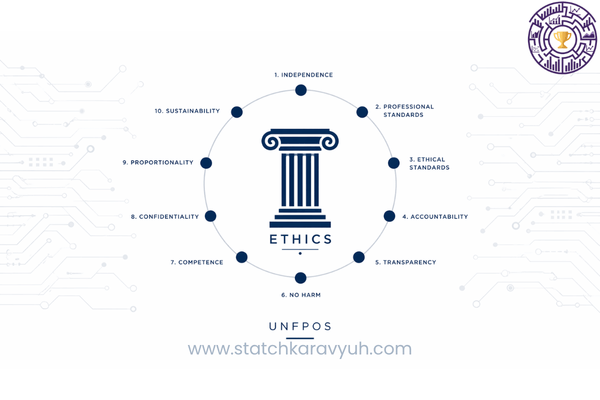
As an ISS aspirant, you are expected to know these 10 principles by heart, as they form the ethical backbone of your future career:
Principle 1: Relevance, Impartiality, and Equal Access Official statistics are an indispensable public good. They must be compiled and made available on an impartial basis to honour the citizens’ entitlement to public information. Interview context: This means data cannot be released only to a select few businessmen or politicians first; it must be equally accessible to all citizens simultaneously.
Principle 2: Professional Standards and Ethics To retain trust, statistical agencies must decide their methods strictly based on professional considerations, scientific principles, and professional ethics. You cannot choose a flawed formula just because it gives a more “favourable” result.
Principle 3: Accountability and Transparency Statistical agencies must present information according to scientific standards on the sources, methods, and procedures of the statistics. Translation: If you publish the CPI, you must clearly publish the metadata explaining exactly how you calculated it, so independent researchers can verify your math.
Principle 4: Prevention of Misuse Statistical agencies are entitled to comment on erroneous interpretations and the misuse of statistics. If the media or politicians are heavily twisting your survey data to spread fake news, the statistical agency has the absolute right (and duty) to issue a public clarification.
Principle 5: Sources of Official Statistics Data for statistical purposes may be drawn from all types of sources – be they statistical surveys or administrative records. Agencies must choose the source considering quality, timeliness, costs, and the burden on respondents. Why conduct a costly door-to-door survey if you can get the exact same data from a GST portal?
Principle 6: Confidentiality (The Golden Rule) Individual data collected by statistical agencies, whether they refer to natural or legal persons, are strictly confidential and used exclusively for statistical purposes. Interview context: If a company reports massive losses in the Annual Survey of Industries (ASI), you cannot secretly hand over this data to the Income Tax Department to raid them.
Principle 7: Legislation The laws, regulations, and measures under which the statistical systems operate must be made public. (This is exactly why we have the Collection of Statistics Act, 2008 published openly!).
Principle 8: National Coordination Coordination among statistical agencies within countries is essential to achieve consistency and efficiency. MoSPI must coordinate with State DESes and other central ministries to avoid overlapping surveys.
Principle 9: Use of International Standards Using international concepts, classifications, and methods promotes the consistency and efficiency of statistical systems at all official levels. This is why India follows the UN’s System of National Accounts (SNA) 2008 for calculating GDP!
Principle 10: International Cooperation Bilateral and multilateral cooperation in statistics contributes to the improvement of systems of official statistics in all countries. India regularly interacts with the IMF, World Bank, and ILO to upgrade its statistical machinery.
Part 2: Modernization & The DI-Lab
Now that we know the ethical rules of the game, let us look at the tools of the game.
The days of carrying massive paper schedules to rural villages are officially over. The Indian Statistical System is currently undergoing a massive digital transformation, spearheaded by the Data Informatics and Innovation Division (DIID) (formerly known as the Computer Centre).
Here are the most futuristic, high-tech initiatives that you must quote in your subjective papers to show the examiner that you are updated with the latest technological trends:
1. The Data Innovation Lab (DI-Lab)
Acknowledging the requirement for continual improvement through modern innovations, MoSPI has proposed the setup of a Data Innovation Lab (DI-Lab) under the DIID.
- What does it do? The DI-Lab is designed to create an ecosystem for experimentation. It offers a space to develop “Proof-of-Concepts” by integrating new ideas from entrepreneurs, tech start-ups, and academic-research organizations.
- Recent Success: DIID has already conducted successful in-house Proof-of-Concepts using AI-based chatbots for document search and AI tools for legacy data rejuvenation!
2. e-SIGMA (e-Survey Instrument and Generalised Multimodal Application)
Developed by the Data Quality Assurance Division (DQAD), e-SIGMA is the ultimate digital weapon of the NSO.
- Its primary aim is to convert the entire data collection endeavour from a paper-schedule mode to a Computer Assisted Personal Interview (CAPI) mode.
- It has built-in, real-time data validation capabilities, ensuring that enumerators cannot enter logically incorrect data on their tablets. It is also highly flexible, allowing for Computer Assisted Telephone Interviews (CATI) and Web Interviews (CAWI).
3. e-Sankhyiki and Microdata Portals
To ensure that researchers get seamless access to data, DIID recently launched the advanced e-Sankhyiki Portal (in June 2024), which provides centralized, user-centric access to official statistics with advanced data visualization and API-sharing features. They also revamped the Microdata Portal in collaboration with the World Bank to align data dissemination with global best practices.
Conclusion & What Lies Ahead?
As an upcoming ISS officer, your duty is not just to crunch numbers. Your duty is to uphold the 10 UN Fundamental Principles – protecting confidentiality, ensuring transparency, and preventing the misuse of data. Simultaneously, you must embrace the future by utilizing AI, CAPI, and the DI-Lab to make data collection faster and more accurate than ever before.
But wait, our journey does not end here!
While we have talked about human ethics and digital modernization, we have left out one of the most critical elements of a nation’s survival: our relationship with nature, and the massive piles of unstructured administrative data lying idle in government offices.
Traditional GDP calculations completely ignore the fact that cutting down a forest permanently destroys a natural asset. And traditional surveys are becoming too expensive when we already have millions of digital footprints generated daily by government services!
In our very next instalment, Part 18: Environmental & Administrative Accounting, we will explore how MoSPI is revolutionizing these two exact domains. We will dive into the fascinating world of the Social Statistics Division (SSD) and learn how they are putting a price tag on nature through EnviStats, Ocean Accounts, and Urban Accounts.
Furthermore, we will decode the immense power of Administrative Data (data generated as a by-product of routine government work). We will explore how the newly established Administrative Statistics and Policy Division (ASPD) has recently launched the National Metadata Structure (NMDS 2.0) to completely standardize and harmonize administrative data across all government ministries!
Keep revising your UN principles, stay fascinated by the tech, and we will see you in Part 18!
This article is part of our complete guide to Official Statistics for UPSC ISS. Bookmark the main guide for the full roadmap.
[…] our Grand Finale, Part 17: The Future & The Ethics (UNFPOS & Modernization), we will decode the 10 UN Fundamental Principles of Official Statistics, explore MoSPI’s […]