

Welcome back, future Indian Statistical Service (ISS) officers!
In our previous session, Part 1, we explored the grand architecture of the Indian Statistical System. We walked through the corridors of the Ministry of Statistics and Programme Implementation (MoSPI) and decoded how the National Statistical Office (NSO) acts as the massive engine generating data for a nation of 1.4 billion people. We learned about the National Accounts Division (NAD) calculating GDP and the Field Operations Division (FOD) acting as the ground army.
But here is a fundamental question for you to ponder: If the NSO collects and compiles the data, who watches the NSO?
How does the public, the global investors, or the United Nations know that the data produced by the Indian government is not manipulated? How do we ensure that the numbers are statistically accurate, politically unbiased, and follow the highest global standards?
To answer these questions, the Indian government created a supreme advisory and regulatory body. Enter The National Statistical Commission (NSC)—the ultimate watchdog of Indian statistics.
In this blog, we are going to deep-dive into the genesis, structure, mandate, and future of the NSC. From an ISS examination and interview perspective, the NSC is a high-yield topic. You are not just expected to know what it is; you are expected to understand why it exists and how it functions. Let us begin!
As you go through this guide, please share your queries or insights in the comments section below. I will be monitoring them personally to provide further clarity.
The Genesis: Why Did India Need an NSC?
To understand the NSC, we have to travel back in time to the turn of the 21st century. The Indian economy had opened up after the 1991 liberalization. Foreign investments were pouring in, and the private sector was expanding rapidly. However, the Indian Statistical System, which was largely designed in the 1950s by Prof. P.C. Mahalanobis, was struggling to keep up with the fast-paced, data-hungry modern economy. There were complaints about data gaps, lack of coordination between the Centre and the States, and issues with data credibility.
Realizing that the system needed a massive overhaul, the Government of India set up a high-level commission in January 2000, headed by the eminent economist and former RBI Governor, Dr. C. Rangarajan.
The Rangarajan Commission reviewed the entire gamut of official statistics in the country and submitted a landmark report in August 2001. One of the most historic and key recommendations of this report was the establishment of a permanent National Commission on Statistics. Dr. Rangarajan envisioned this body to serve as a nodal and empowered authority that would act independently, evolve statistical priorities, enforce standards, and ensure coordination among various data-collecting agencies.
Following this recommendation, the Government of India passed a resolution on 1st June 2005 to set up the National Statistical Commission. Finally, on 12th July 2006, the NSC was formally constituted, taking on the monumental task of restoring and enhancing public trust in India’s official statistics.
The Anatomy of the Watchdog: Composition of the NSC
The NSC is not a massive government department filled with thousands of employees. It is a lean, highly specialized, and expert-driven body. As an ISS aspirant, you must memorize the exact composition of the NSC, as it reflects the diverse expertise required to govern a nation’s data.
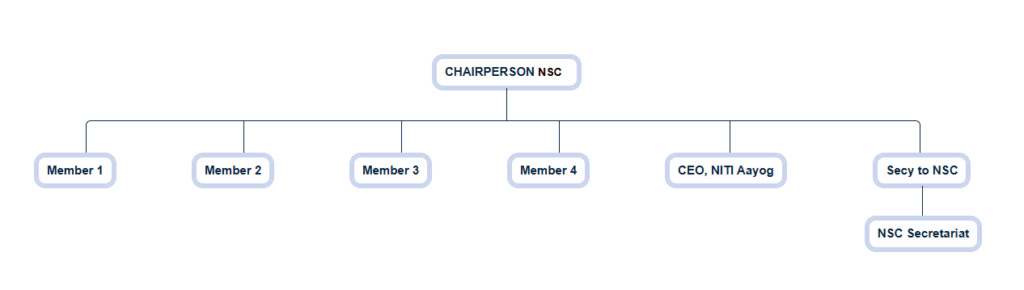
The NSC consists of Five Members (including the Chairperson), along with two ex-officio/secretary-level participants:
- The Chairperson (Part-time): The head of the NSC enjoys the rank of a Minister of State (MoS). The Chairperson is chosen from among eminent statisticians or economists. (Note: Prof. Suresh D. Tendulkar was the first Chairman of the NSC, serving from 2006 to 2009).
- Four Part-time Members: These four members are not chosen randomly. The rules explicitly specify that they must possess specialization and experience in distinct domains:
- Member 1: Specialized in Economic Statistics (Experience in agriculture, industry, infrastructure, trade, or finance).
- Member 2: Specialized in Social Statistics (Experience in population, health, education, labor, employment, or environment).
- Member 3: Specialized in Statistical Operations (Experience in large-scale censuses, sample surveys, and information technology).
- Member 4: Specialized in National Accounts and State Statistical Systems.
- Ex-Officio Member: The Chief Executive Officer (CEO) of NITI Aayog serves as an ex-officio member to ensure that India’s supreme planning think-tank is aligned with the statistical watchdog.
- The Secretary: The Chief Statistician of India (CSI), who is also the Secretary of MoSPI, serves as the Secretary to the NSC.
Tenure and Term Limits: To maintain dynamic leadership, the tenure of the Chairperson and the four Members is limited to 3 years or until they attain the age of 70 years, whichever is earlier. The Chief Statistician of India (CSI), however, serves a tenure of 5 years or until the age of 65 years, whichever is earlier.
The Mandate: What Does the NSC Actually Do?
The NSC is empowered with a powerful 13-point mandate. While you don’t need to memorize all 13 points word-for-word, you must understand its four core pillars of responsibility:
1. Identifying “Core Statistics”
In a country where thousands of datasets are generated by panchayats, municipalities, states, and central ministries, the NSC’s first job is to identify “Core Statistics”. Core Statistics are indicators of immense national importance that are critical to the development of the economy (like GDP, CPI, IIP, and Employment rates). Once a dataset is tagged as “Core Statistics,” it becomes mandatory for the government to collect and disseminate it following strict protocols.
2. The Power of Statistical Audits (The Supreme Auditor)
This is perhaps the most crucial function of the NSC. Just as the Comptroller and Auditor General (CAG) audits the financial accounts of the government, the NSC is mandated to exercise Statistical Audits over the statistical activities of various agencies. The goal of this audit is to ensure the quality, integrity, and methodological purity of statistical products. For instance, the NSC has previously conducted audits on the All India Index of Industrial Production (IIP) and the Periodic Labour Force Survey (PLFS).
3. Evolving National Policies and Standards
The NSC lays down the “laws of physics” for Indian data. It evolves standard statistical concepts, definitions, classifications, and methodologies. It dictates how data should be tabulated, processed, and disseminated. It ensures that India’s data standards are perfectly aligned with the United Nations Fundamental Principles of Official Statistics (UNFPOS).
4. Enhancing Public Trust and Coordination
Data is useless if the public and policymakers do not trust it. A major function of the NSC is to evolve measures for improving public trust in official statistics. Furthermore, because India has a decentralized system, the NSC acts as the great coordinator between Central Ministries, State Governments, and Union Territory Administrations to strengthen institutional mechanisms.
To enforce all of this, the NSC has been granted specific powers equivalent to a civil court in certain matters. It can require the production of any document that serves a statistical purpose, demand detailed methodologies from any statistical agency, and even issue notices requiring the attendance of any person (including public servants) on matters connected with core statistics.
The Future: Modernization and the Draft NSC Bill
While the NSC has done commendable work since 2006, it has operated under a major limitation: it was created through an executive government resolution, not an Act of Parliament. For years, experts have argued that without statutory backing, the NSC lacks the absolute legal teeth required to act entirely independent of the government of the day.
To fix this, MoSPI released the Draft National Statistical Commission (NSC) Bill, 2019. This is a massive current affairs topic for ISS aspirants!
The proposed Bill aims to establish the NSC as a nodal and autonomous statutory body (a body corporate) for core statistical activities. Key revolutionary provisions of the draft bill include:
- National Statistical Audit and Assessment Organization: The bill proposes creating a dedicated audit wing within the NSC, headed by a Chief Statistical Auditor holding the rank of Secretary to the Government of India.
- Financial Autonomy: To ensure absolute independence, the bill envisages the creation of an independent National Statistical Fund.
- Independent Secretariat: It proposes setting up an independent secretariat for the NSC, headed by a Secretary-rank officer, separating it from MoSPI’s direct operational control.
- Advisory and Suo-Moto Powers: The newly empowered NSC would have the power to take suo-moto cognizance (acting on its own accord without a formal complaint) of matters related to legislative policies, technology interventions, and data quality across the Centre and States.
(Note: As an ISS candidate, you should keep an eye on the news regarding the passage and implementation of this Bill, as it represents the future of statistical governance in India).
Why Does the NSC Matter to You?
As a future Indian Statistical Service officer, the NSC is your ultimate guiding star. Whether you are posted in the National Accounts Division calculating the GDP, or in the Household Survey Division designing the next consumption survey, the methodologies you use, the classifications you adopt, and the quality standards you uphold will all be dictated by the policies evolved by the NSC.
The NSC ensures that when an ISS officer releases a data report, the world respects it as an impartial, scientific, and strictly professional piece of public good.
What’s Next?
We have now understood who collects the data (MoSPI/NSO in Part 1) and who monitors the quality of this data (the NSC in Part 2).
But in a massive democracy like India, you cannot simply walk up to a citizen or a massive corporate factory and demand their private data without legal authority. Data collection requires the power of the Law.
In our next exciting installment, Part 3: The Rule Book – Acts Driving Data Collection, we will decode the constitutional provisions and the powerful legal Acts—like the Collection of Statistics Act, 2008, and the Census Act, 1948—that give ISS officers the legal mandate to execute their duties.
Stay curious, keep revising your notes, and we will see you in Part 3!
Have a doubt about a specific NSC? Ask in the comments below.
This article is part of our complete guide to Official Statistics for UPSC ISS. Bookmark the main guide for the full roadmap.
[…] crucial role belongs to an independent watchdog body. In our very next blog, Part 2: The Watchdogs: National Statistical Commission (NSC), we will look at how the NSC functions, its mandate, and why it is considered the supreme advisory […]
[…] In Part 1, we walked through the corridors of MoSPI and the National Statistical Office (NSO). In Part 2, we analysed the supreme watchdog, the National Statistical Commission (NSC). Finally, in Part 3, […]
[…] of Statistics and Programme Implementation (MoSPI) and its National Statistical Office (NSO). In Part 2, we met the supreme watchdog, the National Statistical Commission (NSC), which ensures that the […]
These blogs are fantastic. Very well written, properly arranged and very relevant for iss aspirants. Hats off to you for ur hard work sir.