
Welcome back, future Indian Statistical Service (ISS) officers!
In our previous session, Part 5 we mastered how the National Accounts Division (NAD) measures the overall wealth and production of our economy through GDP and GVA. Towards the end of that blog, we encountered a critical concept: the difference between Nominal GDP and Real GDP. We learned that to find the true economic growth, we must strip away the illusion created by rising prices by using constant base-year prices.
But how does the government actually measure these changing prices? How do we calculate the exact rate at which your money is losing its purchasing power?
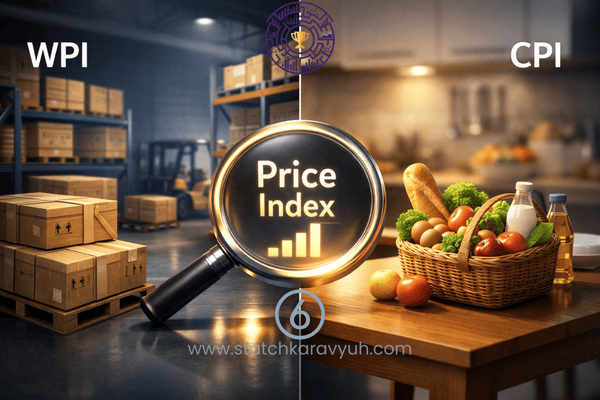
Welcome to the world of Inflation Tracking. In India, measuring inflation is a highly sophisticated operation divided across different ministries and divisions, primarily tracked through two major indices: the Consumer Price Index (CPI) and the Wholesale Price Index (WPI). Furthermore, a new Producer Price Index (PPI) is also on the horizon.
For the UPSC ISS exam and interviews, this is a very high-yield topic. The interview board loves testing candidates on the exact methodological and structural differences between CPI and WPI, as well as recent base year updates. Let us decode the mathematics of prices!
The Two Faces of Inflation
Imagine a simple supply chain: A factory produces soap, sells it in bulk to a wholesale distributor, who then sells it to your local retail shop, from where you finally purchase it. Prices change at every level of this chain.
- If we measure the price changes at the first point of bulk transaction (factory/wholesale level), we use the Wholesale Price Index (WPI).
- If we measure the price changes at the final point of sale, where the end consumer actually pays from their pocket, we use the Consumer Price Index (CPI).
Let us examine both these indices in detail, along with the specific divisions that compile them.
1. Consumer Price Index (CPI): The Citizen’s Reality
The CPI acts like a report card of the cost of living. It reflects the change in average retail prices paid by the consumers for a fixed basket of goods and services. However, India is incredibly diverse. The consumption pattern of an agricultural labourer in a village is vastly different from an IT employee in a metro city or an industrial worker in a factory.
Because of this, India does not have just one CPI; it has multiple CPIs tailored to specific population groups, compiled by two different agencies!
A. CPI (Rural, Urban, Combined)
This is the headline inflation number you see flashed on the news every month.
- Compiled By: The Price Statistics Division (PSD) of the National Statistical Office (NSO), MoSPI.
- Data Collection: The primary data is collected by the Field Operations Division (FOD) of the NSO. They collect data for 1,078 quotations across 310 towns for CPI (Urban) and from 1,181 village markets for CPI (Rural).
- Release Date: It is released precisely on the 12th of every month.
- Base Year: The current operational base year is 2012=100. (Note: A revision to 2024 is currently in progress).
- Weights: The weights for the items in the CPI basket are derived from the Household Consumer Expenditure Survey (HCES) conducted by the NSSO. (Connectivity Note: You will study the HCES in deep detail in Module 4!)
B. CPI for Industrial Workers (CPI-IW)
This index is crucial for the government and corporate sectors.
- Compiled By: The Labour Bureau (under the Ministry of Labour & Employment), released on the last working day of every month, headquartered in Chandigarh/Shimla.
- Purpose: This is primarily used for calculating the Dearness Allowance (DA) for Central/State Government employees, and for fixing or revising minimum wages in scheduled employments. It is also used as a deflator to convert nominal wages into real wages.
- Base Year: The base year is 2016=100.
- Coverage: It covers working-class families in seven sectors: factories, mines, plantations, railways, public motor transport, electricity generation, and ports and docks.
C. CPI for Agricultural Labourers / Rural Labourers (CPI-AL/RL)
- Compiled By: The Labour Bureau. Data is collected by NSO’s FOD from 600 representative sample villages and transmitted to the Labour Bureau.
- Purpose: Specifically used for fixing and revising minimum wages in the agricultural sector (such as MGNREGA wages).
- Base Year: 1986-87=100 (An update to a newer base year is currently in the final stages).
2. Wholesale Price Index (WPI): The Producer’s Pulse
While CPI measures what you and I pay, WPI measures the inflation at the wholesale transaction level. It helps the government make timely interventions before wholesale price increases spill over to retail prices.
- Compiled By: The Office of the Economic Adviser (OEA), Department for Promotion of Industry and Internal Trade (DPIIT), under the Ministry of Commerce and Industry.
- Release Date: Released on the 14th of every month.
- Base Year: The current base year is 2011-12.
- The Basket (697 Items): WPI is strictly restricted to Goods Only. It does not cover services like housing, education, or medical care.
- Primary Articles: 22.62% weight (includes Food, Non-food, Minerals).
- Fuel and Power: 13.15% weight.
- Manufactured Products: 64.23% weight (the largest component).
(Advanced Fact: The OEA also releases the Index of Eight Core Industries, comprising Coal, Crude Oil, Natural Gas, Refinery Products, Fertilizers, Steel, Cement, and Electricity. These eight industries carry a massive 40.27% weight in the Index of Industrial Production (IIP). We will decode IIP in our very next part!)
The Ultimate Interview Showdown: CPI vs. WPI
If an interview panel asks you to differentiate between CPI and WPI, you must present your answer with sharp statistical clarity. Memorize this comparison:
- Stage of Transaction: WPI reflects changes in average prices for bulk sales at the first stage of transaction (ex-factory, mandi level). CPI reflects changes at the final retail level paid by the consumer.
- Inclusion of Services: WPI evaluates only goods. CPI evaluates both goods and services (like education, health, transport, housing rent).
- Source of Weights: The weights for WPI are based on production values/net traded value in the base year. The weights for CPI are derived from the average household consumption expenditure (from the NSSO’s CES data).
- Food Weightage: In WPI, food items carry a combined weight of around 24.38% (Primary food + Manufactured food). In CPI (Combined), Food and Beverages carry a massive weight of 45.86%. This is why CPI is much more sensitive to spikes in tomato or onion prices!
- Target Audience: WPI is an indicator for producers and businesses. CPI is the official benchmark used by the Reserve Bank of India (RBI) to set monetary policy and repo rates.
(Note: Both WPI and CPI calculations currently employ the Laspeyres’ price index formula, which uses base-year quantities as weights.)
Current Affairs Focus
As an ISS aspirant, you must understand the difference between Headline and Core inflation.
- Headline Inflation: This is the raw inflation figure reported through the CPI, containing all items in the basket.
- Core Inflation: Food and fuel prices are highly volatile; they spike during droughts and crash during bumper harvests. If you strip away the volatile Food and Fuel components from the Headline CPI, what you are left with is Core Inflation. Policymakers look at Core Inflation to understand the underlying, long-term trend of prices in the economy.
Indices lose their relevance if the base year becomes too old because consumption patterns change over time. With the monumental shift of the GDP base year to 2022-23, the entire Indian statistical framework is undergoing a massive recalibration.
CPI Base Year Revision: The base year for the Consumer Price Index (CPI) is currently being revised to 2024 to reflect modern consumption habits better.
WPI/PPI Base Year Revisions: Concurrently, the base year for the Wholesale Price Index (WPI) is also being actively revised to align with the new constant price estimates of the GDP.
🔥 Interview Highlight: The Producer Price Index (PPI): In a massive methodological leap, the latest official releases have formally introduced the formulation of a Producer Price Index (PPI) alongside the WPI. While WPI measures prices at the wholesale market level, PPI measures the average changes in prices received by domestic producers for their output. The introduction of PPI in India is a highly anticipated reform, making it a guaranteed discussion point for your ISS interviews!
What Lies Ahead?
We have now conquered how India tracks the prices of its goods and services through CPI and WPI (and soon, PPI).
But how do we specifically measure the health and physical growth volume of our massive manufacturing factories, mines, and power plants? In our next piece, Part 7: Industrial Statistics – ASI vs IIP, we will dive into the Economic Statistics Division (ESD) and Enterprise Survey Division (EnSD) to decode the Annual Survey of Industries and the Index of Industrial Production (which is also shifting to the 2022-23 base!).
Keep revising your weights and base years, stay updated on the upcoming PPI roll-out, and we will see you in Part 7!
This article is part of our complete guide to Official Statistics for UPSC ISS. Bookmark the main guide for the full roadmap.
[…] our next blog, Part 6: Measuring Inflation: CPI vs WPI, we will step out of the National Accounts Division and walk into the Price Statistics Division […]
[…] have been making fantastic progress. In our previous session (Part 6), we completely updated our knowledge on how inflation is measured using the CPI and WPI, and we […]
[…] GDP and National Accounts (Part 5), tracked the cost of living and inflation using CPI and WPI (Part 6), and measured the massive output of our factories and service sectors through ASI, IIP, ASUSE, and […]
[…] conquered Module 2: Economic Statistics, where we decoded the complex mathematics of GDP, Inflation (CPI/WPI), Industrial Output (IIP/ASI), and the formulas of Index […]
The way you have linked static part with current affairs this is what I was looking for, The official statistics series you’re providing is something one couldn’t get even after spending ₹80,000 on coaching. I’m preparing through self-study, and I’m making my notes on Official Statistics and Computer Applications entirely from your blogs. This is extremely valuable for me. Please continue this series—I would be truly grateful to you always.
Thank you so much for your kind words.
This truly means a lot. My purpose behind this series is exactly this, to make Official Statistics and related topics more structured, practical, and connected with current affairs for serious UPSC ISS aspirants.
I am really glad these blogs are helping you in your self-study and note-making.
Yes, I will definitely continue this series.
Wishing you the very best for your preparation.