
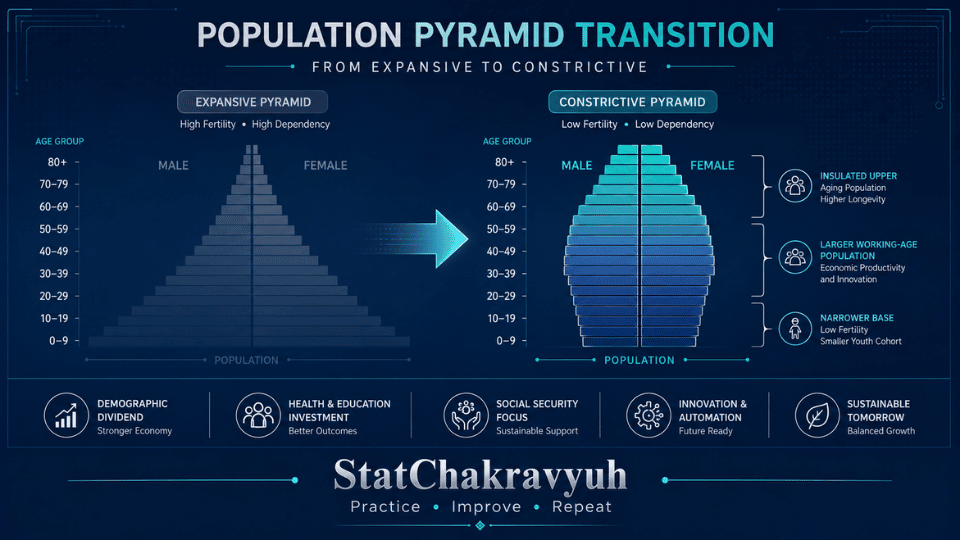
International rules and partnerships shape India’s external environment. Internally, the deepest long term shift is demographic. The decline in India’s fertility rate is now an exam favourite.
India is officially below the replacement level of fertility. The National Family Health Survey 5 pegged the national Total Fertility Rate at 2.0, with urban areas at 1.6 and rural areas at 2.1. The State of World Population 2025 by the United Nations Population Fund reported India’s fertility rate at 1.9. This is a demographic milestone with far reaching implications for the economy, society, and policy.
What the data tells us
India is the world’s most populous country, with the population estimated at around 146 crore in 2025 according to UN sources. Yet the Total Fertility Rate is below 2.1, which is the level required for a population to replace itself across generations. Most southern and western states are well below replacement. Bihar, Meghalaya, and Uttar Pradesh remain the main exceptions, although they are also moving downward.
Why fertility is falling
Multiple drivers act together. Improved female education, with women holding 12 plus years of schooling having a TFR of 1.7 against 2.8 for those with no schooling. Wider access to modern contraception, with a contraceptive prevalence rate above 60 percent. Improved child survival, with infant mortality rate falling from 66 in 2000 to around 28 in 2023. Higher cost of living, urbanisation, and aspirational shifts also play a role.
Implications for the economy
A lower fertility rate enables a demographic dividend in the short and medium term, with a larger working age share. However, over time, the dependency ratio shifts the other way as elderly population rises. This means rising public spending on health, pensions, and elderly care, alongside the need for productivity gains and continued labour force participation. The Economic Survey has highlighted these long term planning needs.
Why ISS aspirants must care
Population, demography, and gender are evergreen ISS topics. Quoting NFHS 5, SRS 2023, and UNFPA 2025 makes any answer credible. Add a sentence on the urban rural fertility gap, the southern states’ lead, and the policy debate around small family norms and you have a strong, balanced response.
India’s Fertility Snapshot
| Indicator | Value |
| NFHS 5 National TFR | 2.0 |
| NFHS 5 Urban TFR | 1.6 |
| NFHS 5 Rural TFR | 2.1 |
| UNFPA 2025 India TFR | 1.9 |
| Replacement Level | 2.1 |
| States Above Replacement | Bihar, Meghalaya, UP and a few others |
A Real Aspirant Story
Think of a young couple named Aman and Nidhi in Pune. They have one child, both work full time, and pay a sizeable home loan EMI. Their conscious decision to stop at one child is repeated millions of times across urban India. The aggregate of these private choices is the falling fertility rate that policy makers now have to plan for, with an ageing population in mind 30 years from today.
Bridge to the Next Topic
An ageing population will be increasingly assisted by intelligent machines. That brings us to the final piece of this 25 part series, AI Governance, where India’s voice is becoming central to global frameworks. Read here