

Welcome, future Indian Statistical Service (ISS) officers!
If you are reading this, you are embarking on a journey to crack one of the most prestigious and highly specialized examinations in the country. But before we dive into the complex mathematics of Index Numbers or the rigorous methodologies of GDP calculation, we need to take a step back. We need to look at the grand architecture.
Imagine a massive country like India, with over 1.4 billion people, millions of businesses, and countless farms. How does the government know if poverty is decreasing? How does the Reserve Bank of India (RBI) decide the interest rates? How do policymakers know if employment is rising? The answer is simple: Data. But data does not just magically appear; it is collected, processed, and published by a highly structured, giant machinery.
This blog is your ultimate “Blueprint” of that machinery. Today, we are going to explore the Indian Statistical System from scratch to an advanced level. As an ISS aspirant, understanding this ecosystem is non-negotiable because this is the exact system you are going to manage, lead, and revolutionize tomorrow!
As you go through this guide, please share your queries or insights in the comments section below. I will be monitoring them personally to provide further clarity.
The Nature of the Beast: A Decentralized Ecosystem
When you hear “Indian Statistical System,” you might picture one giant building in New Delhi where all the data in the country is crunched. That is entirely incorrect. The Indian Statistical System is uniquely designed to mirror the federal structure of our Constitution.
Our system is both laterally and vertically decentralized.
- Vertical Decentralization: Data collection is divided between the Central Government and the State/Union Territory (UT) Governments. The States collect data at the ground level through their Directorates of Economics and Statistics (DES), and this data flows upward to the Centre to create national aggregates.
- Lateral Decentralization: At the Central level, data is not collected by just one ministry. The responsibility is divided based on subjects. For instance, the Ministry of Agriculture collects agricultural statistics, the Ministry of Health collects health data, and the RBI collects banking statistics.
Because data is scattered across so many different ministries and states, there is a desperate need for a “Captain of the Ship” to ensure everyone follows the same global standards, avoids duplication, and works together smoothly. This is where our nodal agency comes into play.
The Brain of the Operation: MoSPI
The Ministry of Statistics and Programme Implementation (MoSPI) is the central nerve center of the Indian Statistical System. It came into existence as an independent ministry on 15th October 1999, following the merger of the Department of Statistics and the Department of Programme Implementation.
MoSPI is divided into two distinct wings:
- The Programme Implementation (PI) Wing: This wing is primarily responsible for monitoring heavy infrastructure projects and government schemes. It contains the Infrastructure and Project Monitoring Division (IPMD), which tracks massive central sector projects costing more than Rs. 150 crores. It also contains the MPLADS Division, which manages the Member of Parliament Local Area Development Scheme, where MPs are allocated Rs. 5 crores annually for local developmental works.
- The Statistics Wing: This is your primary domain as an ISS officer. This wing is officially known as the National Statistical Office (NSO).
Understanding the NSO (National Statistical Office)
Historically, the Statistics Wing consisted of two separate bodies: the Central Statistical Organisation (CSO) and the National Sample Survey Organisation (NSSO). However, to streamline operations and bring the system under one unified umbrella, the government merged the CSO and NSSO to form a single, powerful entity called the National Statistical Office (NSO).
The NSO is the executive wing of the government in the field of statistics. It is headed by the Chief Statistician of India (CSI), an officer of the rank of Secretary to the Government of India, who also serves as the Secretary of MoSPI.
As an ISS aspirant, you must know the anatomy of the NSO inside out. The NSO operates through several highly specialized divisions. Let us take an advanced look at these divisions, as we will be referring to them constantly in our upcoming modules.
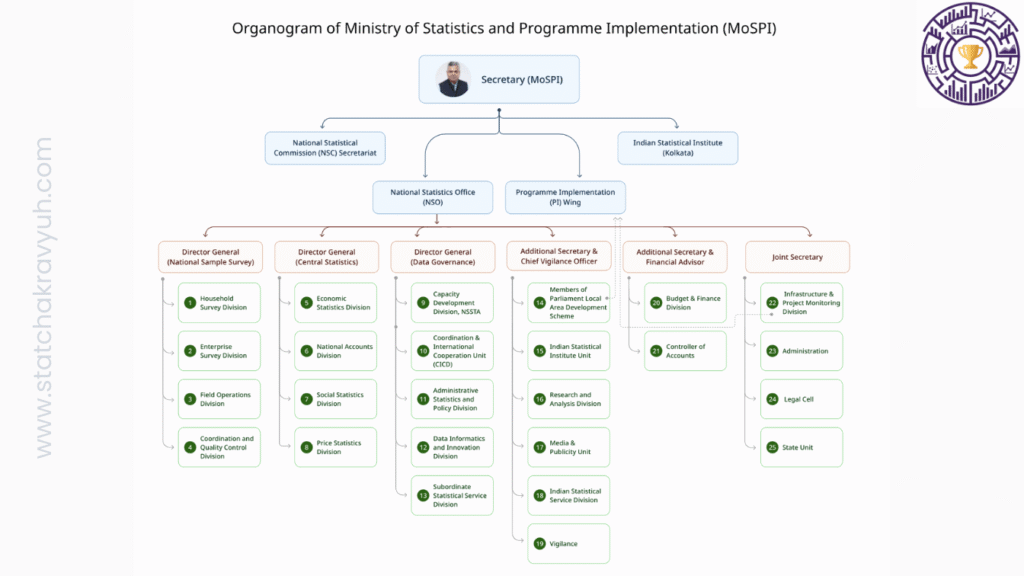
Image Source: MoSPI Official website
1. The Core Economic Divisions (The Money Track)
- National Accounts Division (NAD): This is the division responsible for the macroeconomic pulse of the country. NAD computes the Gross Domestic Product (GDP), National Income, Gross Value Added (GVA), and compiles the crucial Input-Output Transaction Tables (IOTT) and Supply-Use Tables (SUT). (Connectivity Note: We will decode exactly how NAD calculates GDP using the Production, Income, and Expenditure approaches in Module 2).
- Price Statistics Division (PSD): PSD is responsible for tracking inflation. It compiles and releases the Consumer Price Index (CPI) for Rural, Urban, and Combined sectors on the 12th of every month. (We will deeply explore PSD’s methodologies and the CPI vs. WPI debate in Module 2).
- Economic Statistics Division (ESD): ESD monitors the industrial and commercial heartbeat of India. It compiles the Index of Industrial Production (IIP) and is responsible for conducting the massive all-India Economic Census.
2. The Survey and Social Divisions (The People Track)
- Household Survey Division (HSD): Formerly known as the Survey Design and Research Division (SDRD), HSD is responsible for the technical planning, sample design, and schedule formulation of large-scale socio-economic surveys. This division designs the famous Periodic Labour Force Survey (PLFS) and the Household Consumption Expenditure Survey (HCES). (We will master HSD’s survey designs when we reach Module 4).
- Enterprise Survey Division (EnSD): If HSD surveys households, EnSD surveys businesses. EnSD is responsible for the Annual Survey of Industries (ASI), the Annual Survey of Unincorporated Sector Enterprises (ASUSE), and the upcoming Annual Survey of Service Sector Enterprises (ASSSE).
- Social Statistics Division (SSD): SSD deals with data that reflects human welfare. It monitors India’s progress on the UN Sustainable Development Goals (SDGs) and develops the National Indicator Framework (NIF). It is also pioneering the highly advanced field of Environmental Economic Accounting (publishing ‘EnviStats India’). (This will be a major focus in our Module 5: Global Standards).
- Field Operations Division (FOD): You can design the best survey in the world, but it is useless without primary data. FOD is the “Army” of the NSO. With a massive network of Zonal, Regional, and Sub-Regional offices across India, FOD enumerators travel to villages and cities to collect primary data for PLFS, ASI, and Crop Statistics directly from the citizens.
3. The Innovators and Regulators (The Modern Track)
The ISS exam loves testing candidates on recent advancements. MoSPI has evolved heavily in recent years, adding divisions dedicated to modernization.
- Data Informatics and Innovation Division (DIID): Previously known as the Computer Centre, DIID is spearheading MoSPI’s digital transformation. They recently launched the advanced e-Sankhyiki Portal for data visualization, a renewed Microdata Portal, and are currently experimenting with AI-based chatbots for data retrieval.
- Administrative Statistics and Policy Division (ASPD): A relatively newer division mandated to unlock the potential of administrative data (data generated as a by-product of routine government work). ASPD recently released the National Metadata Structure (NMDS 2.0) to standardize how different ministries format their data.
- Coordination and Quality Control Division (CQCD): This division acts as the glue, coordinating activities among different NSO divisions, handling parliamentary questions, and organizing data user conferences.
- Capacity Development Division (CDD): CDD handles the human resource development aspect. It oversees the National Statistical Systems Training Academy (NSSTA) in Greater Noida, which trains ISS officers, and implements the National Internship in Official Statistics (NIOS).
Why does this architecture matter to you?
As a future ISS officer, you will not just be crunching numbers; you will be placed at the helm of these very divisions. You might be posted in the NAD deciding the base year revision for GDP, or in the FOD managing hundreds of field investigators in rural India, or in the DIID integrating Artificial Intelligence into official surveys.
Furthermore, this intricate web of divisions ensures that India complies with the United Nations Fundamental Principles of Official Statistics (UNFPOS), which India officially adopted in 2016. These principles demand relevance, impartiality, professional ethics, and transparency.
What lies ahead?
In this blog, we have built the foundation by understanding MoSPI, the NSO, and its vast network of divisions. However, there is a catch. The NSO produces the data, but who ensures that this data is politically unbiased, statistically accurate, and free from manipulation? Who audits the NSO?
That crucial role belongs to an independent watchdog body. In our very next blog, Part 2: The Watchdogs: National Statistical Commission (NSC), we will look at how the NSC functions, its mandate, and why it is considered the supreme advisory body on statistical matters in India.
Later in this series, as we move to Module 2 and Module 3, we will continuously reconnect with the divisions we learned about today. When we calculate Industrial Output, you will instantly remember ESD and EnSD. When we look at poverty lines, you will know exactly how HSD structured the survey.
Stay tuned, revise these divisions, and prepare to decode the fascinating world of Official Statistics!
Have a doubt about a specific NSO division? Ask in the comments below.
This article is part of our complete guide to Official Statistics for UPSC ISS. Bookmark the main guide for the full roadmap.
Thank you so much Sir, please drop part 2 as soon as possible
Thank you for your kind words. I am glad you found it helpful. Part 2 will be published soon, so stay tuned.
[…] Part 1: The Indian Statistical System – WHO RUNS THE NUMBERS […]
[…] you have been following our series, you now know the grand architecture of data collection. In Part 1, we explored the massive machinery of the Ministry of Statistics and Programme Implementation […]
[…] Parts, we have thoroughly decoded the modern architecture of the Indian Statistical System. In Part 1, we walked through the corridors of MoSPI and the National Statistical Office (NSO). In Part 2, we […]
[…] we jump into the formulas, let us reconnect with an old friend from Part 1. The responsibility of computing India’s macroeconomic aggregates lies securely with the National […]
[…] to pat yourselves on the back. We have officially crossed the halfway mark of our journey! In Module 1, we built the grand administrative architecture of MoSPI and the NSO. In Module 2, we chased the […]
[…] knowledge. You know how the Ministry of Statistics and Programme Implementation (MoSPI) operates (Module 1), how GDP and Inflation are calculated (Module 2), how we estimate crops and livestock (Module 3), […]
[…] journey you have completed. We started by building the grand administrative machinery of MoSPI (Module 1), counted the nation’s wealth and industrial output (Module 2), walked through the […]
[…] the entire Indian Statistical System. You have conquered the complex architectures of MoSPI (Module 1), the rigorous mathematics of GDP and Inflation (Module 2), the sprawling fields of Agricultural […]