
Welcome back, future Indian Statistical Service (ISS) officers!
Congratulations on successfully completing Module 1, where we decoded the vast administrative and legal architecture of the Indian Statistical System. We explored the corridors of MoSPI, understood the watchdog role of the NSC, and paid our respects to the Father of Indian Statistics, Prof. P.C. Mahalanobis.
Now, it is time to transition from theory and administration to hard numbers. Welcome to Module 2: Economic Statistics (The Money Part).
Imagine you are running a household or a small business. At the end of the year, you calculate your total income, your total expenditures, and your savings to understand your financial health. Now, imagine doing this exact same accounting, but for a massive, diverse country of over 1.4 billion people. How do we measure the value of every single haircut, every car manufactured, every software code written, and every grain of wheat harvested?
This mammoth task is called National Income Accounting. In this blog, National Account 101, we are going to dive deep into how India measures its economic pulse. This is one of the most technical, formula-heavy, and high-yield topics for your UPSC ISS written exams and interviews. Get your notebooks ready!
The Architects: National Accounts Division (NAD)
Before we jump into the formulas, let us reconnect with an old friend from Part 1. The responsibility of computing India’s macroeconomic aggregates lies securely with the National Accounts Division (NAD), which operates under the National Statistical Office (NSO) of MoSPI.
Historically, the first official set of estimates of national income for the entire Indian Union was compiled by the ‘National Income Committee’, a high-powered expert committee set up by the Government of India in 1949, chaired by none other than Prof. P.C. Mahalanobis.
Today, the NAD prepares these estimates based on the internationally agreed standard set of recommendations known as the United Nations System of National Accounts (SNA), 2008. Aligning with SNA 2008 ensures that India’s economic data speaks a global language and is directly comparable with the economies of the US, China, or the UK.
Decoding the Vocabulary: Gross, Net, Domestic, and National
In National Accounts, you will constantly encounter four words. As an ISS aspirant, your conceptual clarity on these terms must be absolute:
- Gross: This means the total product, regardless of the use to which it is subsequently put. It includes the wear and tear of machinery used in production.
- Net: This means “Gross” minus the amount that must be used to offset depreciation (officially termed as Consumption of Fixed Capital or CFC). Therefore, Net = Gross – CFC.
- Domestic: This means the boundary is strictly geographical. We are counting all goods and services produced within the country’s physical borders, regardless of who produces them (whether it is an Indian citizen or a foreign multinational company operating in India).
- National: This means the boundary is defined by citizenship (nationality). We count all goods and services produced by the nationals of the country, regardless of where that production physically takes place in the world. Therefore, National = Domestic + Net Factor Income from Abroad.
Gross Domestic Product (GDP): The Ultimate Scorecard
Gross Domestic Product (GDP) is the market value of all final goods and services produced within the territorial borders of a country for a given period of time.
There are three primary approaches to calculating GDP, and theoretically, all three should yield the exact same number. This is because, in an economy, total production generates an equal amount of income, which in turn generates an equal amount of expenditure.
1. The Production Approach (Value Added Method)
This approach estimates GDP from the production side by summing the gross value added of different kinds of economic activities.
- Formula: Gross Value Added (GVA) = Value of Output at basic price – Intermediate Consumption. Intermediate consumption refers to the material inputs used up in the production process (like flour used to make bread).
2. The Income Approach
The production process creates income not only for the owners of the inputs but also for the owners of capital. This approach calculates GDP by summing the incomes generated by all factors of production.
- Formula: GVA at basic prices = Compensation of Employees (CE) + Operating Surplus/Mixed Income (OS/MI) + Consumption of Fixed Capital (CFC) + Production taxes less Production subsidies.
3. The Expenditure Approach
This approach calculates GDP by summing all the final expenditures incurred in the economy during one year.
- Formula: GDP = Private Final Consumption Expenditure (PFCE) + Government Final Consumption Expenditure (GFCE) + Gross Fixed Capital Formation (GFCF) + Change in Stocks (CIS) + Valuables + Net Exports (Exports – Imports).
(Connectivity Note: The GFCE is compiled by analyzing government budget documents, while the PFCE is generally derived through a “commodity flow approach”.)
The Ultimate Interview Question: GDP vs. GVA
In 2015, India made a massive methodological shift. The headline number used to measure economic growth shifted from GDP at factor cost to GDP at constant market prices, and sector-wise growth began to be measured in GVA at basic prices.
As an ISS candidate, you must know the exact mathematical and conceptual difference between GDP and GVA.
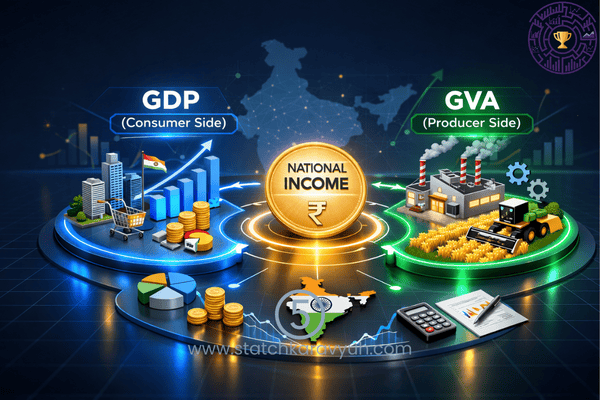
- GVA (Gross Value Added): This is the producer’s perspective. It tells us the value of goods and services produced in an economy after deducting the cost of inputs and raw materials that have gone into the production. Basic price is the natural price of the producer as it includes production taxes but excludes production subsidies.
- GDP (Gross Domestic Product): This is the consumer’s perspective. It is what the end consumer pays.
The bridge between GVA and GDP is built using taxes and subsidies. But here is the trick that confuses 90% of candidates, the difference between Production taxes and Product taxes.
The Golden Formula: GDP = ∑GVA at basic prices + Product taxes less Product subsidies.
Understanding the Taxes (Memorize This!):
- Production Taxes/Subsidies: These are paid or received with relation to production and are independent of the volume of actual production.
- Examples of Production Taxes: Land Revenues, Stamps & Registration fees, Tax on profession.
- Examples of Production Subsidies: Subsidies to Railways, Subsidies to village and small industries.
- Product Taxes/Subsidies: These are paid or received on per unit of product.
- Examples of Product Taxes: Excise duties, Sales tax, Service Tax, and Import/Export duties.
- Examples of Product Subsidies: Food, Petroleum, and fertilizer subsidies.
When you calculate GVA at basic prices, you have already accounted for Production taxes and subsidies. To arrive at the final market GDP, you must add the Product taxes (which consumers pay) and deduct the Product subsidies (which the government bears).
Real vs. Nominal GDP
If a country produced 10 cars last year priced at Rs. 1 Lakh each, the GDP was Rs. 10 Lakhs. If this year, the country still produced only 10 cars, but inflation drove the price to Rs. 2 Lakhs each, the GDP would appear to be Rs. 20 Lakhs. Did the economy actually grow? No. The production volume remained stagnant; only the prices inflated.
To solve this illusion, NAD prepares estimates at both current and constant prices:
- Nominal GDP (Current Prices): GDP measured at the prevailing prices of the current year.
- Real GDP (Constant Prices): GDP measured at the prices of a selected “base year”. Real GDP reflects the true value of all goods and services produced by removing the effect of inflation. Comparing Real GDP over the years gives the true measure of economic growth.
Advanced Tools: SUTs and IOTTs
The NAD doesn’t just stop at calculating one headline GDP number. It maps the intricate web of the economy using advanced matrices:
- Supply-Use Tables (SUT): Published by NAD, SUTs offer a detailed analysis of the process of production and use of goods and services. It balances supply and demand, linking the output of industries with intermediate and final uses. Crucially, the Supply table is calculated at basic prices, whereas the Use table is at purchasers’ prices.
- Input-Output Transaction Tables (IOTT): This table gives the inter-industry transactions in value terms at factor cost. Presented as a commodity-by-industry matrix, it shows how the output of one industry (like steel) becomes the input for another industry (like automobile manufacturing). All entries in the IOTT exclude trade and transport margins and net indirect taxes.
Current Affairs & Interview Focus: The Historic Base Year Revision to 2022-23

Why does the government change the base year? The base year is revised periodically to reflect structural shifts in the economy, integrate new data sources, and improve the accuracy of economic estimates.
For over a decade, the base year for National Accounts was 2011-12 (shifted from 2004-05 on January 30, 2015). However, on 27th February 2026, the Ministry of Statistics and Programme Implementation (MoSPI) officially released the New Series of GDP Estimates, revising the base year to 2022-23.
Why 2022-23? This year was selected because it represents the most recent “normal” period following the heavy economic disruptions caused by the COVID-19 pandemic (2019-2021).
🔥 Interview Goldmine: What changed in the new 2022-23 methodology?
If the interview panel asks you about the new GDP series, you must mention these highly advanced methodological upgrades:
- New Data Sources: The government reduced its reliance on proxy indicators. The new series heavily integrates real-time, granular data like GST filings, the Public Financial Management System (PFMS), e-Vahan (for road transport), ASUSE, and PLFS.
- Double Deflation: In a massive mathematical upgrade, India has now adopted Double Deflation for the Agriculture and Manufacturing sectors (single deflation has been discontinued).
- Capturing the Gig Economy: The new series better captures unincorporated enterprises, self-employed individuals, and the platform/gig economy.
- Supply and Use Tables (SUT): The SUT framework has been integrated into the compilation process to ensure that total supply strictly matches total demand, effectively reducing statistical discrepancies.
(Note: Following this, the base years for the Wholesale Price Index (WPI) and the Index of Industrial Production (IIP) are also undergoing revisions to align with the new economic framework!)
What Lies Ahead?
We have now decoded how the nation measures its overall wealth, production, and growth through the lens of the National Accounts Division. However, as we saw in the Real vs. Nominal GDP debate, “prices” play a mischievous role in distorting our understanding of economic health.
How does the government actually measure these price changes? How do we calculate Inflation?
In our next blog, Part 6: Measuring Inflation: CPI vs WPI, we will step out of the National Accounts Division and walk into the Price Statistics Division (PSD) and the Labour Bureau to decode the mathematics of the Consumer Price Index (CPI) and the Wholesale Price Index (WPI).
Keep practicing the GDP vs. GVA formulas, internalize the difference between production and product taxes, and we will see you in the next blog!
This article is part of our complete guide to Official Statistics for UPSC ISS. Bookmark the main guide for the full roadmap.
[…] our previous session, Part 5 we mastered how the National Accounts Division (NAD) measures the overall wealth and production of […]
[…] sessions, we have successfully decoded the nation’s wealth through GDP and National Accounts (Part 5), tracked the cost of living and inflation using CPI and WPI (Part 6), and measured the massive […]
[…] Part 5: National Account 101 […]
Insightful, Thankyou so much!!
Thank you so much! Glad you found it insightful 😊
[…] this blog, we have compiled the ultimate Formula Cheat Sheet. We will cover National Accounts, Vital Statistics, Employment (PLFS), and Index […]
[…] machinery of MoSPI (Module 1), counted the nation’s wealth and industrial output (Module 2), walked through the agricultural fields (Module 3), tracked the human population and employment […]
[…] our journey! In Module 1, we built the grand administrative architecture of MoSPI and the NSO. In Module 2, we chased the money, decoding GDP, Inflation, and Industrial output. In Module 3, we walked […]
[…] the complex architectures of MoSPI (Module 1), the rigorous mathematics of GDP and Inflation (Module 2), the sprawling fields of Agricultural Statistics (Module 3), the vital pulse of our Population and […]
[…] and Programme Implementation (MoSPI) operates (Module 1), how GDP and Inflation are calculated (Module 2), how we estimate crops and livestock (Module 3), and how we track human population, vital rates, […]
[…] concepts ready, because in Module 2: Economic Statistics (The Money Part), we will kick off with Part 5: National Account 101, where we will mathematically decode how India […]