
Welcome to Module 6: The Ultimate Revision, future ISS officers!
You have studied the theory, you understand the divisions, and you know the history. But when you are sitting in the UPSC examination hall solving Statistics Paper II, your conceptual knowledge must translate into flawless mathematical equations. Official Statistics is highly scoring if you know the exact formulas the government uses to calculate its indicators.
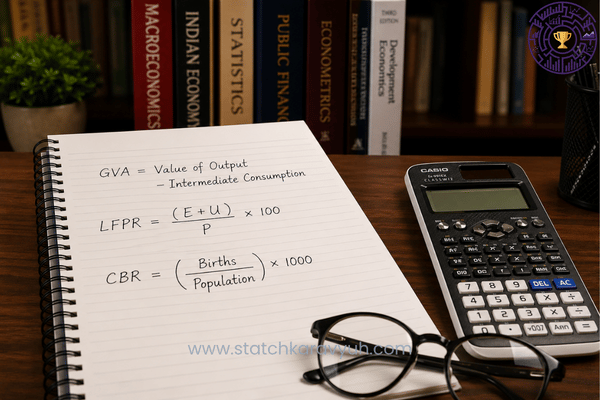
In this blog, we have compiled the ultimate Formula Cheat Sheet. We will cover National Accounts, Vital Statistics, Employment (PLFS), and Index Numbers.
Read here Last Part 18 Environmental & Administrative Accounting – Valuing Nature and Unlocking Data
Let us dive into the mathematics!
1. National Accounts & GDP Formulas (The NAD Equations)
Compiled by the National Accounts Division (NAD), these formulas are the backbone of India’s macroeconomic measurement.
- Gross Value Added (GVA) – Production Approach:
GVA at basic prices = Value of Output at basic price – Intermediate Consumption.
- Gross Value Added (GVA) – Income Approach:
CE - Compensation of EmployeesOS/MI–Operating Surplus/Mixed IncomeCFC–Consumption of Fixed Capital
- The Golden Bridge (GVA to GDP):
- Net Domestic Product (NDP) & National Income (NNI):
CFC – Consumption of Fixed Capital or Depreciation
GNI – Gross National Income
- GDP Deflator (General Knowledge Concept):
While the National Accounts compute Real GDP (at constant prices) to remove inflation, the GDP Deflator is mathematically defined as:GDP Deflator = (Nominal GDP / Real GDP) × 100.
- Double Deflation Method (Important for Real GVA):
To compute Real GVA accurately, both output and intermediate consumption must be deflated separately:
(This method ensures correct removal of price effects when input and output prices move differently.)
2. Employment Statistics Formulas (The PLFS Equations)
If there is one survey you must memorize, it is the Periodic Labour Force Survey (PLFS). The definitions are strict, and you cannot mix up the denominators.
- Worker Population Ratio (WPR):
- Labour Force Participation Rate (LFPR):
- Unemployment Rate (UR) – Beware the Denominator!:
(Remember: Labour Force = Employed + Unemployed. It does not include students or retirees not looking for work).
3. Vital Statistics Formulas (The SRS/CRS Equations)
Used heavily by the Office of the Registrar General of India (ORGI), these formulas measure the life and death pulse of the country.
- Crude Birth Rate (CBR):
- Crude Death Rate (CDR):
- Infant Mortality Rate (IMR):
- Neo-Natal & Post Neo-Natal Mortality (The Micro-Splits):
- Late Neo-natal mortality rate:
- Post Neo-natal mortality rate (PNMR):
4. Index Number Formulas
- Laspeyres’ Price Index Formula: This is the most practically used formula by the Indian Government. It uses the base-year quantities as weights.
Application: Both the Wholesale Price Index (WPI) and the Consumer Price Index (CPI) are fundamentally computed using the Laspeyres’ formula with a fixed base system.
Formula:
- Paasche’s and Fisher’s Indices: Remember for your objective exams: Fisher’s Ideal Index (the geometric mean of Laspeyres and Paasche) satisfies both the Time Reversal Test and the Factor Reversal Test.
5. Quick Bonus: Pareto Distribution Parameter Estimation
The Pareto distribution is heavily used in economics to model wealth distribution (the 80/20 rule). Its Probability Density Function (PDF) is given by:
- Estimating ‘b’ (Scale Parameter/Minimum Value): Using Maximum Likelihood Estimation (MLE), the estimator for ‘b’ is simply the minimum order statistic of your sample:
- Estimating ‘a’ (Shape Parameter/Tail Index): Using MLE, once ‘b’ is known, the estimator for ‘a’ is:
What Lies Ahead?
You now have the mathematical ammunition required to tackle the numerical problems in the ISS examination. But numbers don’t exist in a vacuum; they belong to Ministries.
In our final wrap-up, Part 20, we present the ultimate “Who Releases What?” Quick Lookup Table. It is the most powerful cheat sheet you can revise on the morning of your examination! See you there!
This article is part of our complete guide to Official Statistics for UPSC ISS. Bookmark the main guide for the full roadmap.