
GATE Statistics (ST) is a relatively recent addition to the GATE family, which means the pool of Previous Year Questions is smaller compared to papers like GATE CSE or GATE ME. But this is actually an advantage for you – with fewer papers to analyze, you can study every available PYQ in depth and extract maximum strategic value.
In this article, we will analyze the GATE Statistics papers available so far – breaking down topic-wise weightage, identifying high-frequency question types, examining difficulty patterns, and giving you a clear scoring strategy for the exam.
The GATE ST Paper Structure – A Quick Recap
The paper has 65 questions worth 100 marks, divided into General Aptitude (10 questions, 15 marks) and Core Statistics (55 questions, 85 marks). Question types include MCQs, MSQs, and NATs. The exam is 3 hours long. Negative marking applies only to MCQs.
The core statistics portion covers nine major topic areas. Understanding how marks are distributed across these areas is crucial for strategic preparation.
Topic-Wise Weightage Analysis
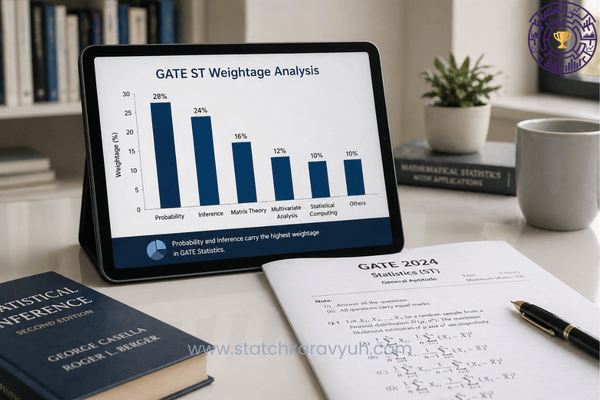
Based on available GATE ST papers, here is the approximate topic-wise mark distribution:
Probability: 15–20 marks This is consistently the single highest-scoring area in GATE ST. Questions cover probability axioms, conditional probability, Bayes’ theorem, random variables (discrete and continuous), expectation, variance, moment generating functions, inequalities (Chebyshev, Markov), and limit theorems (Central Limit Theorem, Weak and Strong Laws of Large Numbers).
Probability questions range from straightforward calculations to application-based problems requiring multi-step reasoning.
Standard Distributions: 10–15 marks Questions on Binomial, Poisson, Geometric, Negative Binomial, Hypergeometric, Uniform, Normal, Exponential, Gamma, Beta, Weibull, Cauchy, and Lognormal distributions. Common question types include finding the mean and variance of a given distribution, computing probabilities, identifying distributions from MGFs, and understanding relationships between distributions (e.g., sum of Poissons is Poisson, square of standard Normal is Chi-square).
Estimation: 10–12 marks Point estimation is heavily tested: Maximum Likelihood Estimation, method of moments, properties of estimators (unbiasedness, consistency, efficiency, sufficiency), Rao-Blackwell theorem, completeness, Lehmann-Scheffe theorem, UMVUE, Fisher information, and Cramer-Rao inequality. Interval estimation (confidence intervals for mean, variance, and proportion) also appears regularly.
Testing of Hypotheses: 8–12 marks Neyman-Pearson fundamental lemma, most powerful (MP) tests, uniformly most powerful (UMP) tests, likelihood ratio tests (LRT), chi-squared goodness-of-fit tests, and tests for mean and variance of normal populations. Questions often ask you to construct the critical region or compute the power of a test.
Regression Analysis: 6–10 marks Simple and multiple linear regression, ordinary least squares (OLS), properties of OLS estimators, Gauss-Markov theorem, ANOVA (one-way and two-way), analysis of residuals, coefficient of determination (R-squared), and multicollinearity. GATE tends to ask both theoretical questions (e.g., properties of OLS estimators) and computational questions (e.g., computing regression coefficients from data).
Multivariate Analysis: 5–8 marks Multivariate normal distribution and its properties, Wishart distribution, Hotelling’s T-squared statistic, MANOVA basics, principal component analysis (PCA), and factor analysis. This topic is unique to GATE ST (not in JAM MS) and carries moderate marks.
Matrix Theory: 6–10 marks Rank, determinants, eigenvalues and eigenvectors, diagonalization, positive definite matrices, quadratic forms, singular value decomposition (SVD), matrix decompositions (LU, QR). Questions are usually computational and test your ability to perform matrix operations accurately.
Calculus: 5–8 marks Limits, continuity, differentiability, Taylor series, maxima and minima, integration, double and triple integrals. Calculus questions in GATE ST are generally moderate in difficulty — they test fundamentals rather than advanced techniques.
Stochastic Processes: 4–6 marks Markov chains (classification of states, transition matrices, stationary distributions), Poisson processes, and birth-death processes. This section typically has 2–3 questions worth 4–6 marks.
Non-Parametric Statistics: 3–5 marks Sign test, Wilcoxon signed-rank test, Mann-Whitney U test, Kruskal-Wallis test, and Kolmogorov-Smirnov test. Usually 1–2 questions per paper.
General Aptitude: 15 marks Verbal ability, quantitative reasoning, data interpretation, and analytical reasoning. This section is common across all GATE papers and is generally considered easy by well-prepared students.
Difficulty Analysis
Based on student feedback from GATE ST 2019 – 2025, and 2026 papers:
Easy Questions (30–35 marks): Typically include GA questions, straightforward probability calculations, basic distribution properties, simple matrix operations, and direct formula applications. A well-prepared student should aim to get 100% accuracy on these.
Moderate Questions (35–40 marks): Include multi-step inference problems, application-based regression questions, and questions requiring careful analysis. These questions test understanding rather than recall. Expect to solve 60–70% of these correctly with good preparation.
Difficult Questions (20–25 marks): Include complex MSQ problems, advanced multivariate analysis, tricky stochastic process questions, and problems with non-obvious solutions. These separate the top rankers from the rest. Even if you solve 30–40% of these, your score will be competitive.
Realistic Score Target: If you aim for 30–35 (easy) + 25–28 (moderate) + 7–10 (difficult) = 62–73 marks, you are looking at a very strong rank.
High-Frequency Question Types
Here are question types that appear in almost every GATE ST paper:
1. “Find the MLE of parameter θ.” Given a random sample from a specified distribution, find the Maximum Likelihood Estimator. This is tested every single year. The distribution varies – Uniform(0,θ), Exponential(θ), Poisson(θ), Normal(μ,σ²), etc.
2. “Check if T is an unbiased estimator of θ.” Given an estimator, verify unbiasedness, compute variance, or check if it achieves the Cramer-Rao lower bound.
3. “Find the most powerful test for H0 vs. H1.” Apply Neyman-Pearson Lemma to find the critical region. Often involves Exponential, Normal, or Binomial families.
4. “Compute eigenvalues and determine properties of a matrix.” Given a matrix, find eigenvalues, eigenvectors, trace, determinant, or check if it is positive definite or diagonalizable.
5. “Find the distribution of a function of random variables.” Given X ~ some distribution, find the distribution of Y = g(X). Uses techniques like CDF method, transformation method, or MGF method.
6. “Compute regression coefficients from given data.” Given summary statistics (means, variances, covariance or correlation), compute the regression equation, R-squared, or test the significance of coefficients.
Common Mistakes in GATE ST
Mistake 1: Ignoring General Aptitude. 15 marks of GA is free scoring. Many students leave 3–5 marks on the table because they did not practice basic verbal and quantitative reasoning.
Mistake 2: Attempting all MCQs. Negative marking in MCQs can destroy your score. If you are guessing on more than 5 MCQs, your strategy needs adjustment.
Mistake 3: Skipping NATs. Every unanswered NAT is a wasted opportunity. There is zero penalty, so always attempt NATs – even rough estimates.
Mistake 4: Neglecting GATE-specific topics. Multivariate analysis, SVD, and non-parametric statistics are unique to GATE ST. Students who prepare only from JAM MS material miss these topics entirely.
Mistake 5: Poor time management. Spending 15 minutes on one tough question while leaving 5 easy ones unanswered is a common trap.
Using PYQs Strategically
Step 1: Solve all available GATE ST papers topic-wise first. Group all probability questions together, all estimation questions together, etc.
Step 2: Solve them again as full-length papers under timed conditions.
Step 3: For topics with limited GATE ST PYQs (like multivariate analysis), supplement with questions from GATE Mathematics, UPSC ISS, and ISI entrance exam papers.
Step 4: After solving PYQs, identify the 5 question types you struggle with most. Dedicate focused practice to these.
PYQs Tell You Where to Score – Mock Tests Tell You If You Can
PYQs reveal the exam’s pattern and difficulty. But to know if you can actually score well on exam day, you need to test yourself with fresh, unseen questions under real exam conditions.
StatChakravyuh’s GATE Statistics test series is built on deep PYQ analysis. Every test mirrors the actual GATE ST paper in topic distribution, difficulty gradation, and question types – but with completely original problems. The phased structure starts with diagnostic tests (to find your baseline), builds through discipline and rank-conditioning phases, and culminates in full simulation exams that replicate the actual GATE experience.
Conclusion
GATE Statistics PYQ analysis reveals a clear pattern: probability and inference dominate the paper, linear algebra is the easiest path to math marks, and GA is free scoring. The difficulty is increasing gradually, with more conceptual and application-based questions replacing pure computation.
Use this analysis to prioritize your preparation. Focus on high-weightage topics. Practice high-frequency question types. Take regular mock tests. And on exam day, execute your strategy with confidence.
StatChakravyuh provides PYQ-analyzed test series for GATE Statistics and IIT JAM Statistics. Practice. Improve. Repeat.