
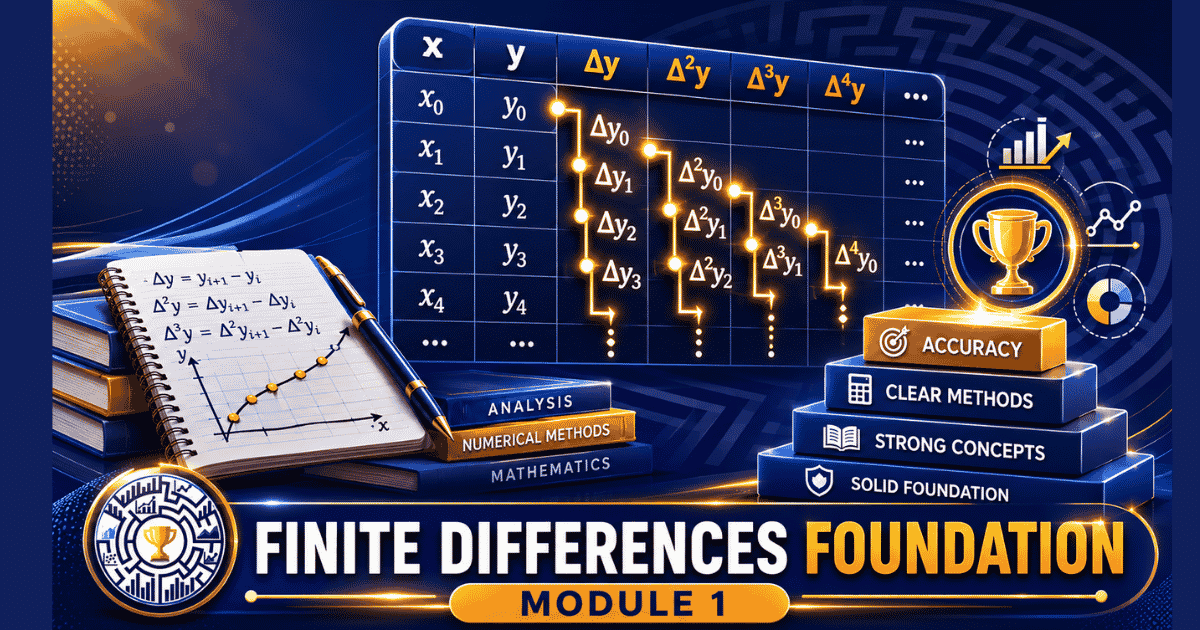
Welcome to Module 1, the starting point of your UPSC ISS Numerical Analysis preparation. If Numerical Analysis is a building, this module is the foundation. Every concept in Modules 2 through 8 stands on the operator algebra, factorial polynomials, and difference relationships you will master here.
Most aspirants treat this module casually because the topics feel “basic”. That casual approach is exactly why they later struggle with Newton’s forward formula, divided differences, and even Runge-Kutta error analysis. The shortcuts that save you 4 minutes per question in Modules 2 to 7 are not invented there. They are derived here, in the operator identities.
This hub page indexes all 6 parts in Module 1 with brief descriptions, the recommended reading order, the free practice PDF, and answers to common questions about this module.
← Return to UPSC ISS Numerical Analysis Complete Guide
Why This Module Decides the Rest of Your Preparation
Three reasons this foundation matters more than aspirants realize.
Reason 1: Operator algebra replaces 70% of arithmetic.
In later modules, when you face a question on Newton’s Forward Interpolation, the textbook approach asks you to build a full difference table. With operator identities, you skip the table entirely. The identity E equals 1 plus Delta, combined with the identity Delta minus Nabla equals Delta times Nabla, lets you compute any forward or backward difference in a single mental step.
Reason 2: Factorial polynomials simplify integration and differentiation.
In Module 5, when you compute numerical integration of a polynomial expressed in factorial form, the integration becomes a one-line affair. The conversion technique you learn in Part 4 of this module is the key.
Reason 3: Differences of zero appear in 3 to 4 questions every year.
UPSC ISS examiners love direct questions on Delta to the power n of zero, particularly when the function is a polynomial. These are guaranteed 7.5 to 10 marks every paper, and they take 15 seconds each once you know the pattern from Part 5.
What You Will Learn in This Module
By the end of these 6 parts, you will confidently handle:
The four primary operators (Delta, Nabla, E, D) and their interrelations through identity proofs.
Manipulation of operator expressions, including taking inverses and powers.
Separation of symbols technique to solve operator equations.
Converting any polynomial to factorial form and back.
The complete behavior of Delta to the power n of zero for various functions.
The conceptual foundation of interpolation, including when interpolation is valid and what its limitations are.
Total time investment: 5 to 7 days at 1 hour per day. Plus 2 days for solving the practice PDF.
The 6 Parts in Module 1
Read them in the order presented below. Each builds directly on the previous.
Part 1: The Basics of Finite Differences
The starting point. Introduces what a finite difference is, why it matters in numerical computation, and the fundamental Delta operator. Establishes the vocabulary you will use throughout the next 34 parts.
What you will master: Definition of forward difference, first principle derivation, basic Delta computation on simple functions.
Read Part 1: The Basics of Finite Differences →
Part 2: Operator Algebra and Their Manipulations
Introduces the full operator family (Delta, Nabla, E, D) and their identities. The 10 most useful identities are derived here, including E equals 1 plus Delta, and Delta times Nabla equals Delta minus Nabla.
What you will master: Operator identity derivations, manipulating operator expressions, choosing the right operator for a given problem.
Read Part 2: Operator Algebra and Their Manipulations →
Part 3: Separation of Symbols and Theorems
Teaches a powerful manipulation technique where you treat operators like algebraic symbols, separate them, and solve operator equations. Several UPSC ISS PYQs are framed directly around this technique.
What you will master: Separation of symbols method, common theorems including the inverse operator theorem, and application to typical UPSC question patterns.
Read Part 3: Separation of Symbols and Theorems →
Part 4: Factorial Representation of Polynomials
Shows how to convert any polynomial in x into a polynomial in factorial notation, and back. This single technique simplifies summation and integration problems in later modules dramatically.
What you will master: Forward and reverse conversion between standard and factorial polynomial forms, application to summation, common UPSC patterns.
Read Part 4: Factorial Representation of Polynomials →
Part 5: Differences of Zero and Delta Properties
Focused entirely on Delta to the power n of zero. Covers the recursive computation, the closed forms for common functions, and the direct UPSC formulas that have appeared in 7 out of the last 10 papers.
What you will master: Delta^n(0) computation, behavior for polynomial and exponential functions, direct PYQ patterns.
Read Part 5: Differences of Zero and Delta Properties →
Part 6: The Concept of Interpolation Explained
The transition Part. Explains what interpolation actually means, the assumptions behind it, when it is valid, and what error sources exist. This blog connects Module 1 to Module 2 and prevents the common mistake of applying interpolation in inappropriate situations.
What you will master: Conceptual understanding of interpolation, the validity conditions, the difference between interpolation and extrapolation, error sources.
Read Part 6: The Concept of Interpolation Explained →
Free Practice PDF for Module 1
Once you complete all 6 parts, the next step is solving questions until the patterns become automatic. We have prepared a dedicated practice PDF for this module.
What is inside the Module 1 PDF:
- 50 multiple choice questions covering all 6 topics
- Complete step-by-step solutions for every question
- A formula sheet of all operator identities on one page
- A collection of UPSC ISS Previous Year Questions from this module
- Common trap patterns with worked examples
How to get it:
The PDF is released free for WhatsApp Community members on Sunday, July 5, 2026. The download link is shared directly in the community group.
👉 Join the UPSC ISS WhatsApp Community to receive the PDF
Recommended Reading Order and Pace
For a serious aspirant studying 1 hour daily, here is the ideal pace for Module 1:
| Day | Activity |
|---|---|
| Day 1 | Read Part 1 and Part 2. Make notes of all 10 operator identities. |
| Day 2 | Read Part 3. Practice 5 separation of symbols problems from Saxena textbook. |
| Day 3 | Read Part 4. Practice converting 10 polynomials to factorial form. |
| Day 4 | Read Part 5. Memorize the 3 closed forms for Delta^n(0). |
| Day 5 | Read Part 6. Revise the entire operator identity sheet. |
| Day 6 to 7 | Solve the Module 1 Practice PDF (50 MCQs). |
If you find yourself struggling on any day, do not skip ahead. The foundation matters too much. Spend an extra day on the Part you found difficult.
FAQs for UPSC ISS Finite Differences
-
Can I skip Module 1 if I already studied Finite Differences in M.Sc.?
Not recommended. M.Sc. textbooks cover the theoretical depth, but the UPSC ISS shortcut patterns (especially operator identities used for time-saving) are usually not emphasized in academic courses. At minimum, skim each Part and solve the practice PDF.
-
How much of Module 1 directly appears in UPSC ISS papers?
Approximately 3 to 4 direct questions per paper come from operator manipulations, separation of symbols, and differences of zero. That is roughly 7.5 to 10 marks straight from Module 1 alone, before its indirect contribution to other modules.
-
Do I need to memorize all 10 operator identities?
Yes. They are non-negotiable. Without them, you will rebuild them from first principles in the exam hall, wasting 3 to 4 minutes per question.
-
What if I get stuck on factorial polynomial conversion?
Practice 20 conversions from Saxena’s textbook. The pattern becomes muscle memory after about 15 examples. The Module 1 PDF includes 10 dedicated practice questions on this technique.
What Comes After Module 1
Once you complete this module and the practice PDF, you are ready for Module 2. Module 2 covers Interpolation with Equal Intervals, including Newton-Gregory Forward and Backward formulas. The operator identities you just learned will be applied immediately and visibly there.
Continue to Module 2: Interpolation with Equal Intervals →
← Return to UPSC ISS Numerical Analysis Complete Guide
Join the Community for Daily Practice
Get daily one-line shortcuts from Module 1, doubt resolution, and the free practice PDF on release. Free forever, instant access.
👉 Join the UPSC ISS WhatsApp Community
Practice Under Exam Conditions
If you want structured testing while you learn Module 1, our Complete Chakravyuh Test Series includes module-wise sectional tests with detailed solutions.
👉 Explore the Complete Chakravyuh Test Series
The foundation you build in Module 1 determines how fast and accurately you solve Modules 2 to 7. Take it seriously.
Practice Improve Repeat.