
Welcome to Part 12, the final part of Module 3, updated for the UPSC ISS 2026 to 2027 cycle. In Part 11 we met the Gauss Forward and Backward formulas. They work, but their zig zag paths are clumsy for hand calculation. Mathematicians fixed this by averaging them, and the averages became the two most powerful weapons of central interpolation: Stirling’s formula and Bessel’s formula.
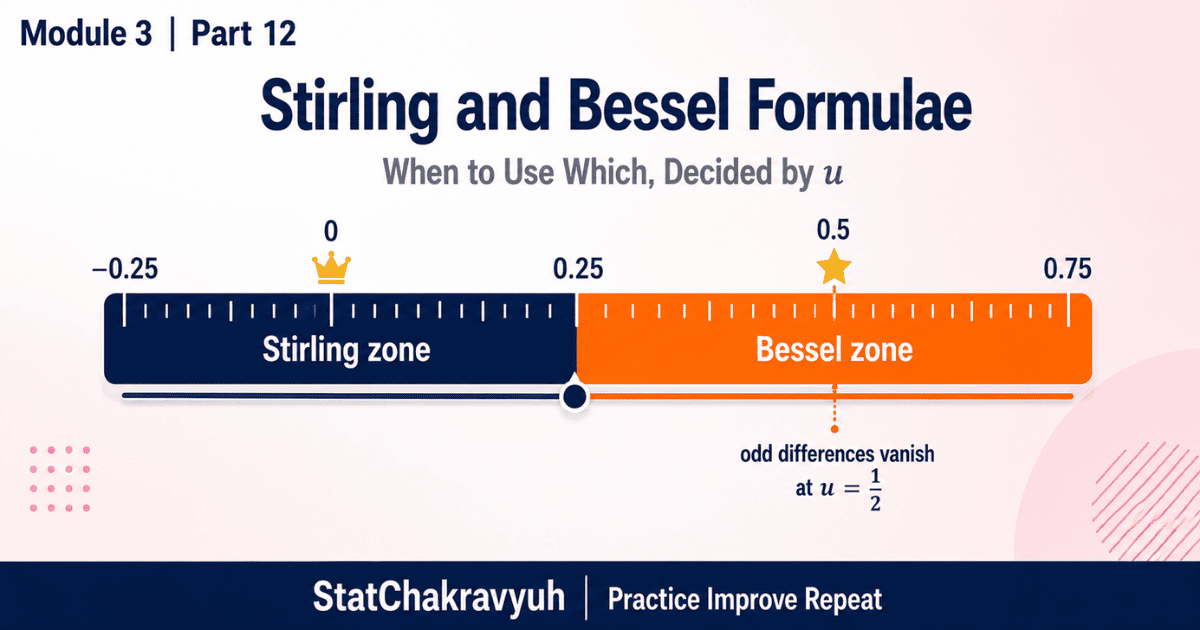
The decision rule in one breath: Stirling’s formula, the mean of the two Gauss formulas, works best for small step values, . Bessel’s formula, the mean of Gauss Forward and the origin shifted backward formula, works best for . And at exactly , every odd order term of Bessel’s formula vanishes.
Why this matters for marks: with 80 questions in 120 minutes at 2.5 marks each and about 0.83 deducted per wrong answer, picking the wrong central formula means endless fractional arithmetic with no calculator, and usually a skipped or wrongly guessed question.
This post is Part 12 of the Central Differences Guide (Module 3), inside our UPSC ISS Numerical Analysis Complete Guide. Books and strategy live at the UPSC ISS hub.
The Story of Karan and the Actuarial Table
Karan, an ISS officer in the insurance regulatory sector, analyzes a life expectancy table for ages 30, 40, 50, 60, and 70. His director asks for two estimates: the value at age 51, and the value at age 55.
Karan makes 50 the central origin with . For age 51, , very close to zero, so he uses Stirling’s formula. For age 55, , exactly midway between two arguments, so he uses Bessel’s formula, where half the terms vanish automatically. Karan finishes in 2 minutes while others wrestle with fractions for 15.
Stirling’s Interpolation Formula
Construction. Stirling’s formula is the arithmetic mean of Gauss’s Forward and Gauss’s Backward formulas. Averaging the two zig zag paths, it takes the mean of the odd differences just above and below the central line, and the even differences exactly on the central line.
The golden exam rule. Stirling gives the best results when the target lies very close to the central origin:
Bessel’s Interpolation Formula
Construction. Bessel’s formula is also a mean of the Gauss pair, but with a twist: the origin of the backward formula is first shifted to the next point. The result uses odd differences below the central line and the means of even differences on and below the line.
The golden exam rule. Bessel gives the best results when the target lies near the middle of an interval:
StatChakravyuh Pro Tips
- The half value magic. Every odd order term in Bessel’s formula carries the factor . So at , all odd order differences vanish instantly, cutting the calculation roughly in half. This special case is called the formula for interpolating to halves, and UPSC loves it.
- The origin shift discipline. If your computed comes out as 0.8, do not force Bessel. Shift the origin to the next tabulated value so the new becomes minus 0.2, then use Stirling. Always keep as small as possible.
- The one line identification. If a question asks which formula has zero coefficients for all odd order differences at , the answer is Bessel, no calculation needed.
- The family tree. Gauss Forward and Backward are the parents. Their plain mean is Stirling. Their mean with a shifted origin is Bessel. Knowing the tree converts several theory questions into instant marks.
Solved PYQ Masterclass
PYQ pattern (strategy selection type): Census data is given for 1980, 1990, 2000, 2010, and 2020. Case A asks for the population of 1992. Case B asks for the population of 1995. Which formulas apply?
Mental solution.
Case A, year 1992. With origin 2000 and , , uncomfortably large. Shift the origin to 1990: new . Since lies inside , use Stirling’s formula.
Case B, year 1995. Keep the origin at 1990: . This sits inside and is the exact half value, so use Bessel’s formula, where the odd difference terms vanish and the arithmetic collapses.
Two strategy decisions, zero calculations, and both questions are worth the same 2.5 marks as the longest computation on the paper.
Common Traps to Avoid
Trap 1: Using Bessel for a large like 0.8 instead of shifting the origin. The correct habit is shift first, then choose.
Trap 2: Swapping the two u ranges. Small near zero belongs to Stirling; near one half belongs to Bessel.
Trap 3: Forgetting that both formulas, like every central formula, demand strictly equal intervals.
Frequently Asked Questions
-
What is the main difference between Stirling’s and Bessel’s formulas?
Stirling’s formula is the plain mean of Gauss Forward and Backward, averaging the odd differences. Bessel’s formula is the mean of Gauss Forward and the origin shifted backward formula, averaging the even differences.
-
When should I use Stirling’s formula?
When the computed step value lies very close to the origin, specifically in the range .
-
When should I use Bessel’s formula?
When the target lies near the middle of an interval, specifically when .
-
What is the formula for interpolating to halves?
It is Bessel’s formula at , where the coefficients of all odd order differences become exactly zero, making the calculation dramatically shorter.
-
Can Stirling’s formula handle unequal intervals?
No. Stirling, Bessel, and the entire Gauss family require strictly equal intervals. Unequal intervals belong to Module 4 with divided differences and Lagrange’s formula.
Take the Next Step with StatChakravyuh
Join the Free UPSC ISS WhatsApp Community. The Module 3 Practice PDF with 40 MCQs, a formula sheet, and the PYQ pattern collection releases in the community this Sunday. 👉 Join the WhatsApp Community now
Enroll in the Free UPSC ISS Course. Structured lessons and practice sets on the Practice Improve Repeat system, at zero cost. 👉 Enroll in the Free Course
Module 3 is complete. Next stop, Module 4: we finally break the equal interval rule and handle messy real world data with Divided Differences and Lagrange’s formula.
[…] cycle. In Modules 1 to 3 we lived in a perfect world where every formula, from Newton Gregory to Stirling and Bessel, demanded equally spaced arguments. Real data is rarely that polite. When the intervals turn […]