
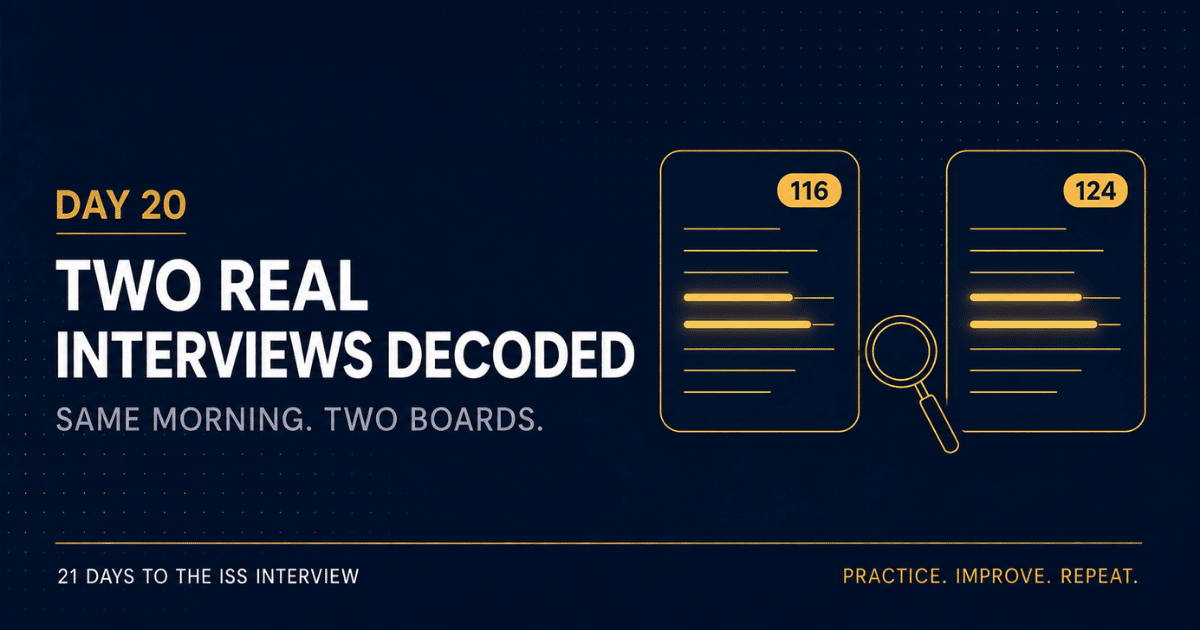
Two candidates faced the Indian Statistical Service board on the same December morning in 2024. One scored 116 out of 200 and finished first in the country. The other scored 124 and finished third. Read together, in the accounts they shared publicly, the two interviews teach more about what boards test than any list of tips can.
Day 20 walks through both, in our own words rather than theirs, and ends with the method to decode your own recordings the same way. Names are left out on purpose; the pattern is the lesson, not the person.
Interview A: the topper, 116, about twenty five minutes
The chairperson opened warmly, noting the candidate’s unusual interests and going straight into the listed hobby, an interest in linguistics. Three questions followed in exactly the three level shape this series described on Day 6: definitions from inside the field, then whether the subject should be taught in schools, then an opinion on a popular claim linking an ancient language to programming. A fourth question turned to the candidate’s school’s founding tradition and whether its teachings still serve the country. Four questions, all from the form, none technical, and the candidate’s depth on a hobby that was genuinely practised carried them.
Then the members took the specialisation named on the form, advanced probability, and did not go gently: why large samples help inference, the modes of convergence and their relationships, a comparison of pointwise and almost sure convergence and why one is rarely used, and finally a lovely applied question, whether the value of pi could be estimated by statistical simulation, with a follow up on efficiency. This is what a claimed specialisation earns you: a real examination, which the candidate passed because the claim was true.
Finally, official statistics. Had the candidate visited the MoSPI website and read a recent publication? What is the current value of a named economic indicator, and how is it calculated? And then a run of official statistics questions the candidate, by their own account, could not answer at the time and could not even recall afterwards.
The decode: three territories in twenty five minutes, deep where the form made a claim, honest where knowledge ran out, and a first rank at the end of it. The official statistics gap is also the clearest argument this series has made for Week 2.
Interview B: the third rank, 124, about twenty minutes
The chairperson opened with the hobby, jogging: the difference between jogging and running, the distance covered, how to measure pulse without any device, and a question on how weight is calculated. Then, without warning, technology: the difference between machine learning and artificial intelligence, whether the candidate feared for their job, and a discussion of a brain chip venture in the news.
A member took the wider frame: the impact of women’s education on human development and the sustainable development goals, then the limitations of statistics and how to reduce them. Another went straight into the form and the syllabus: an award listed there and a data mining project, then a test of hypothesis question, the Neyman Pearson lemma and when it applies, probability proportional to size sampling and how it differs from simple random sampling, snowball sampling, the methods of national income estimation and when each is used, and the current size of India’s economy in dollars, where the candidate gave a figure and was immediately asked for the same in purchasing power terms. The last member asked for two tourist places in the candidate’s district, followed a named site into its mythology, and closed on index numbers and what one needs to build them.
The decode: this board covered all five zones of this series in twenty minutes, and the 124 came from breadth, from readiness with numbers, and from a district story told with a real detail. Note the purchasing power follow up: every number you carry into the room has a neighbour, and the board will ask for the neighbour to check whether the number was memorised or understood.
What the two interviews say together
Same morning, two boards, two shapes: one board went deep in three places, the other went wide across everything. So prepare zones, not boards, because you will not know which you get. The higher interview score went to the lower final rank, which is the arithmetic of this examination in one line: written marks and interview marks add, and neither alone decides. And both candidates hit questions they could not answer, and both were recommended near the top of the list, which is Day 16 proven twice on one page.
Decode your own recording the same way
Take your latest mock from Day 19 and mark four things on a sheet: which zone each question came from, how many levels deep the questioner went on each topic, every I do not know, and every moment you reached beyond what you knew. Then look at the sheet the way you just looked at these two interviews. The pattern you find is your revision plan for the days that remain.
Tomorrow, Day 21, the final post: the last forty eight hours before your interview, and the close of this series.
For the free ISS Interview Starter Kit and the DAF Question Mapper, send the word INTERVIEW on WhatsApp to +91 842591 5355.
Frequently Asked Questions
-
What kind of questions are asked in the ISS interview?
From the public record of recommended candidates: your form and hobbies, your named specialisation examined in depth, core statistics and sampling, official statistics including current indicator values, opinion and situational questions, and your home district.
-
How much does the ISS interview score matter?
A great deal, but it adds to the written score rather than replacing it. In the 2024 cycle a candidate scoring 124 in the interview finished third while a candidate scoring 116 finished first.
-
Do toppers answer every question in the ISS interview?
No. Both interviews decoded here included questions the candidates could not answer, and both candidates were recommended near the top of the list.
Practice. Improve. Repeat.