
Welcome back, future Indian Statistical Service (ISS) officers!
You have successfully reached the grand finale of Module 3: Agricultural Statistics. In our previous session (Part 9), we walked through the fascinating fields of India, learning how the government estimates the area sown and the total crop yield using traditional Patwaris (TRS/EARAS) and scientific Crop Cutting Experiments (GCES).
But crop production tells us only half of the rural story. Knowing how much wheat or rice is produced is important, but policymakers also desperately need to know who is producing it. Are our farms getting smaller? Are farmers using tractors or traditional ploughs? And what about the millions of cows, buffaloes, sheep, and poultry that form the backbone of India’s dairy and rural economy?
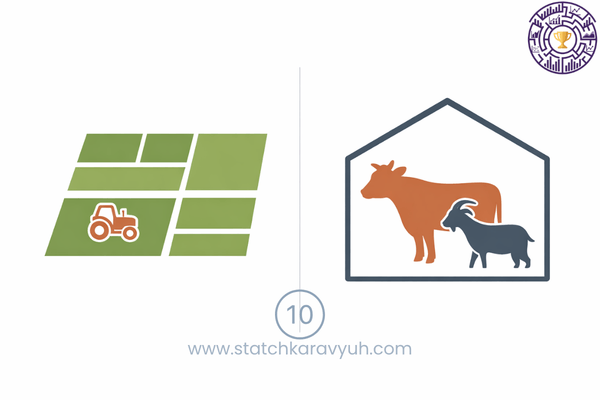
To answer these critical questions, the Indian Statistical System conducts two of the most massive, rigorous, and logistically complex quinquennial (five-yearly) exercises in the world: The Agriculture Census and The Livestock Census.
For your UPSC ISS exams and interviews, the conceptual differences between these two censuses, especially the reasons why they cannot be conducted together, are absolute high-yield topics. Let us decode the census of land and animals!
When we hear the word “Census,” we usually think of the Population Census conducted by the Ministry of Home Affairs. However, the Agriculture Census is an entirely different beast, conducted quinquennially (once every five years) by the Department of Agriculture and Farmers Welfare.
Its primary objective is to collect essential quantitative data on the structure, distribution, and operation of agricultural holdings across India.
The Golden Concept: “Operational Holding”
If you sit for the ISS interview, the panel will almost certainly ask you to define the basic unit of the Agriculture Census. You must clearly state that the basic unit of enumeration is an “Operational Holding”, not an ownership holding.
What is the difference?
- Ownership Holding: This refers to the land legally owned by a person, regardless of who is actually farming it.
- Operational Holding: This is defined as “all land which is used wholly or partly for agricultural production and is operated as one technical unit by one person alone or with others, without regard to title, legal form, size, or location”.
For example, if a wealthy landlord owns 10 hectares of land but leases it out to three different tenant farmers who cultivate it independently, the Agriculture Census will record this as three operational holdings, not one ownership holding. The government cares about who is operating the land, because they are the ones who need seeds, fertilizers, and credit!
The Three Phases of the Agriculture Census
To manage this mammoth task, the Agriculture Census is executed in three distinct phases:
- Phase 1 (Complete Enumeration): This phase involves a complete count of all operational holdings. Data is collected on the primary characteristics of the holdings, such as the gender and social group (SC/ST) of the holder, and the size of the holding (Marginal, Small, Semi-Medium, Medium, Large).
- Phase 2 (The 20% Sample): Once the basic list is ready, the statisticians dig deeper. In this phase, data is collected on a sample basis from 20 percent of the villages. Detailed characteristics of the operational holdings are recorded, such as tenancy status, exact land use, irrigation facilities, and cropping patterns.
- Phase 3 (The Input Survey): Also known as the Input Survey, this is conducted as a follow-up survey to the main Agriculture Census. Data is collected from a 7 percent sample of villages. It tracks the pattern of input use by farmers, including the use of chemical fertilizers, pesticides, agricultural credit, inventory of agricultural machinery (like tractors and pumps), and multiple cropping practices.
The Livestock Census: Counting the Animals
While crops provide seasonal income, livestock acts as a continuous source of income and a financial safety net for millions of Indian farmers. To track this, the Department of Animal Husbandry and Dairying (under the Ministry of Fisheries, Animal Husbandry and Dairying) conducts the Livestock Census.
Historical Legacy: This is one of the oldest continuing statistical exercises in India, having started way back in 1919-20. So far, 20 such censuses have been successfully completed (the 20th was conducted between October 2018 to September 2019), and the 21st is currently in progress.
What does it count? It is a complete, 100% headcount of all domesticated animals and poultry at a pre-defined reference point of time. It is the only official source of statistics on livestock numbers, their age and sex structure, and their functional classification (e.g., distinguishing between milch cows, dry cows, and draught animals).
The Modern Digital Shift: Just like the Crop Cutting Experiments we discussed in Part 9, the Livestock Census has undergone a massive digital transformation. The 20th Livestock Census was a landmark exercise because, for the first time, field data was collected entirely using tablet computers and mobile applications, eliminating paper schedules and allowing for real-time data validation and geo-tagging.
The Ultimate Interview Question: Why Not Conduct Them Together?
Here is a classic, advanced-level question for ISS aspirants: “Both the Agriculture Census and the Livestock Census are conducted quinquennially (every 5 years), and both deal with the rural agrarian economy. Why does the government waste resources by conducting them separately? Why can’t they be conducted simultaneously?”
You must provide these four sharp, highly technical reasons:
- Difference in the Basic Unit of Enumeration:
- In the Agriculture Census, the basic unit is the “Operational Holding” (the piece of land).
- In the Livestock Census, the basic unit is the “Household” (the family, regardless of whether they operate land or not, because landless labourers also own cows and goats).
- Difference in the Reference Period:
- The Agriculture Census uses a reference period of one full Agricultural Year (July to June) because crop seasons span across months.
- The Livestock Census uses a specific reference date (a single day) for the count of numbers, much like the human population census.
- Difference in Coverage:
- The Agriculture Census is a hybrid program consisting of a census (Phase 1) followed by sample surveys (Phases 2 and 3).
- The Livestock Census requires 100% complete enumeration of all households in the country, covering both rural and urban areas.
- Difference in Field Agencies:
- The Agriculture Census relies heavily on the state revenue department’s Patwari agency (who maintain the land records).
- The Livestock Census is executed by the field staff and veterinary officers of the State Department of Animal Husbandry, who have the technical expertise to identify the breed, age, and health status of the animals.
(Pro-Tip for Interviews: While they are currently separate, you can mention that theoretically, they could be synchronized if the Agriculture Census fully adopts a household approach across all states, limits the livestock count to a 20% sample, and utilizes a single highly-trained reporting agency. However, administratively, keeping them separate ensures higher data accuracy for both!)
Conclusion & What Lies Ahead?
By integrating the data from the Agriculture Census (which tells us about farm sizes and machinery) and the Livestock Census (which maps our animal wealth), the government formulates massive rural policies, from deciding tractor subsidies to launching nationwide animal vaccination drives.
Congratulations! You have now officially mastered Module 3: Agricultural Statistics. You know how crops are estimated, how farms are measured, and how animals are counted.
But what about the humans? What about the 1.4 billion people living, working, and studying across this massive subcontinent?
Take a deep breath, because in our next phase, we are entering the most vital and relatable module of our syllabus, Module 4: Social & Demographic Statistics (The People Part).
We will kick things off with Part 11: The Grand Count – Population Census, where we will explore the Office of the Registrar General of India (ORGI), the massive decennial human census, and the complex tables (like Migration and Fertility tables) that shape our democracy!
Keep revising your sampling designs and census definitions, and we will see you in Part 11!
This article is part of our complete guide to Official Statistics for UPSC ISS. Bookmark the main guide for the full roadmap.