Part 24: Linear Difference Equations for UPSC ISS: CF and PI Made Simple
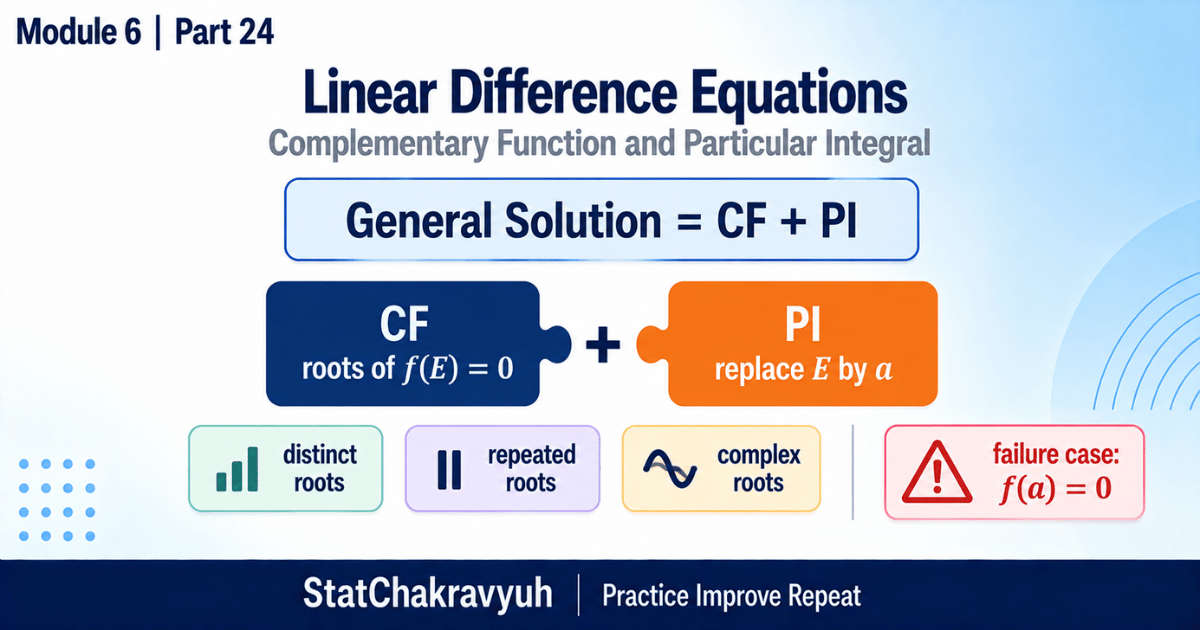
Linear difference equations solved by complementary function plus particular integral for UPSC ISS Part 24

Welcome back to Part 24 of Module 6, updated for the UPSC ISS 2026 to 2027 cycle. Part 23 handled systems where today depends only on yesterday. Real data often looks back two or three steps and absorbs an external growth force on top. The tool for those systems is the Linear Difference Equation with … Read more
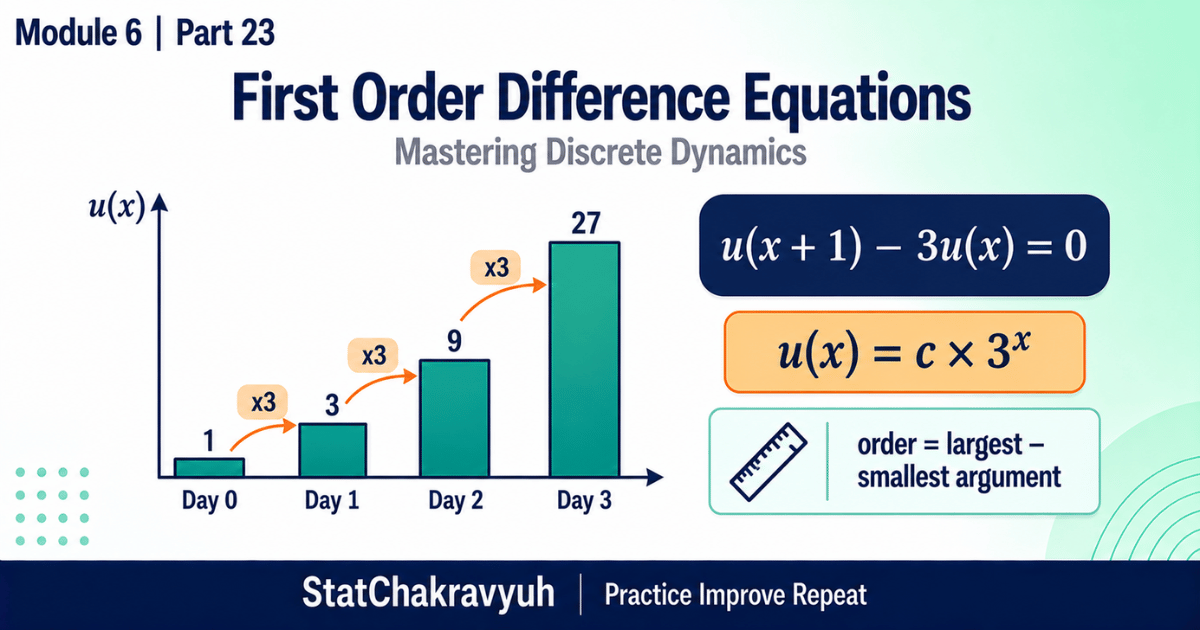
Part 23: First Order Difference Equations for UPSC ISS: Order Rule and Direct Solutions

First order difference equation order rule and solution c times a power x for UPSC ISS Part 23

Welcome to Part 23 and the opening of Module 6, updated for the UPSC ISS 2026 to 2027 cycle. With the heavy calculus of Module 5 behind you, we shift gears into the quick win territory of the syllabus: Difference Equations. Differential equations describe continuous change through dydx\dfrac{dy}{dx}​; difference equations describe discrete change, data that … Read more

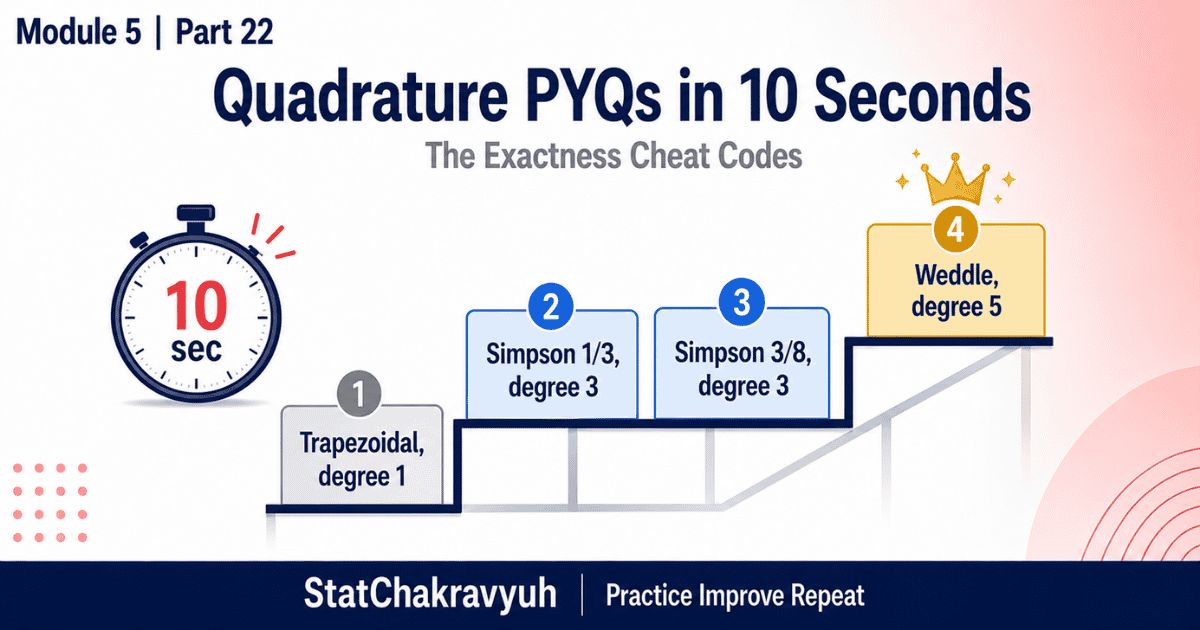
Part 22: Quadrature PYQs in 10 Seconds: The Exactness Cheat Codes for UPSC ISS

Quadrature Exactness Cheat Codes for UPSC ISS

Welcome to Part 22, the finale of Module 5, updated for the UPSC ISS 2026 to 2027 cycle. Across the last four parts we built the entire integration toolkit, from straight lines to parabolas to Weddle’s precision. Knowing the formulas is half the battle. The other half: knowing when you never need them. A quadrature … Read more

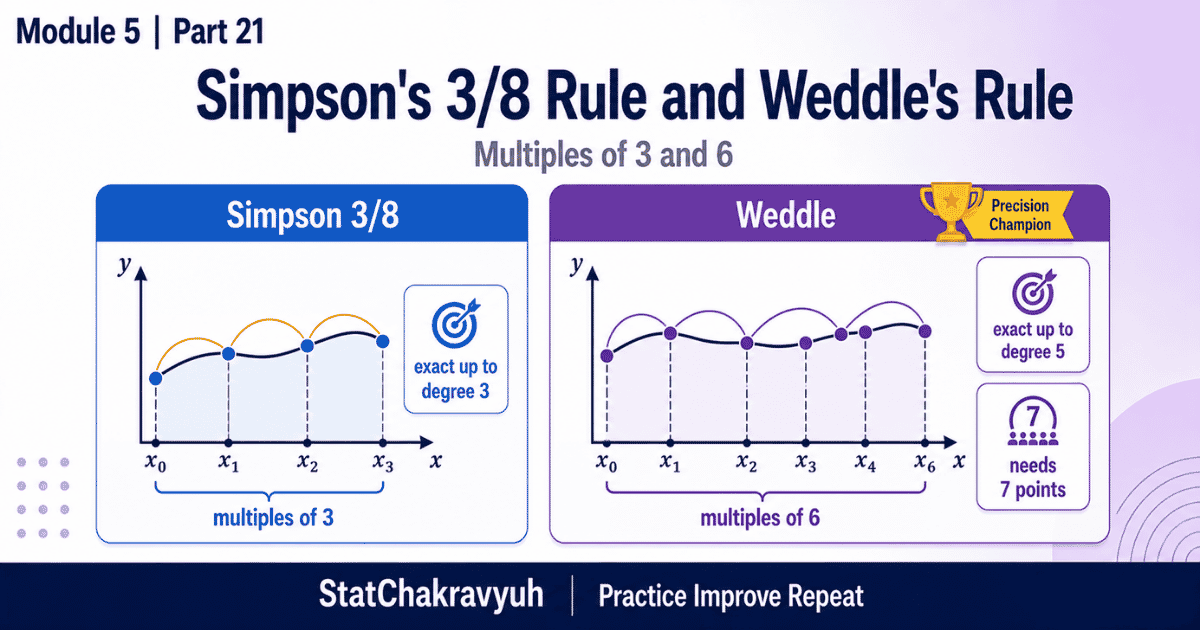
Part 21: Simpson’s 3/8 Rule and Weddle’s Rule for UPSC ISS: Multiples of 3 and 6

Simpson 38 Rule and Weddle Rule for UPSC ISS

Welcome back to Part 21 of Module 5, updated for the UPSC ISS 2026 to 2027 cycle. Simpson’s 1/3 Rule upgraded straight lines to parabolas, but it locked us into an even number of intervals. What if the data arrives in groups of 3 or 6? Two formulas answer: Simpson’s 3/8 Rule and the precision … Read more

Part 20: Simpson’s 1/3 Rule for UPSC ISS: The Degree 3 Exactness Trick

Welcome back to Part 20 of Module 5, the single most important part of this module, updated for the UPSC ISS 2026 to 2027 cycle. The Trapezoidal Rule draws straight lines and pays for it with an O(h2)O(h^2) error. The upgrade: replace straight lines with parabolas. That upgrade is Simpson’s 1/3 Rule, and hidden inside … Read more

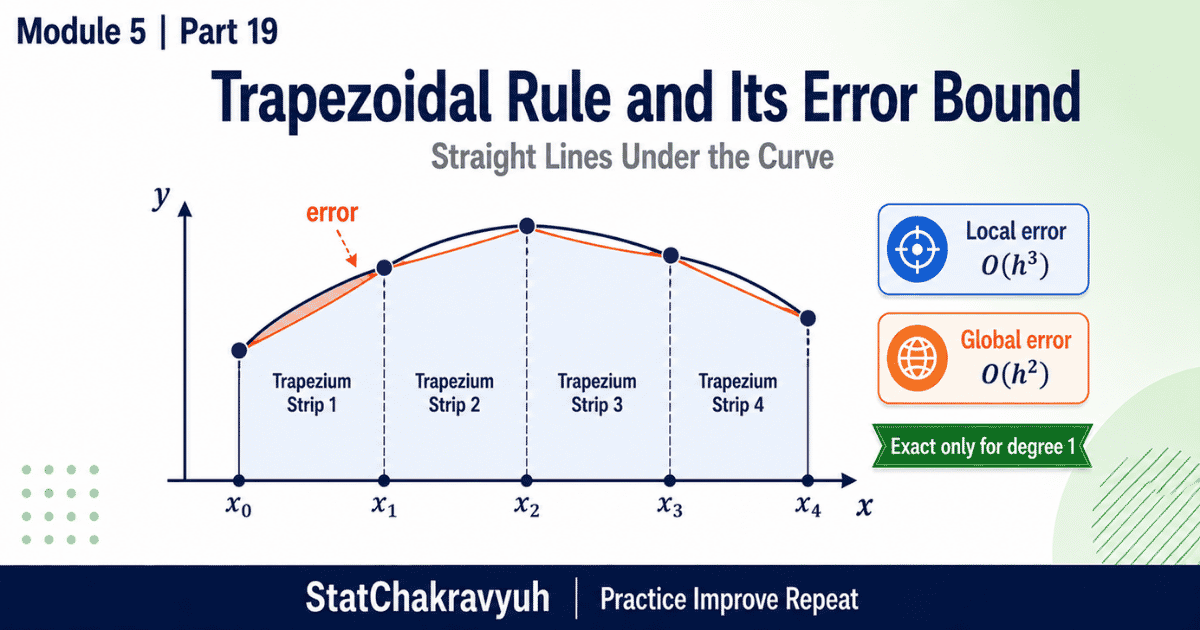
Part 19: Trapezoidal Rule for UPSC ISS: Formula, Error Bound, and the Degree 1 Exactness

Trapezoidal Rule for UPSC ISS

Welcome back to Part 19 of Module 5, updated for the UPSC ISS 2026 to 2027 cycle. In Part 18 we met the mother of all integration rules and watched n=1n = 1 give birth to its first child. Today we study that child in full depth: the Trapezoidal Rule, and more importantly, the concept … Read more

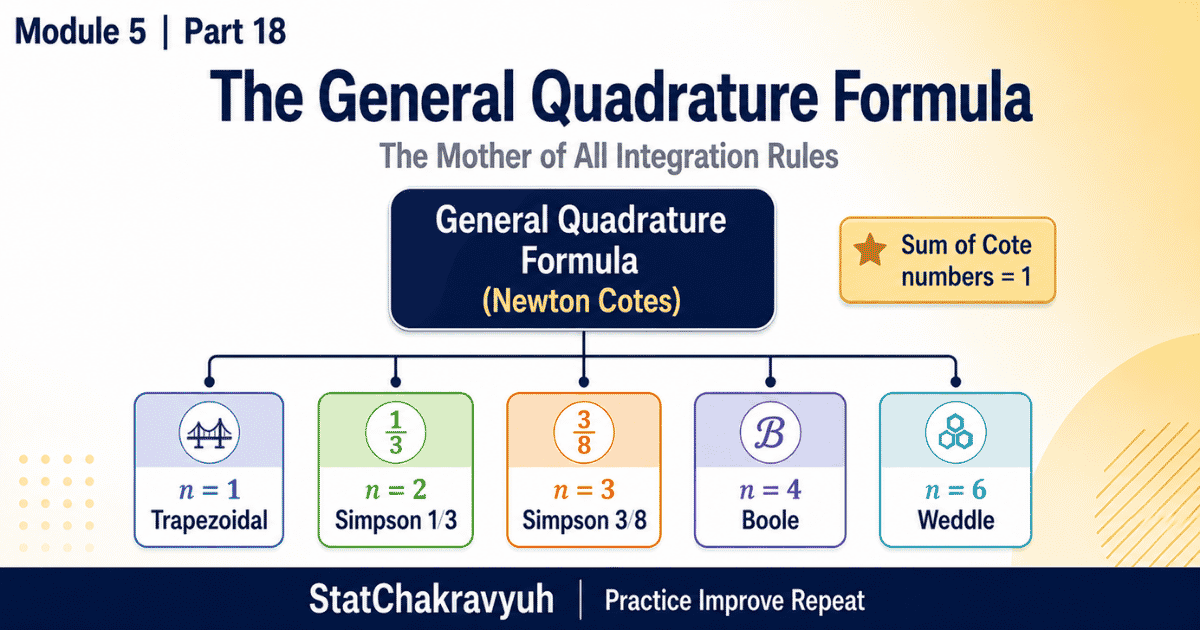
Part 18: General Quadrature Formula for UPSC ISS: The Mother of All Integration Rules

General Quadrature Formula for UPSC ISS

Welcome back to Part 18 of Module 5, updated for the UPSC ISS 2026 to 2027 cycle. Part 17 taught us rates of change from tables. Today we learn accumulated areas from tables: Numerical Integration, and it all begins with one master equation, the General Quadrature Formula, also called the Newton Cotes Quadrature Formula. Numerical … Read more

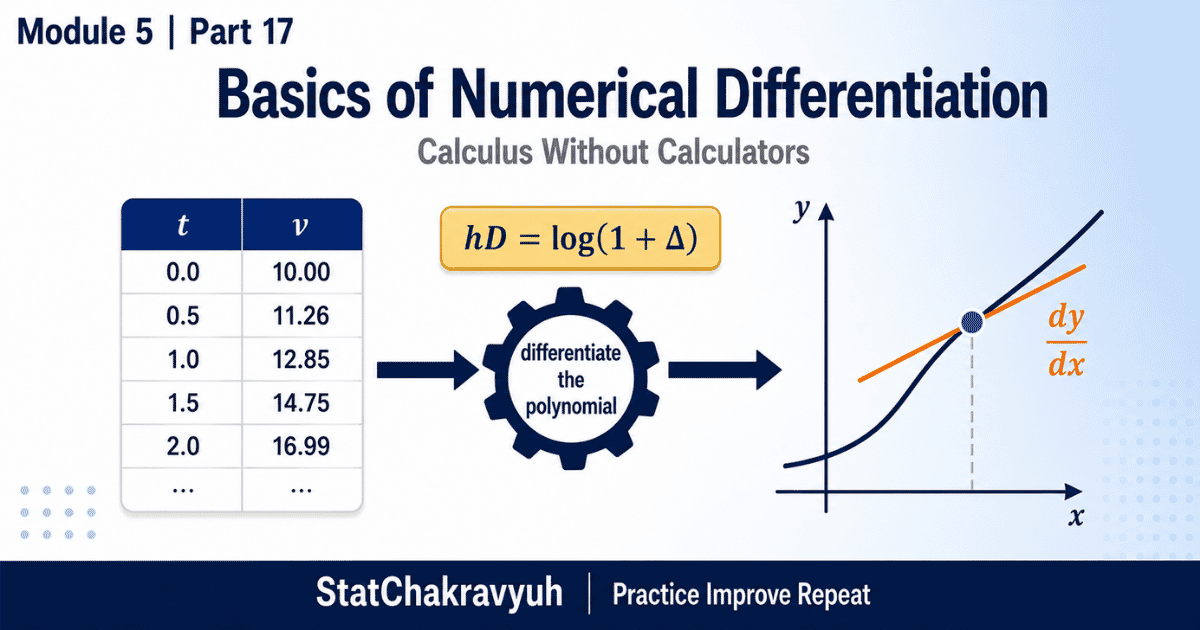
Part 17: Numerical Differentiation for UPSC ISS: Calculus Without Calculators

Numerical Differentiation for UPSC ISS

Welcome to Part 17 and the opening of Module 5, updated for the UPSC ISS 2026 to 2027 cycle. With Modules 1 to 4 behind you, interpolation holds no fear. Now we enter the highest weightage block of the Numerical Analysis unit: calculus without calculators, beginning with Numerical Differentiation. Numerical differentiation evaluates the derivative of … Read more

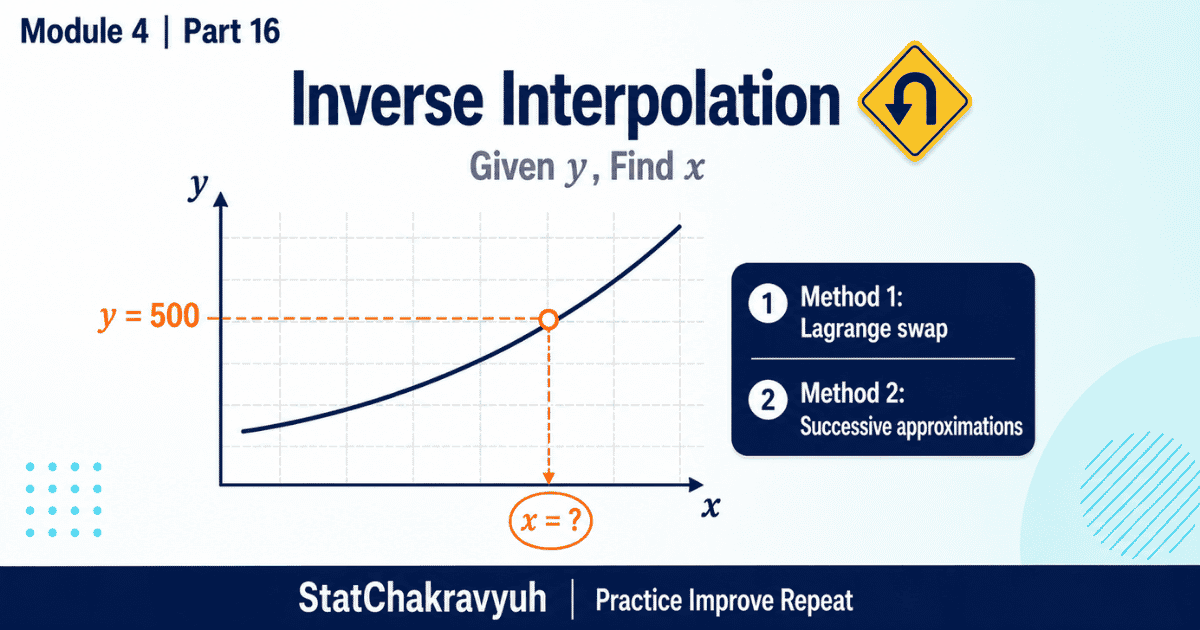
Part 16: Inverse Interpolation for UPSC ISS: Lagrange’s Swap and the Iterative Method

Inverse Interpolation for UPSC ISS

Welcome to Part 16, the final part of Module 4, updated for the UPSC ISS 2026 to 2027 cycle. So far the problem was always the same: given the arguments xx and their entries yy, predict a missing yy. That is direct interpolation. Today the examiner flips the script: given a value of yy, find … Read more

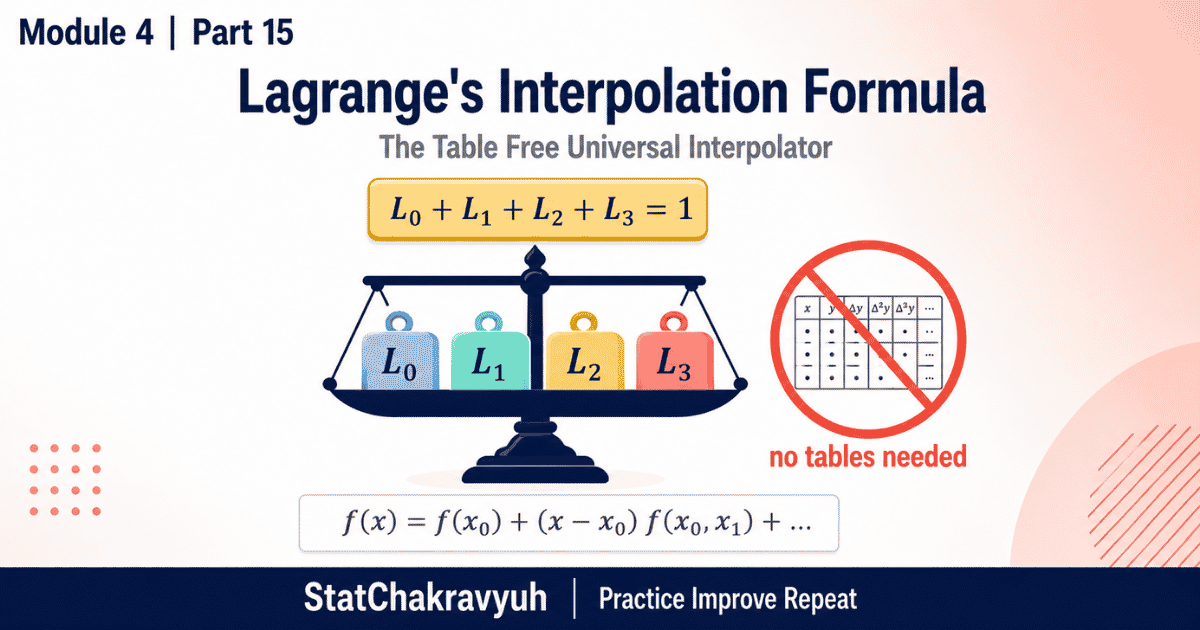
Part 15: Lagrange Interpolation Formula for UPSC ISS: The Table Free Interpolator

Lagrange Interpolation Formula for UPSC ISS

Welcome back to Part 15 of Module 4, updated for the UPSC ISS 2026 to 2027 cycle. In Part 14 we met Newton’s Divided Difference formula. Powerful, but it still needs a table. Today we go table free with the formula the syllabus names as “Lagrange’s formula for unequal intervals”: Lagrange’s Interpolation Formula, the examiner’s … Read more