
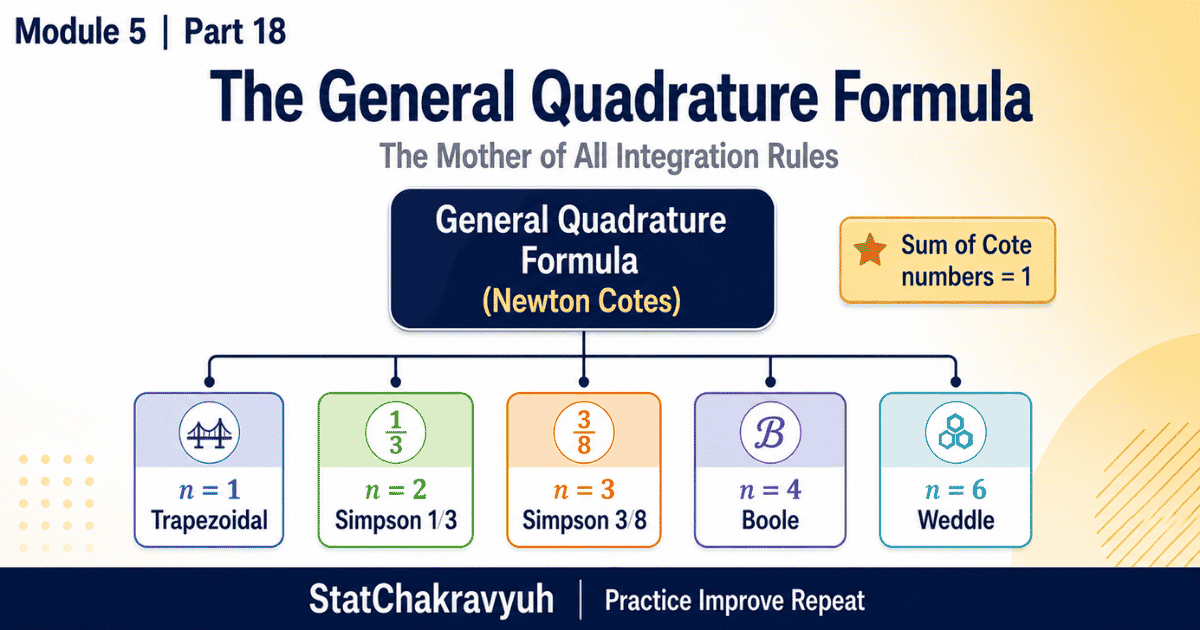
Welcome back to Part 18 of Module 5, updated for the UPSC ISS 2026 to 2027 cycle. Part 17 taught us rates of change from tables. Today we learn accumulated areas from tables: Numerical Integration, and it all begins with one master equation, the General Quadrature Formula, also called the Newton Cotes Quadrature Formula.
Numerical quadrature evaluates a definite integral from discrete values of the integrand. Integrating the Newton Gregory Forward formula over n equal parts gives the mother formula, and substituting produces the Trapezoidal Rule, Simpson’s 1/3, Simpson’s 3/8, Boole’s Rule, and Weddle’s Rule respectively.
Exam context: 80 questions, 200 marks, 2 hours, 2.5 marks per question, about 0.83 deducted per wrong answer, and integration questions form the heart of the Numerical Analysis block. Several are pure theory on this very page.
This post is Part 18 of the Numerical Calculus Guide (Module 5), inside our UPSC ISS Numerical Analysis Complete Guide. Roadmap at the UPSC ISS hub.
The Story of Karthik and the Highway Land Survey
Karthik, an ISS officer in the Ministry of Road Transport and Highways, must report the exact area of an irregular tract of land bordered by a curving river, so farmers can be compensated fairly for the new expressway.
A textbook problem would hand him the river’s equation to integrate. The real river obeys no equation. His surveyors instead give him the land’s width measured at equal 10 metre intervals. Karthik fits a polynomial through the discrete widths using Newton’s Forward formula, integrates the polynomial, and reports the area within minutes. That is numerical quadrature at work.
Quadrature and Cubature
Numerical quadrature is the evaluation of a definite integral of a function of a single variable from discrete values, geometrically an area. When the object is a double integral in two variables, the process is called mechanical cubature, geometrically a volume. UPSC has framed direct definitional questions on the distinction.
The Mother Formula
Divide the range into equal parts of width , giving points . Approximating by Newton’s Forward formula and integrating from to :
The family tree. Every famous rule is a child of this equation:
gives the Trapezoidal Rule. gives Simpson’s 1/3 Rule. gives Simpson’s 3/8 Rule. gives Boole’s Rule. gives Weddle’s Rule.
Cote’s Numbers: The Hidden Goldmine
The Newton Cotes formula can also be written by weighting the entries directly: , where the weights are the Cote numbers, depending only on and and never on the function.
Two must memorize properties.
- Symmetry: . The coefficients mirror from both ends, so you only ever compute half of them.
- Unit sum: for every , without exception.
StatChakravyuh Pro Tips
- The one second Cote hack. If a question asks for the sum of Cote coefficients for an 8th degree Newton Cotes formula, or any degree at all, the answer is 1. Tick and move on.
- The root formula fact. Asked which interpolation formula the general quadrature is derived from, the answer is strictly the Newton Gregory Forward formula.
- Equidistant only. The Newton Cotes family assumes strictly equal intervals. Unequal spacing requires integrating Lagrange’s polynomial instead.
Solved Derivation Masterclass
Question: Derive by putting in the General Quadrature Formula.
Solution.
- With , the fitted curve through 2 points is a straight line, so second and higher differences vanish.
- Substitute: .
- Use : .
Result: the exact Trapezoidal Rule, produced by pure algebra with no calculus. Part 19 explores this child in full depth.
Common Traps to Avoid
Trap 1: Attaching Weddle’s Rule to . Weddle comes from ; the number 5 is the planted distractor.
Trap 2: Believing Cote numbers depend on the function being integrated. They depend only on and .
Trap 3: Applying Newton Cotes to unequally spaced data. The derivation itself assumes a constant .
Frequently Asked Questions
-
What is the difference between quadrature and cubature?
Quadrature is numerical integration of a single variable function, giving an area. Mechanical cubature evaluates a double integral in two variables, giving a volume.
-
How is the General Quadrature Formula derived?
By integrating the Newton Gregory Forward Interpolation Formula over a range divided into equal sub intervals.
-
Which rules come from the Newton Cotes formula?
Substituting gives the Trapezoidal Rule, Simpson’s 1/3 Rule, Simpson’s 3/8 Rule, Boole’s Rule, and Weddle’s Rule respectively.
-
What are Cote’s numbers?
The constant weights multiplying the entries in the Newton Cotes formula. They depend only on and , never on the function being integrated.
-
What are the exam critical properties of Cote’s numbers?
Symmetry, , and the unit sum, for every .
Take the Next Step with StatChakravyuh
Join the Free UPSC ISS WhatsApp Community. All parts of this series plus the Module 5 Practice PDF with 60 MCQs arrive there first. 👉 Join the WhatsApp Community now
Enroll in the Free UPSC ISS Course. Structured lessons and practice sets on the Practice Improve Repeat system, completely free. 👉 Enroll in the Free Course
Coming up in Part 19: the first child of the family, the Trapezoidal Rule, and the local versus global error distinction that UPSC loves to test.