
Welcome to Part 22, the finale of Module 5, updated for the UPSC ISS 2026 to 2027 cycle. Across the last four parts we built the entire integration toolkit, from straight lines to parabolas to Weddle’s precision. Knowing the formulas is half the battle. The other half: knowing when you never need them.
A quadrature rule is exact for a polynomial when its truncation error vanishes, making the numerical answer identical to the analytical integral. With calculators banned, a manual 10 interval Simpson computation costs 10 minutes and invites a fractional slip worth minus 0.83 marks. An analysis of past papers shows the examiners repeatedly design questions to reward the exactness properties instead. Today is a rapid fire session on exactly those questions.
This post is Part 22 of the Numerical Calculus Guide (Module 5), inside our UPSC ISS Numerical Analysis Complete Guide. Roadmap at the UPSC ISS hub.
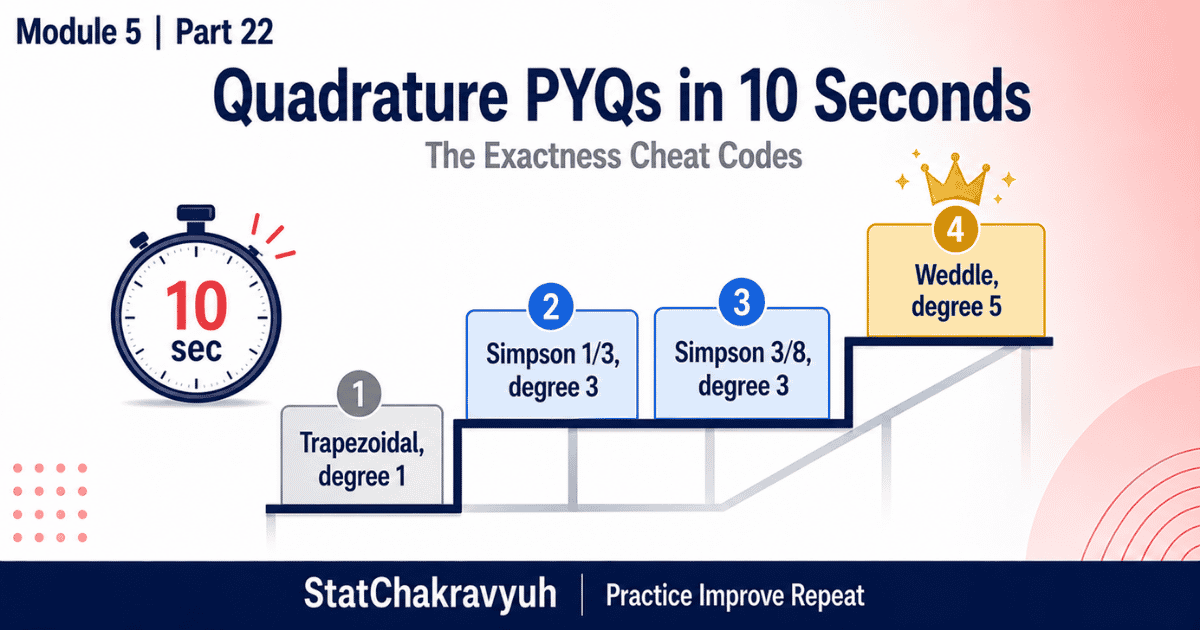
The Exactness Cheat Code Summary
Memorize this table permanently. It is the single highest value block of Module 5.
Trapezoidal Rule: exact only for linear polynomials, degree 1. Simpson’s 1/3 Rule: exact for quadratic and cubic polynomials, up to degree 3. Simpson’s 3/8 Rule: exact for quadratic and cubic polynomials, up to degree 3. Weddle’s Rule: exact for polynomials of degree 5 or lower, so a 4th degree polynomial is handled perfectly.
The universal decision procedure: read the degree of the integrand, compare it with the rule’s exactness ceiling. Degree within the ceiling means zero error and the numerical answer equals the plain analytical integral; degree above the ceiling, or a non polynomial integrand, means the formula must actually be used.
Case Study 1: The Error Difference Trap
The pattern: let a be the exact value , and let be the value computed by Simpson’s 1/3 rule with 10 equal subdivisions. Find .
The trap: computing all 11 ordinates and grinding the composite formula, several minutes of fraction work under pressure.
The 5 second logic: the integrand has degree 2, inside Simpson’s degree 3 ceiling, so equals exactly and . Marks secured without touching a rough sheet.
Case Study 2: The Direct Integration Bypass
PYQ (UPSC ISS 2020 cycle, as recorded in our PYQ archive): is evaluated by Simpson’s one third rule with . The value obtained is:
(a) 23 (b) 24.56 (c) 25.33 (d) 26
The 10 second logic: the invites a fractional table at . Ignore it. The integrand has degree 2, inside the ceiling, so the Simpson value equals the analytical value: .
Final Answer: (d) 26.
Case Study 3: The Statement Based Theory Trap
PYQ (UPSC ISS 2025 cycle, as recorded in our PYQ archive): Consider the statements:
I. The Trapezoidal rule gives an exact result for a linear polynomial. II. The Trapezoidal rule gives an exact result for a quadratic polynomial. III. Simpson’s one third rule gives an exact result for a cubic polynomial. IV. Simpson’s one third rule gives an exact result for a quadratic polynomial.
Which statements are correct?
The logic: the Trapezoidal rule draws straight lines, so its error vanishes only for degree 1; statement I is true and statement II is false. Simpson’s 1/3 carries the degree 3 exactness through its fourth derivative error term, so statements III and IV are both true.
Final Answer: I, III, and IV.
When the Trick Does Not Apply
Honesty matters as much as speed. The exactness bypass fails in two situations: the integrand is not a polynomial at all, such as , , or ; or the polynomial degree exceeds the rule’s ceiling, such as under Simpson’s 1/3. In those cases the formula must genuinely be applied, and UPSC then keeps the arithmetic gentle, typically with small integer ordinates. Recognizing which regime a question belongs to is itself the skill this part trains.
Frequently Asked Questions
-
Will I ever need the actual Simpson formula in the exam?
Yes, whenever the integrand is not a polynomial, like or , or the degree exceeds 3, like . In such questions the values are usually kept simple for manual work.
-
What is the exactness degree of Weddle’s Rule?
Weddle’s Rule is exact for polynomials of degree 5 or lower. A statement claiming exactness for a 4th degree polynomial is therefore correct.
-
How do I predict whether an integral will carry an error?
Compare the degree of the integrand with the rule’s exactness ceiling. Trapezoidal on a quadratic has an error; Simpson’s 1/3 on a 4th degree polynomial has an error; Weddle on a 4th degree polynomial has none.
Take the Next Step with StatChakravyuh
Join the Free UPSC ISS WhatsApp Community. The Module 5 Practice PDF with 60 MCQs, the biggest of the series, releases in the community. 👉 Join the WhatsApp Community now
Enroll in the Free UPSC ISS Course. Structured lessons and practice sets on the Practice Improve Repeat system, at zero cost. 👉 Enroll in the Free Course
Module 5, the biggest scoring module, is complete. Next stop, Module 6: Difference Equations and the Summation of Series, the quick win module of the syllabus.