
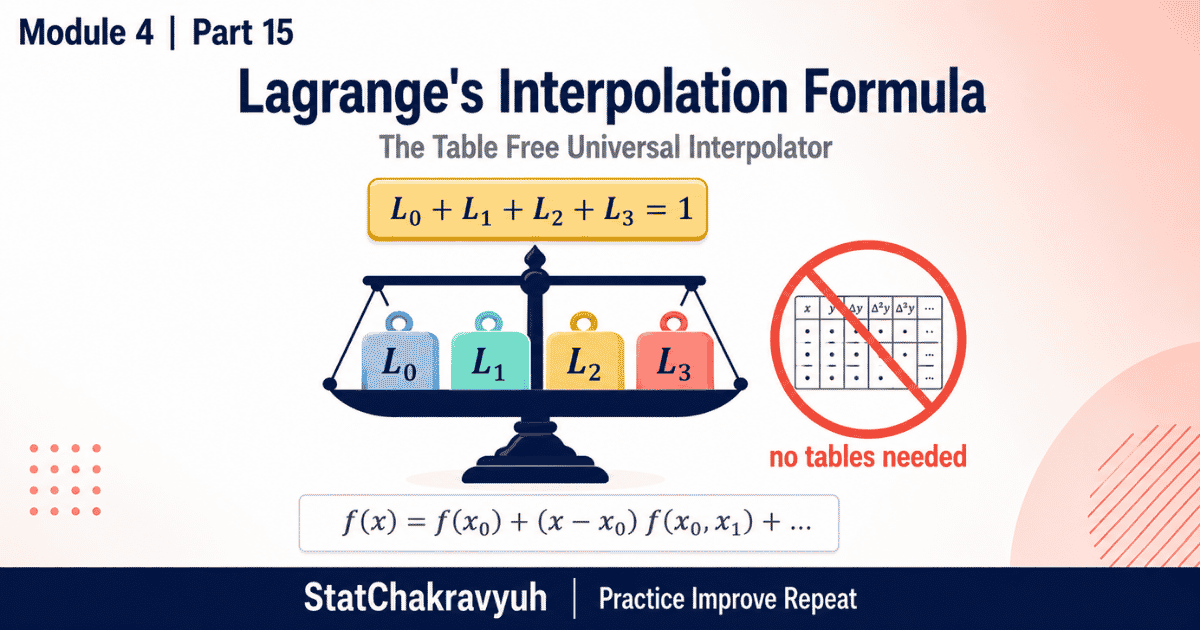
Welcome back to Part 15 of Module 4, updated for the UPSC ISS 2026 to 2027 cycle. In Part 14 we met Newton’s Divided Difference formula. Powerful, but it still needs a table. Today we go table free with the formula the syllabus names as “Lagrange’s formula for unequal intervals”: Lagrange’s Interpolation Formula, the examiner’s favourite tool for degree of polynomial questions.
The formula fits a polynomial of degree at most n through points as a direct weighted sum: each entry is multiplied by a Lagrangian coefficient , and the coefficients always sum to exactly 1.
Exam context: 80 questions, 200 marks, 2 hours, 2.5 marks per question, about 0.83 deducted per wrong answer, and close to 20 questions from Numerical Analysis. The degree counting trick below converted one such question from a five minute trap into a ten second tick in the 2021 cycle.
This post is Part 15 of the Unequal Intervals and Inverse Interpolation Guide (Module 4), inside our UPSC ISS Numerical Analysis Complete Guide. New to the exam? Start at the UPSC ISS hub.
The Story of Vikram and the FDI Curve
Vikram, an ISS officer in the Ministry of Commerce, analyzes India’s FDI inflows. Policy shifts left him data only for 2015, 2017, 2022, and 2024. His minister asks not for a single estimate but for the actual polynomial curve modelling the growth.
With Newton’s method, Vikram would compute divided differences and then expand nested brackets like to reach the polynomial. With Lagrange’s formula, the polynomial appears directly as a sum of independent weighted terms. One step, ten minutes of rough work saved.
The Master Formula
Let be the values of at arguments that are not necessarily equally spaced. Assuming is a polynomial of degree :
The hide and replace memory trick. For the term attached to , hide in the numerator, and in the denominator replace by . For the term attached to , hide in the numerator and replace by in the denominator. The pattern repeats, perfectly symmetric, with zero difference tables.
StatChakravyuh Pro Tips
- The sum of coefficients is unity, heavily tested. The multipliers of are the Lagrangian coefficients or fundamental polynomials , and their sum is always exactly 1: . If a question asks for the sum of Lagrangian coefficients for 500 data points, tick 1 without a second thought. A related instant fact: equals 1 when and 0 otherwise, which is precisely why the polynomial passes through every given point.
- Universal application. Famous for unequal intervals, but fully valid for equal intervals too. The formula is completely independent of the spacing of the arguments.
- The inverse interpolation superpower. Lagrange’s formula is merely a relation between two variables, either of which can be treated as the independent one. Given and asked for , simply swap the roles of and in the formula. Newton’s formulas never permit this swap.
- The honest weakness. If a new data point arrives later, every Lagrangian coefficient must be recomputed from scratch, whereas Newton’s divided difference form only grows by one term. Statements based questions exploit this contrast.
Solved PYQ Masterclass: Finding Polynomial Degrees
The golden rule. Given exactly points, the interpolating polynomial has degree at most .
PYQ (UPSC ISS 2021 cycle, as recorded in our PYQ archive): Consider the data:
: 0, 1, 2, 5 : 2, 3, 12, 147
What is the degree of the Lagrange interpolation polynomial that represents this data?
(a) 4 (b) 3 (c) 2 (d) 1
The 10 second logic.
- Count the points: exactly 4, so the maximum degree is .
- Confirm the degree does not collapse lower. Mental divided differences: first order values are 1, 9, and 45; second order values are 4 and 9; third order value is 5−09−4=1, which is non zero.
- Since the third divided difference is non zero, the degree is exactly 3.
Final Answer: (b) 3. A potentially five minute computation defused by counting points and two mental subtractions.
Bonus evaluation pattern: for the unequally spaced points the unique quadratic through them is , so by recognition, no formula grinding needed. Pattern recognition before computation, always.
Common Traps to Avoid
Trap 1: Reporting the count of points as the degree. Four points mean degree 3, not degree 4. The off by one option is always present.
Trap 2: Forgetting to check whether the degree collapses. If the top order divided difference is zero, the true degree is lower than the maximum.
Trap 3: Assuming Lagrange needs equal intervals or a table. It needs neither, and statements claiming otherwise are false options.
Frequently Asked Questions
-
Why use Lagrange’s formula instead of Newton’s Divided Difference formula?
Lagrange’s formula needs no difference table. For a small number of points, or when the polynomial itself is demanded, it is cleaner and less prone to cascading arithmetic errors.
-
What is the maximum degree of a polynomial through 6 data points?
Degree 5. A polynomial through distinct points has degree at most .
-
Can Lagrange’s formula handle equal intervals?
Yes. It is designed for scattered data but is completely independent of spacing, so it works perfectly on equal intervals too.
-
What are Lagrangian coefficients?
The fractional multipliers attached to each entry in the formula. Their signature exam property is , and additionally is 1 when and 0 otherwise.
-
How does Lagrange’s formula enable inverse interpolation?
Because it is symmetric between the two variables, you can interchange and everywhere in the formula and directly find the argument corresponding to a given entry.
Take the Next Step with StatChakravyuh
Join the Free UPSC ISS WhatsApp Community. All parts of this series plus the Module 4 Practice PDF with 40 MCQs arrive there first. 👉 Join the WhatsApp Community now
Enroll in the Free UPSC ISS Course. Structured lessons and practice sets on the Practice Improve Repeat system, at zero cost. 👉 Enroll in the Free Course
Coming up in Part 16, the final part of Module 4: Inverse Interpolation, where we reverse the mathematics to find missing arguments and even hunt roots of equations.
[…] methods dominate: Lagrange’s inversion, where xx and yy are interchanged in Lagrange’s formula because either variable can serve as the independent one, and the iterative method of successive […]