
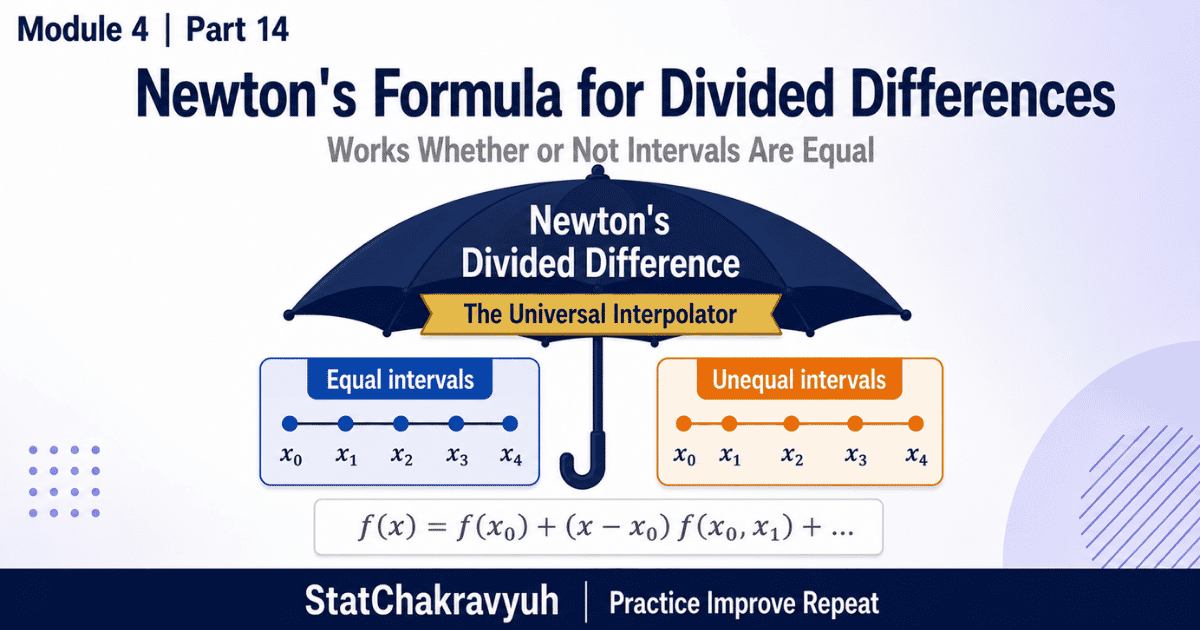
Welcome back to Part 14 of Module 4, updated for the UPSC ISS 2026 to 2027 cycle. In Part 13 we defined divided differences and discovered their symmetry. But a single difference is not a prediction. To actually build a polynomial and estimate a missing value from scattered data, we need the most versatile weapon in the syllabus: Newton’s Divided Difference Interpolation Formula, named explicitly in the official syllabus as “Newton’s formula for divided difference”.
The formula reads . Its defining property is universality: it applies whether or not the arguments are uniformly distributed, and for equal intervals it reduces exactly to the Newton Gregory Forward formula.
The stakes: 80 questions worth 200 marks in 2 hours, 2.5 marks each, about 0.83 deducted per wrong answer, close to 20 questions from Numerical Analysis. This exact topic has produced direct theory questions, including the one we solve below from the 2021 cycle.
This post is Part 14 of the Unequal Intervals and Inverse Interpolation Guide (Module 4), inside our UPSC ISS Numerical Analysis Complete Guide. Books and strategy at the UPSC ISS hub.
The Story of Kavita and the Delhi AQI
Kavita, an ISS officer with the Central Pollution Control Board, analyzes Delhi’s hazardous winter AQI. Sensor maintenance broke the recording schedule, leaving her readings only for Day 1, Day 3, Day 8, and Day 10. The gaps run 2 days, 5 days, 2 days. Completely unequal.
When her director urgently asks for the estimated AQI of Day 5, Newton Gregory would crash instantly without a constant . Kavita builds a quick divided difference table, applies Newton’s Divided Difference Formula, and delivers the estimate in 3 minutes.
The Master Formula
Let take the values at arguments without any constant step size.
The remainder term. Just as in Part 6, is the truncation error:
The magic assumption. If the true function is exactly a polynomial of degree , its th divided difference vanishes, so and the interpolating polynomial is exact.
StatChakravyuh Pro Tips
- The universal property, heavily tested. Is this formula only for unequal intervals? No, and that misconception is the trap. It is fully applicable whether or not the arguments are uniformly distributed. On equally spaced data it returns exactly the Newton Gregory answer.
- The bridge to ordinary differences. With equal intervals of gap , each divided difference converts through . Substituting this into the formula reduces it perfectly to Newton Gregory Forward. So Newton Gregory is the special case, not the other way around.
- The extension advantage. Adding one more data point later only appends one more term to the formula; the earlier table entries stay valid. This is the practical reason Newton’s form is preferred over Lagrange when data keeps arriving.
Solved PYQ Masterclass
PYQ (UPSC ISS 2021 cycle, as recorded in our PYQ archive): Which one of the following statements is correct about Newton’s divided difference formula?
(a) It is a special case of Newton’s forward difference formula. (b) It is not applicable if values of the arguments are uniformly distributed. (c) It is applicable whether or not the values of the arguments are uniformly distributed. (d) The roles of argument and the entry can be interchanged in this formula.
The 10 second logic.
Option (a) is false and reversed: Newton’s forward formula is the special case of the divided difference formula when is constant. Option (b) is false: divided differences work perfectly on uniformly distributed data. Option (c) is exactly the universal property from our Pro Tip, so it is true. Option (d) is false: freely interchanging argument and entry is the specialty of Lagrange’s formula in inverse interpolation, not of Newton’s formula.
Final Answer: (c). Two and a half marks in 10 seconds, earned purely through conceptual clarity.
Common Traps to Avoid
Trap 1: Believing the formula fails on equal intervals. It never fails there; it simply reproduces Newton Gregory.
Trap 2: Swapping argument and entry in Newton’s formula for inverse problems. That swap belongs to Lagrange, arriving in Part 15 and Part 16.
Trap 3: Forgetting the remainder structure. carries the product of all brackets and the th divided difference; dropping one bracket is a common option level distortion.
Frequently Asked Questions
-
What is the main advantage over Newton Gregory formulas?
Newton Gregory strictly needs equally spaced arguments. Newton’s Divided Difference formula interpolates irregular, scattered data seamlessly, and still works on equal intervals.
-
Can I use this formula on equally spaced data?
Yes, absolutely. It applies whether or not the arguments are uniformly distributed, though on equal intervals the standard Newton Gregory form is usually faster by hand.
-
What happens to the remainder term?
If the data comes from a polynomial of degree , the th divided difference is zero, so vanishes and the polynomial is exact.
-
How are divided differences connected to forward differences?
For equal spacing with gap , the th divided difference equals , and this substitution collapses the formula into Newton Gregory Forward.
-
Will UPSC ask a full five point divided difference computation?
Rarely. With calculators banned, dividing long fractions by hand is too slow for 90 seconds per question. The paper leans on theory: universality, symmetry, remainder logic, and the special case relationships.
Take the Next Step with StatChakravyuh
Join the Free UPSC ISS WhatsApp Community. All parts of this series plus the Module 4 Practice PDF with 40 MCQs arrive there first. 👉 Join the WhatsApp Community now
Enroll in the Free UPSC ISS Course. Structured lessons and practice sets on the Practice Improve Repeat system, completely free. 👉 Enroll in the Free Course
Coming up in Part 15: Lagrange’s Interpolation Formula, the table free interpolator, and the degree counting trick that solves PYQs in 10 seconds.
[…] back to Part 15 of Module 4, updated for the UPSC ISS 2026 to 2027 cycle. In Part 14 we met Newton’s Divided Difference formula. Powerful, but it still needs a table. Today we go […]