
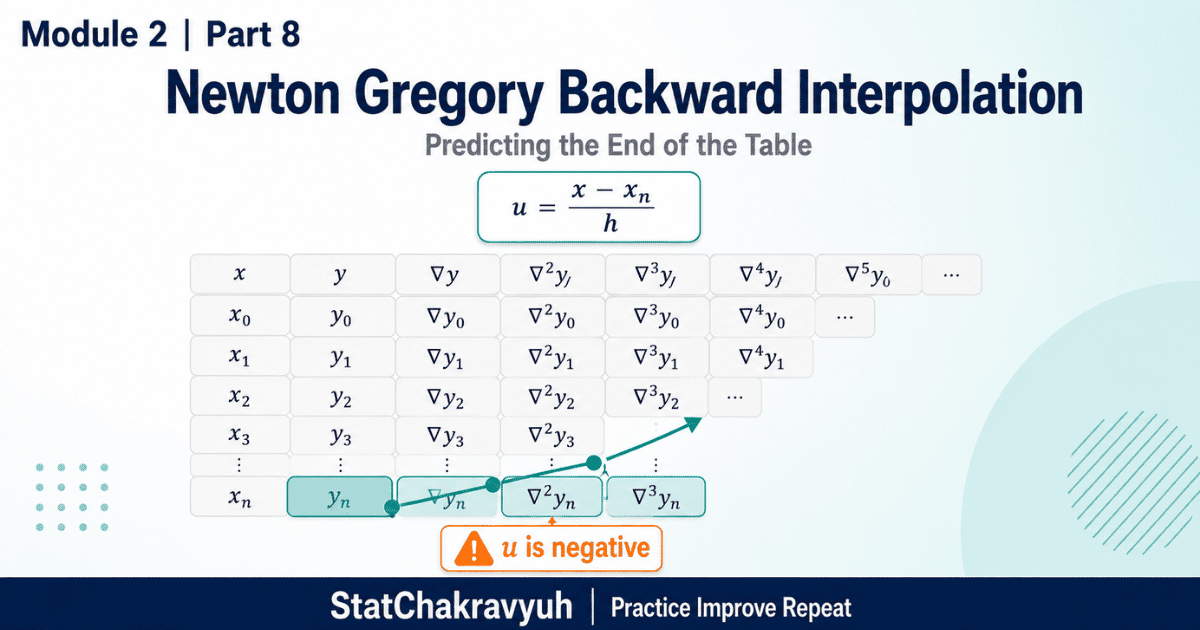
Welcome back to Part 8 of Module 2, updated for the UPSC ISS 2026 to 2027 cycle. In Part 7 we predicted values near the beginning of a table. Today the examiner flips the situation: the target sits near the end of the data. Use the forward formula there and your truncated series carries a large error. The correct tool is the twin sibling: the Newton Gregory Backward Interpolation Formula.
With step value measured from the last argument, the formula is , the binomial expansion of , built entirely on the bottom diagonal of the table.
Remember the stakes. Statistics Paper 1 gives you 80 questions worth 200 marks in 2 hours, so each question is worth 2.5 marks and each wrong answer costs about 0.83 marks. With close to 20 Numerical Analysis questions on the paper, choosing the wrong formula twice can quietly erase a full question’s worth of marks.
This post is Part 8 of the Interpolation with Equal Intervals Guide (Module 2), inside our UPSC ISS Numerical Analysis Complete Guide. For strategy and books, visit the UPSC ISS hub.
The Story of Ravi and the Urgent Estimate
Ravi, an economist in the Ministry of Finance, has sector output data at equal intervals of 10 years: 1990, 2000, 2010, and 2020. One evening his director asks for the estimated figure for 2018 before the next morning.
Ravi notices two things. The intervals are equal, . And 2018 sits at the bottom of the table, just before 2020. A value near the end calls for the differences at the bottom diagonal, traced upward. That is the Newton Gregory Backward formula.
Why Is It Called Backward
The formula contains the values of the tabulated function from the final term moving leftward, and it runs on the backward difference operator . Instead of the leading differences at the top, you pick from the very bottom of the table.
The decision rule in one line: equal intervals plus a target near the end means backward; equal intervals plus a target near the beginning means forward.
The Master Formula
With equidistant arguments interval and step value computed from the last argument:
StatChakravyuh Pro Tips
- The negative u trap. Since the target usually lies just before , the numerator is negative, so is almost always negative. Half the wrong options in the paper exist purely to catch a dropped minus sign here.
- Spot the plus signs. Forward uses ; backward uses . One memory hook: the formula that walks backward compensates with plus signs.
- The operator connection. The full formula is the expansion of . If you trust the operator algebra of Part 2, you can rebuild the formula in the exam hall instead of recalling it blindly.
- The bridge identity. . Both name the same number, . Options often present the unfamiliar label to create doubt.
Solved PYQ Masterclass
PYQ pattern (direct evaluation type): A function takes the values . Using the appropriate Newton Gregory formula, find .
Step 1: Choose the strategy. Arguments 1, 2, 3, 4 with . The target 3.5 lies near the end, so backward it is, with and .
Step 2: Bottom differences by mental math. Entries 1, 4, 9, 16. First backward differences: 3, 5, 7, so . Second: 2, so . Third: 0, so we stop; the data is quadratic.
Step 3: Apply the formula.
Final Answer: 12.25.
Cross check: the data is , and . Mental math verified in under 60 seconds.
Common Traps to Avoid
Trap 1: Forgetting that is negative. Substituting a positive flips the answer toward a wrong option that is always present.
Trap 2: Computing from instead of . The backward formula measures the step from the last tabulated argument.
Trap 3: Using minus signs in the brackets. The backward brackets are all plus.
Frequently Asked Questions
-
How do I choose between Newton’s Forward and Backward formulas?
Check the target value. Near the beginning of an equally spaced table, use Forward. Near the end, use Backward.
-
Can the backward formula handle unequal intervals?
No. Both Newton Gregory formulas need strictly equal intervals. Unequal intervals require Lagrange or divided differences, covered in Module 4.
-
Why does the formula use ∇ instead of Δ?
Because the calculation climbs upward from the bottom of the table, and naturally captures each step against the previous entry.
-
My u came out negative. Is that wrong?
It is perfectly correct. Since the target usually lies before the last argument , the numerator is negative, making negative.
-
What if I use the backward formula near the beginning of the table?
With all terms included it eventually gives the right value, but a truncated series then carries an unnecessarily large error. Each formula converges fastest in its own zone.
Take the Next Step with StatChakravyuh
Join the Free UPSC ISS WhatsApp Community. All parts of this series plus the Module 2 Practice PDF with 50 MCQs, releasing this Sunday, arrive there first. 👉 Join the WhatsApp Community now
Enroll in the Free UPSC ISS Course. Structured lessons and practice sets on the Practice Improve Repeat system, completely free. 👉 Enroll in the Free Course
Coming up in Part 9, the final part of Module 2: the Missing Term hack that skips the difference table entirely, plus Sub-division of Intervals.