
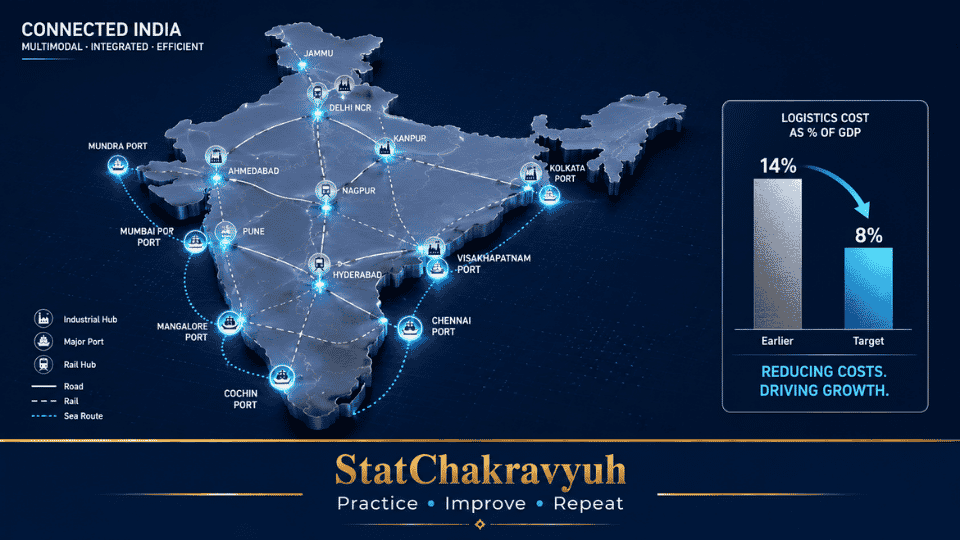
Textile parks and semiconductor units only fly if goods can move quickly and cheaply across India. That is why the National Logistics Policy and the LEADS Index sit at the heart of India’s competitiveness story.
Indian logistics costs have historically been estimated at around 13 to 14 percent of GDP, much higher than the global benchmark of around 8 to 9 percent. The National Logistics Policy, launched in 2022, aims to bring this down sharply through technology, integrated planning, and institutional coordination. The Logistics Ease Across Different States Index, or LEADS Index, ranks states on logistics ease and pushes healthy competition. Both are exam favourites.
What the National Logistics Policy promises
The Policy targets a reduction of logistics cost as a share of GDP, improvement in India’s Logistics Performance Index ranking, and development of an efficient logistics ecosystem. Key components include the Integrated Logistics Action Plan, Unified Logistics Interface Platform, Ease of Logistics Services, and Service Improvement Group. The policy works in tandem with PM Gati Shakti for multimodal connectivity.
PM Gati Shakti as the foundation
PM Gati Shakti is the digital master plan that integrates infrastructure planning across roads, railways, ports, airports, mass transport, waterways, and logistics infrastructure. By overlaying social and economic data, it enables planners to choose project locations and sequencing in a smarter way. The Viksit Bharat National Rural Infrastructure Stack also plugs into Gati Shakti.
How the LEADS Index works
The LEADS Index assesses states across logistics infrastructure, services, and operating environment. It is based on stakeholder surveys and objective indicators. Coastal states with major ports usually feature near the top, while landlocked states improve through dry ports and corridor connectivity. Each annual edition ranks states as Achievers, Fast Movers, and Aspirers.
Why this is testable in ISS
Logistics is one topic where data, geography, and policy intersect. An aspirant who can quote logistics cost as a share of GDP, mention PM Gati Shakti, and link the LEADS Index to state level performance can write a complete and analytical answer. Add a sentence on dedicated freight corridors and your answer stands out.
Logistics Reform: Key Pillars
| Pillar | Function |
| National Logistics Policy | Strategic vision and cost reduction |
| PM Gati Shakti | Integrated multimodal infrastructure planning |
| LEADS Index | Annual ranking of states on logistics ease |
| Dedicated Freight Corridors | High capacity rail freight network |
| Unified Logistics Interface Platform | Single digital interface for shippers and providers |
A Real Aspirant Story
Imagine an exporter named Karan from Indore who ships engineering goods to Mundra port. A decade ago, his shipment passed through four state checkpoints, each with paperwork. Today, with electronic toll, dedicated freight corridors, and digital documentation, the same shipment moves 30 percent faster. That single saved week is the entire reason his European buyer keeps placing repeat orders.
Bridge to the Next Topic
Cheap and fast logistics also support high technology manufacturing. Among the most exciting ones in 2025 was India’s leap into advanced semiconductor design, including the famous 2nm chip story. Read here