
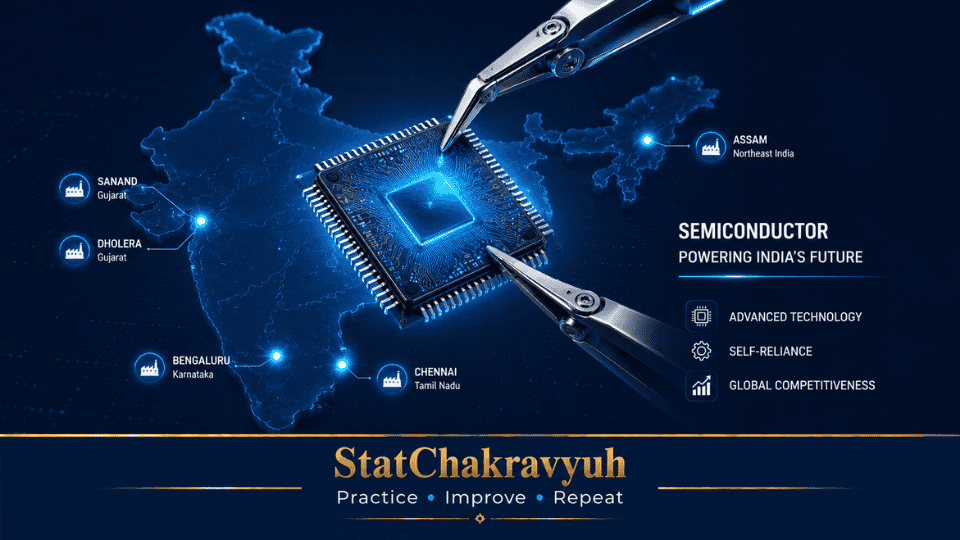
Modern logistics and integrated parks help India move goods quickly. They also enable a more ambitious agenda, building chips, where India crossed an important threshold in 2025-26.
Semiconductors run everything from your phone to your car to satellites. India launched the India Semiconductor Mission in 2021 with a 76,000 crore rupee outlay. By the end of 2025, ten projects had been approved across six states with cumulative investments of around 1.60 lakh crore rupees. Then, in early 2026, Qualcomm announced a 2nm chip design tape out done from Bengaluru, Chennai, and Hyderabad. India had truly entered the global cutting edge of chip design.
The mission at a glance
The India Semiconductor Mission sits under the Ministry of Electronics and Information Technology and runs schemes for semiconductor fabrication units, display fabs, packaging units, compound semiconductor units, and design linked incentives. It supports advanced design through tools, fellowships, and pilot fabrication services for academic institutions and startups.
Key approved projects
Tata Electronics has set up a fabrication unit at Dholera in Gujarat in partnership with Powerchip from Taiwan, with investments running into tens of thousands of crore rupees. Micron has a major assembly and test facility in Sanand, Gujarat. Tata Semiconductor Assembly and Test has an OSAT plant in Assam. CG Power has set up an OSAT pilot line in Sanand. Additional projects are spread across Andhra Pradesh, Odisha, and Uttar Pradesh.
The 2nm tape out story
Tape out refers to the stage where a chip design is finalised and sent to a foundry for manufacturing. Qualcomm announced that a 2nm chip design tape out was completed by its engineering centres in Bengaluru, Chennai, and Hyderabad. While the chip will be fabricated abroad, the design work happened in India. This puts India in a small group of countries doing cutting edge semiconductor design work.
Why this matters strategically
Roughly 20 percent of global semiconductor design talent is already estimated to sit in India. The Mission strengthens this through advanced 3 nanometre design facilities in Noida and Bengaluru, the Vikram 32 bit indigenous processor unveiled at SEMICON India 2025, and a partnership ecosystem with Japan, the United States, and Taiwan. India Semiconductor Mission 2.0 was given a major push in Budget 2026-27.
India Semiconductor Mission: Snapshot
| Aspect | Detail |
| Programme Outlay | Around 76,000 crore rupees |
| Approved Projects (end 2025) | Ten across six states |
| Cumulative Investments | Around 1.60 lakh crore rupees |
| Major Investors | Tata Electronics, Micron, CG Power, HCL Foxconn |
| Design Milestone | 2nm chip tape out from Bengaluru, Chennai, Hyderabad |
| First Indigenous Microprocessor | VIKRAM3201 by ISRO Semiconductor Lab |
A Real Aspirant Story
Imagine an electronics engineering student named Aakash from a tier 2 college. Earlier, the only way to design a chip was to migrate abroad. Today, with free access to industry grade design tools, Aakash can submit a design from his college lab and get it fabricated through the multi project wafer service. The semiconductor revolution is not just about big factories. It is also about young students suddenly having a path into chip design.
Bridge to the Next Topic
Chips are central to modern electronics, but the oldest engine of food security is fisheries. PMMSY completed five years and the review highlights both achievements and gaps. Read here