
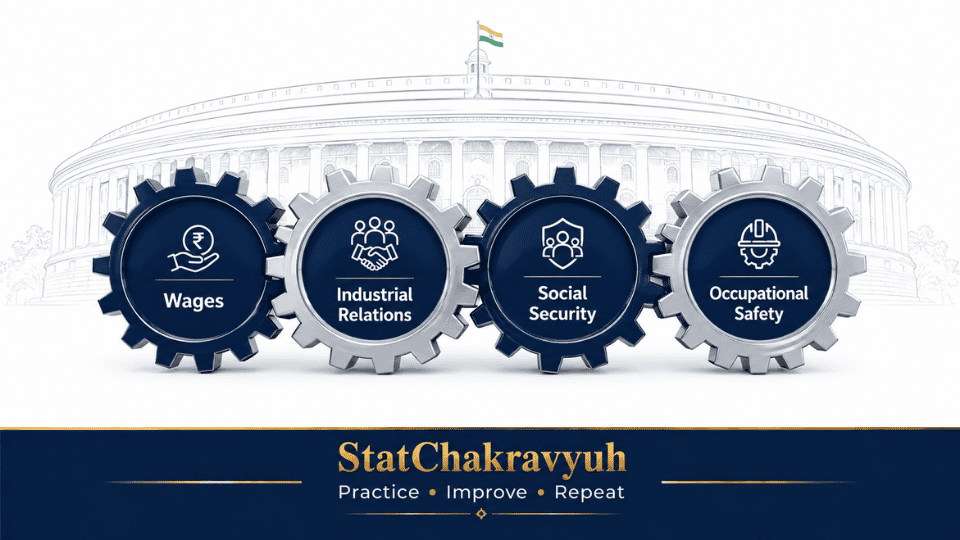
External trade pressures often expose internal labour rigidities. India’s four Labour Codes finally consolidated 29 old laws into a single, modern framework that came into force in late 2025.
India’s labour landscape was governed by 29 separate central laws, many of them dating from the colonial era. The four Labour Codes, namely the Code on Wages 2019, the Industrial Relations Code 2020, the Code on Social Security 2020, and the Occupational Safety, Health and Working Conditions Code 2020, replace this patchwork. After years of delay, large parts of the four Codes were notified during 2025. This is one of the most exam relevant reform stories of this cycle.
The four Codes at a glance
The Code on Wages covers minimum wages, payment of wages, bonus, and equal remuneration. The Industrial Relations Code deals with trade unions, standing orders, and industrial disputes. The Social Security Code expands coverage of EPF, ESIC, gratuity, maternity benefit, and creates a framework for gig and platform workers. The Occupational Safety Code consolidates rules on factories, mines, contract labour, and inter state migrant workers.
Why this is different from earlier reforms
Earlier labour laws were fragmented across thresholds and definitions. The four Codes try to create one definition of wages, one definition of worker, and one set of compliance windows. They allow fixed term employment with statutory benefits. They expand the right to social security beyond formal sector workers, especially through the recognition of gig and platform workers.
Formalisation and the gig economy
For the first time, gig workers, platform workers, and unorganised workers are explicitly part of the social security architecture. Aggregators contribute to a social security fund. Migrant workers gain portable benefits and identification. This is a serious step towards reducing the informal sector share, which has been a chronic challenge in Indian labour markets.
Concerns and debates
Trade unions have raised concerns about easier hire and fire conditions for larger firms, the threshold of workers needed to require government permission for retrenchment, and limits on strikes. Several states still need to notify their own rules for full operational effect. Implementation will therefore be uneven across states for some time.
Four Labour Codes Quick Reference
| Code | Year | Main Coverage |
| Code on Wages | 2019 | Minimum wages, bonus, equal pay |
| Industrial Relations Code | 2020 | Unions, disputes, standing orders |
| Social Security Code | 2020 | EPF, ESIC, gig workers, gratuity |
| Occupational Safety Code | 2020 | Factories, mines, contract, migrants |
A Real Aspirant Story
Imagine a delivery executive named Rohit on a food platform. Earlier he had no formal cover for accident, retirement, or maternity benefits in his family. Under the new Social Security Code, the platform contributes to a dedicated fund and Rohit becomes part of a national database of gig workers. The change is small per worker but huge in aggregate over millions of workers.
Quiz: Four Labour Codes
Q1. How many Labour Codes consolidate India’s central labour laws?
(A) Two
(B) Three
(C) Four
(D) Five
Answer: (C) Four. There are four Labour Codes covering wages, industrial relations, social security, and occupational safety.
Q2. The four Labour Codes replace approximately how many earlier central laws?
(A) 12
(B) 20
(C) 29
(D) 44
Answer: (C) 29. The four Codes replace a patchwork of 29 separate central labour laws.
Q3. In which year was the Code on Wages enacted?
(A) 2018
(B) 2019
(C) 2020
(D) 2021
Answer: (B) 2019. The Code on Wages was enacted in 2019, while the other three Codes were enacted in 2020.
Q4. Gig and platform workers are explicitly recognised under which Code?
(A) Code on Wages
(B) Industrial Relations Code
(C) Code on Social Security
(D) Occupational Safety Code
Answer: (C) Code on Social Security. The Code on Social Security explicitly recognises gig and platform workers and creates a social security framework for them.
Q5. Which Code consolidates rules on factories, mines, contract labour, and migrant workers?
(A) Code on Wages
(B) Industrial Relations Code
(C) Code on Social Security
(D) Occupational Safety, Health and Working Conditions Code
Answer: (D) Occupational Safety, Health and Working Conditions Code. The Occupational Safety, Health and Working Conditions Code consolidates rules on factories, mines, contract labour, and inter state migrant workers.
FAQs: Four Labour Codes
What are the four Labour Codes in India?
The four Labour Codes are the Code on Wages 2019, the Industrial Relations Code 2020, the Code on Social Security 2020, and the Occupational Safety, Health and Working Conditions Code 2020.
How many old laws do the four Labour Codes replace?
The four Labour Codes consolidate 29 separate central labour laws into a single modern framework.
Are gig and platform workers covered under the Labour Codes?
Yes, for the first time gig workers, platform workers, and unorganised workers are explicitly part of the social security architecture under the Code on Social Security.
What is the main aim of the four Labour Codes?
The main aim is to simplify and formalise the labour market by creating uniform definitions, easier compliance, and wider social security coverage.
What concerns have been raised about the Labour Codes?
Trade unions have raised concerns about easier hire and fire conditions for larger firms, retrenchment thresholds, and limits on strikes, and many states still need to notify their own rules.
Bridge to the Next Topic
While urban workers gain new protections, rural employment is also being restructured. The VB G RAM G Mission, replacing MGNREGA, is the next big idea you must understand. Read here
[…] External challenges always push internal reforms. One of the most overdue domestic reforms is in labour law, where India has finally moved on the four Labour Codes after a long wait. Read here […]