
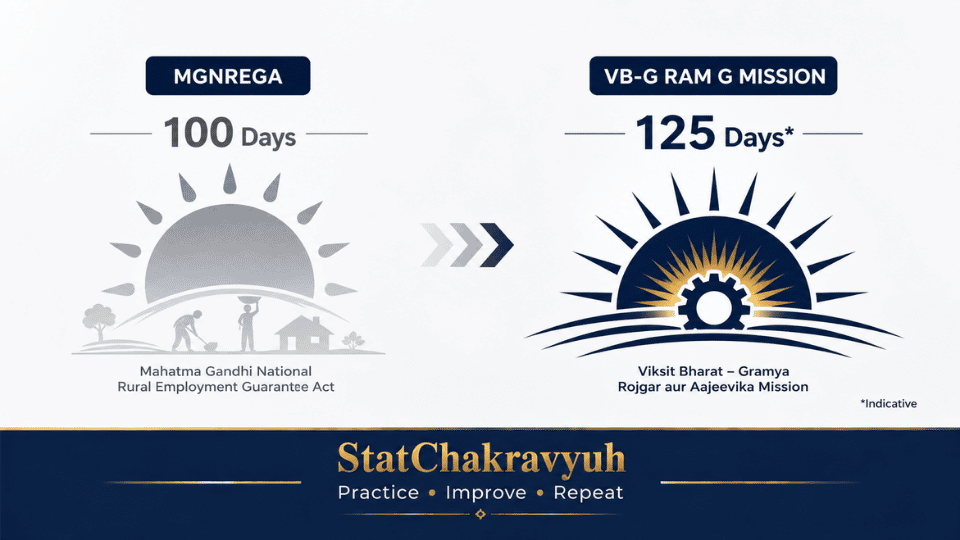
Urban and platform workers are getting new rights through the Labour Codes. Rural workers face a parallel transformation through the proposed replacement of MGNREGA itself.
MGNREGA, in force since 2005, has been the largest rural safety net in the world. In December 2025, the government introduced the Viksit Bharat Guarantee for Rozgar and Ajeevika Mission Gramin, popularly called the VB-G RAM G Bill, in the Lok Sabha. The Bill seeks to replace MGNREGA with a new statutory framework aligned with the Viksit Bharat 2047 vision. This is one of the most debated bills of the year.
What changes in the guarantee
The Bill raises the statutory minimum from 100 days under MGNREGA to 125 days of guaranteed wage employment per rural household per financial year. However, it also introduces an aggregated 60 day no work period during peak sowing and harvesting seasons, to be notified by states. The effective annual window therefore shrinks even as the headline number rises.
How funding shifts
Under MGNREGA, the Centre paid 100 percent of the unskilled wage cost. The new Bill moves to a 60 to 40 cost sharing pattern for most states, with 90 to 10 retained for North Eastern and Himalayan states and union territories without legislatures. The total annual outlay is estimated at around 1.51 lakh crore rupees, with the central share at roughly 95,700 crore rupees.
From open ended to budget capped
MGNREGA was demand driven and open ended. If demand exceeded the labour budget, the Centre was obligated to release supplementary funds. The new Bill replaces this with normative allocations decided by the Centre. Any expenditure beyond the allocation must be borne by the state government. This is a major structural shift from a rights based design to a budget capped design.
Planning and asset creation
Local Viksit Gram Panchayat Plans replace the older Labour Budget. These plans are aggregated upward and integrated with PM Gati Shakti through the Viksit Bharat National Rural Infrastructure Stack. Works focus on four themes, namely water security, rural infrastructure, livelihood related infrastructure, and disaster mitigation. The asset quality dimension becomes central.
The big debate
Supporters argue that the new design ensures fiscal predictability, better assets, and reduced leakages through biometric attendance and AI based fraud detection. Critics worry about dilution of a rights based guarantee, financial pressure on poorer states, and weaker shock absorber capacity in years of distress, similar to what MGNREGA did during COVID-19.
MGNREGA vs VB-G RAM G: Key Differences
| Feature | MGNREGA 2005 | VB-G RAM G Bill 2025 |
| Guaranteed Days | Not less than 100 days | 125 days, with 60 day pause |
| Funding Pattern | Centre 100 percent wage cost | 60:40 Centre State split for most states |
| Budget Design | Demand driven, open ended | Normative allocation, budget capped |
| Planning | Bottom up Labour Budget | Viksit Gram Panchayat Plans, aggregated |
| Coverage | Universal across rural India | Conditional, in notified rural areas |
A Real Aspirant Story
Think of a household in a Bundelkhand village headed by a woman named Sita. Under MGNREGA, she could demand work whenever the family was in distress. Under VB-G RAM G, she may get more days on paper, but only outside the agricultural pause window and only within a state’s annual envelope. The same right looks different on the ground, depending on the design choices behind it.
Quiz: VB-G RAM G Mission
Q1. How many days of guaranteed wage employment does the VB-G RAM G Bill propose per rural household per year?
(A) 100 days
(B) 120 days
(C) 125 days
(D) 150 days
Answer: (C) 125 days. The Bill raises the statutory minimum to 125 days, up from 100 days under MGNREGA.
Q2. The VB-G RAM G Bill seeks to replace which existing law?
(A) PMMSY
(B) MGNREGA
(C) Food Security Act
(D) Land Acquisition Act
Answer: (B) MGNREGA. The VB-G RAM G Bill seeks to replace MGNREGA, 2005.
Q3. What is the proposed Centre to State cost sharing pattern for most states under VB-G RAM G?
(A) 100:0
(B) 90:10
(C) 60:40
(D) 50:50
Answer: (C) 60:40. The Bill moves to a 60 to 40 Centre State split for most states, with 90 to 10 for North Eastern and Himalayan states.
Q4. What is the aggregated agricultural pause period proposed during peak sowing and harvesting?
(A) 30 days
(B) 45 days
(C) 60 days
(D) 90 days
Answer: (C) 60 days. The Bill introduces an aggregated 60 day no work period during peak agricultural seasons.
Q5. In which month and year was the VB-G RAM G Bill introduced in the Lok Sabha?
(A) August 2025
(B) October 2025
(C) December 2025
(D) February 2026
Answer: (C) December 2025. The Bill was introduced in the Lok Sabha on 16 December 2025.
FAQs: VB-G RAM G Mission
What is the VB-G RAM G Bill 2025?
The Viksit Bharat Guarantee for Rozgar and Ajeevika Mission Gramin Bill, or VB-G RAM G Bill 2025, is a proposed law that seeks to replace MGNREGA with a restructured rural employment framework.
How many days of employment does VB-G RAM G guarantee?
The Bill guarantees 125 days of wage employment per rural household per financial year, up from 100 days under MGNREGA, but with a 60 day agricultural pause.
How is funding different under VB-G RAM G compared to MGNREGA?
VB-G RAM G moves from full central funding of wages to a 60 to 40 Centre State cost sharing pattern for most states, with 90 to 10 for North Eastern and Himalayan states.
What is the agricultural pause in VB-G RAM G?
The Bill allows an aggregated 60 day no work period during peak sowing and harvesting seasons, to be notified by states in advance.
What are the main criticisms of VB-G RAM G?
Critics worry about dilution of a rights based guarantee, financial pressure on poorer states, and weaker shock absorber capacity during years of distress.
Bridge to the Next Topic
Rural employment matters, but so does the engine of urban jobs, which is the MSME sector. The MSME reforms of 2025 redrew the basic definitions and credit guarantees of this entire space. Read here
[…] While urban workers gain new protections, rural employment is also being restructured. The VB G RAM G Mission, replacing MGNREGA, is the next big idea you must understand. Read here […]