
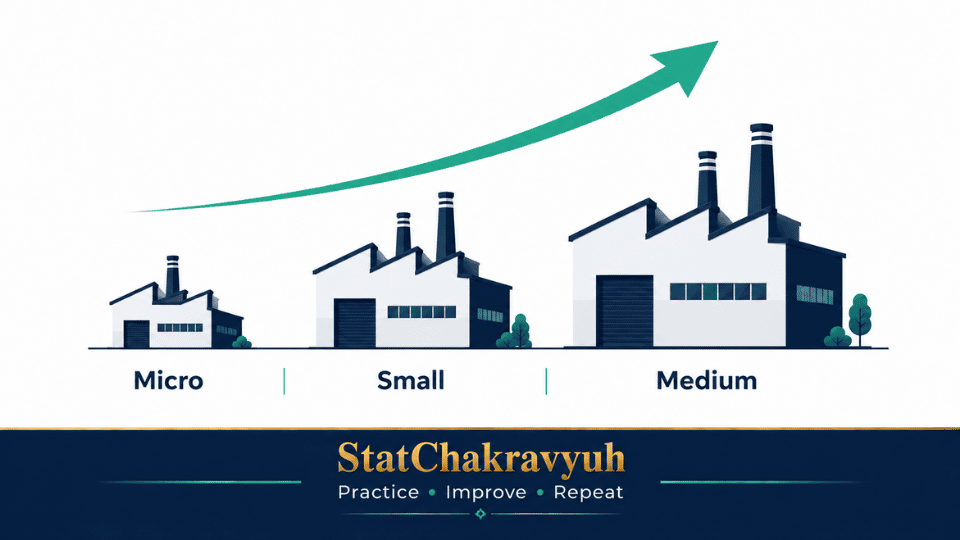
Rural employment is one pillar. The other pillar of mass employment is the MSME sector, which the Budget 2025-26 strengthened with a fresh definition and a much larger credit guarantee.
Micro, Small and Medium Enterprises contribute around 30 percent of India’s GDP and a very large share of total employment outside agriculture. The Budget 2025-26 redefined what counts as an MSME and significantly expanded the credit guarantee structure. For ISS aspirants, MSME questions overlap with employment, formalisation, exports, and financial inclusion in almost every Mains paper.
The revised MSME definition
Investment and turnover thresholds for classifying micro, small, and medium enterprises were revised upward. The aim is to allow growing firms to remain eligible for MSME benefits even after they expand, instead of penalising them for success. The new thresholds are roughly 2.5 times the earlier limits for investment and 2 times for turnover. This benefits a wide range of growing firms in textiles, food processing, and engineering.
Bigger credit guarantee cover
The credit guarantee cover for micro and small enterprises was raised from 5 crore rupees to 10 crore rupees, enabling an additional 1.5 lakh crore rupees in credit over the next five years. For startups, the credit guarantee cover was raised from 10 crore rupees to 20 crore rupees, with a reduced fee of 1 percent for loans in 27 focus sectors. Well run exporter MSMEs can access term loans of up to 20 crore rupees with cover.
Other supporting measures
TReDS expansion, mandatory adoption by larger buyers in subsequent reforms, faster GST refunds for MSMEs, simplified registration windows, and quality control order rationalisation form part of the broader MSME push. Mega Textile Parks, semiconductor packaging units, and electronics component manufacturing also indirectly create MSME ecosystems around themselves.
Why formalisation finally matters
GST 2.0, simplified registration, and easier credit are pulling more enterprises into the formal economy. This expands the tax base, strengthens supply chain compliance, and helps firms access global value chains. India’s competitiveness in textiles, leather, and electronics depends heavily on whether MSMEs can move from informal to formal.
MSME Credit Guarantee Boost: Before and After
| Category | Earlier Cover | Revised Cover (2025-26) |
| Micro and Small Enterprises | Up to 5 crore rupees | Up to 10 crore rupees |
| Startups | Up to 10 crore rupees | Up to 20 crore rupees |
| Exporter MSMEs (Term Loans) | Limited cover | Up to 20 crore rupees |
| Focus Sectors Fee | Standard | Reduced fee of 1 percent in 27 sectors |
A Real Aspirant Story
Consider a small auto component maker named Vijay in Pune. Earlier, banks were reluctant to lend beyond 4 crore rupees because the credit guarantee was capped at 5 crore rupees. With the cover doubled to 10 crore rupees, the same banker is now comfortable extending a 9 crore rupees term loan, and Vijay can finally buy that automated press he needed to win an export order.
Bridge to the Next Topic
Among MSME heavy sectors, textiles is the most labour intensive. The PM MITRA Scheme is the government’s flagship answer to building integrated, world class textile parks across the country. Read here
[…] Rural employment matters, but so does the engine of urban jobs, which is the MSME sector. The MSME reforms of 2025 redrew the basic definitions and credit guarantees of this entire space. Read here […]