
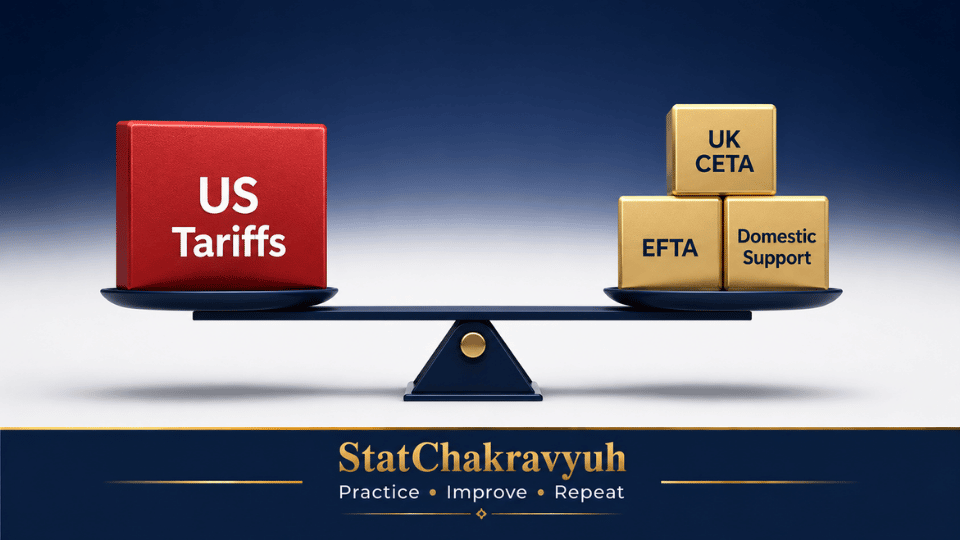
While India was busy signing trade deals with friendly partners, the United States imposed steep tariffs on Indian goods. New Delhi’s reaction shaped much of the policy debate in 2025.
Soon after taking office, the Trump administration in 2025 imposed sharp tariffs on a range of Indian exports, citing trade imbalances and India’s continued purchase of Russian energy. At one point, total tariffs on certain Indian categories reached 50 percent, including a 25 percent baseline plus a 25 percent penalty. For ISS aspirants, this is a textbook example of how external shocks shape domestic policy choices.
Why the United States acted
The official reasoning included concerns about trade deficits with India, India’s continued imports of Russian crude oil, and broader strategic positioning. The tariffs hit textiles, gems and jewellery, leather, certain chemicals, and select engineering goods. Some Indian export segments suddenly became uncompetitive in the US market overnight.
How India responded
India did not retaliate with mirror tariffs. Instead, the response had three layers. First, diplomatic engagement through visits and a continuing negotiation track. Second, market diversification through new FTAs with the UK, EFTA, Oman, and New Zealand. Third, support for affected exporters through revised duty drawback rates, sector specific schemes, and an expanded export credit framework.
Why India did not panic
Roughly 60 percent of India’s growth is driven by domestic consumption, not exports. S&P even noted that the impact of US tariffs would be manageable for this reason. Services exports, particularly in IT and global capability centres, were not hit hard. The macroeconomy could absorb the shock because the rupee, reserves, and current account stayed within reasonable bands.
The deeper lesson
The episode shows that India is now treating trade policy as part of foreign policy. Trade deals are no longer purely commercial. They are tools to balance dependencies, diversify partners, and reduce single market risk. By February 2026, an interim US India trade arrangement was also under operationalisation, showing that dialogue continued even during pressure.
India’s Three Layer Response to US Tariffs
| Layer | Action | Purpose |
| Diplomatic | Continued talks and visits | Keep negotiation channels open |
| Market | New FTAs with UK, EFTA, Oman, NZ | Diversify export destinations |
| Domestic | Support exporters, drawbacks, credit | Cushion immediate sector pain |
| Macro | Use of strong reserves and demand | Absorb shock without retaliation |
A Real Aspirant Story
Picture a gem exporter named Ramesh in Jaipur whose annual US shipment dropped sharply after the tariffs. Within months, the same exporter began testing UK and Oman markets where new tariff free routes opened. The same story repeats across textiles, leather, and engineering. Diversification was not theory anymore, it was survival.
Quiz: US Tariffs and India’s Response
Q1. At its peak, total US tariffs on certain Indian goods reached what level in 2025?
(A) 10 percent
(B) 25 percent
(C) 50 percent
(D) 70 percent
Answer: (C) 50 percent. At one point total tariffs on certain Indian categories reached 50 percent, a 25 percent baseline plus a 25 percent penalty.
Q2. Roughly what share of India’s growth is driven by domestic consumption?
(A) 30 percent
(B) 45 percent
(C) 60 percent
(D) 80 percent
Answer: (C) 60 percent. Roughly 60 percent of India’s growth is driven by domestic consumption, which cushioned the tariff shock.
Q3. How did India primarily respond to the US tariffs?
(A) With immediate mirror tariffs
(B) With a calibrated, non retaliatory strategy
(C) By stopping all trade with the US
(D) By devaluing the rupee sharply
Answer: (B) With a calibrated, non retaliatory strategy. India did not retaliate with mirror tariffs and instead used a calibrated, three layer strategy.
Q4. Which of these was a key reason cited by the US for the tariffs?
(A) India’s space programme
(B) India’s continued imports of Russian crude oil
(C) India’s GST reform
(D) India’s fertility rate
Answer: (B) India’s continued imports of Russian crude oil. The reasoning included trade deficits and India’s continued imports of Russian crude oil.
Q5. Which strategy did India use to reduce single market risk after the tariffs?
(A) Market diversification through new FTAs
(B) Closing all ports
(C) Banning all imports
(D) Raising income tax
Answer: (A) Market diversification through new FTAs. India diversified markets through new FTAs with the UK, EFTA, Oman, and New Zealand.
FAQs: US Tariffs and India’s Response
How high did US tariffs on Indian goods go in 2025?
At their peak, total US tariffs on certain Indian categories reached 50 percent, comprising a 25 percent baseline and a 25 percent penalty.
Why did the United States impose tariffs on India?
The reasons included concerns about trade deficits with India, India’s continued imports of Russian crude oil, and broader strategic positioning.
How did India respond to the US tariffs?
India responded with a calibrated, non retaliatory strategy combining diplomatic engagement, market diversification through new FTAs, and domestic support for affected exporters.
Why was the tariff impact considered manageable for India?
Roughly 60 percent of India’s growth is driven by domestic consumption, so the economy was less exposed to export shocks than a trade dependent economy would be.
Did India and the US continue trade talks during the tariff phase?
Yes, dialogue continued and by early 2026 an interim US India trade arrangement was under operationalisation.
Bridge to the Next Topic
External challenges always push internal reforms. One of the most overdue domestic reforms is in labour law, where India has finally moved on the four Labour Codes after a long wait. Read here