
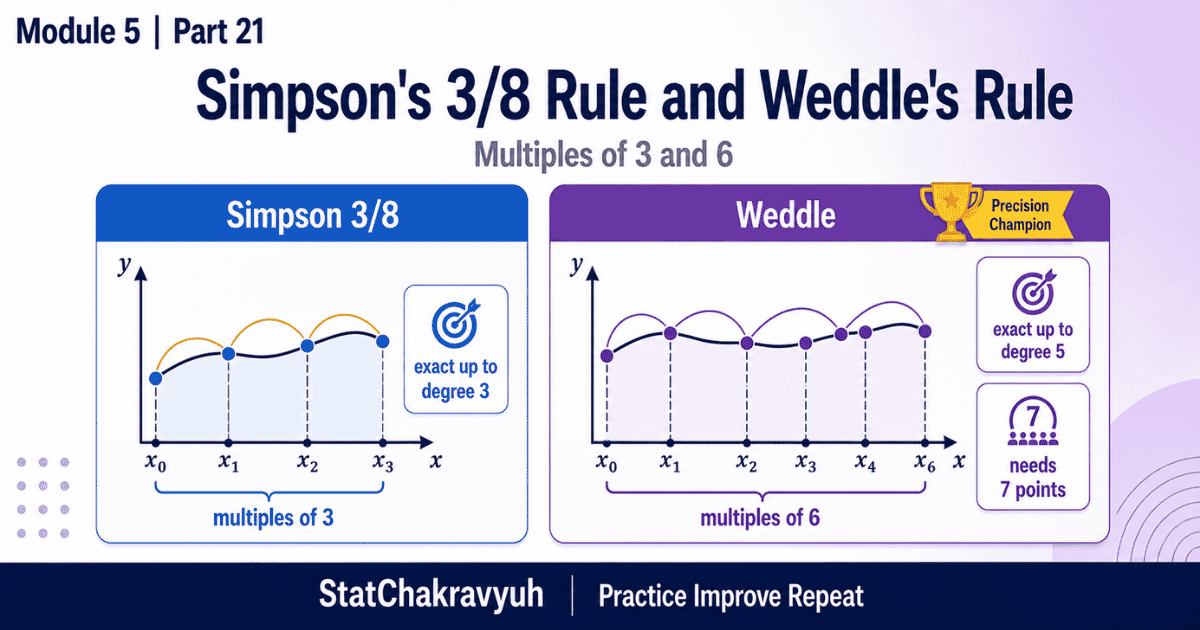
Welcome back to Part 21 of Module 5, updated for the UPSC ISS 2026 to 2027 cycle. Simpson’s 1/3 Rule upgraded straight lines to parabolas, but it locked us into an even number of intervals. What if the data arrives in groups of 3 or 6? Two formulas answer: Simpson’s 3/8 Rule and the precision champion, Weddle’s Rule.
Simpson’s 3/8, from , fits a cubic through every four points, needs a multiple of 3 sub intervals, and is exact up to degree 3. Weddle’s Rule, from , needs a multiple of 6 sub intervals, hence at least 7 consecutive values, and is exact for polynomials of degree 5 or lower with an error of order .
Exam context: 80 questions, 200 marks, 2 hours, 2.5 marks per question, about 0.83 deducted per wrong answer. Both rules have produced direct constraint questions in recent cycles, and both are solved below.
This post is Part 21 of the Numerical Calculus Guide (Module 5), inside our UPSC ISS Numerical Analysis Complete Guide. Roadmap at the UPSC ISS hub.
The Story of Sanjay and the Monsoon Rainfall
Sanjay, an ISS officer at the Meteorological Department, must compute the total accumulated rainfall over a 6 month monsoon season, with readings on the last day of each month: exactly 6 equal sub intervals.
A junior suggests the Trapezoidal Rule; Sanjay knows it will underestimate the heavy mid season peaks. Another suggests Simpson’s 1/3, which works since 6 is even. But Sanjay wants the highest accuracy for the national database. Six is a multiple of 3, so Simpson’s 3/8 qualifies, and better still, six is a multiple of 6, so Weddle’s Rule applies, delivering the most accurate estimate of all.
Simpson’s 3/8 Rule: The Multiple of 3 Rule
Putting in the General Quadrature Formula and neglecting differences above the third order gives a rule that fits a cubic polynomial over groups of three sub intervals:
In simple words: three eighths of the gap, times the first plus last, plus three times the ordinates whose index is not a multiple of 3, plus twice the ordinates whose index is a multiple of 3.
Constraints and accuracy. The number of sub intervals must be a multiple of 3 (3, 6, 9, 12). The global error is , and since the error term carries the fourth derivative, the rule is exact for polynomials of degree 3 or less, matching Simpson’s 1/3 in exactness.
Weddle’s Rule: The Precision Champion
Putting in the master formula gives Weddle’s Rule:
The weight pattern per block of six intervals reads .
Constraints and accuracy. The number of sub intervals must be a multiple of 6, so one application alone needs at least 7 consecutive values, through . The global error is remarkably small, of order , and through the same style of cancellation seen in Part 20, the rule is exact for polynomials of degree 5 or lower. Among the standard Newton Cotes rules, Weddle is generally the most accurate.
Solved PYQ Masterclass
PYQ 1, the constraint question (UPSC ISS 2021 cycle, as recorded in our PYQ archive): The number of sub intervals required in Simpson’s three eighth rule is a multiple of:
(a) 2 (b) 3 (c) 4 (d) 5
Logic: Simpson’s 1/3 needs multiples of 2, Weddle needs multiples of 6, and Simpson’s 3/8 needs multiples of 3. Answer: (b), in 2 seconds.
PYQ 2, the Weddle statements (UPSC ISS 2016 cycle, as recorded in our PYQ archive): Consider the statements:
- Weddle’s rule requires at least six consecutive values of the function.
- If is a polynomial of 4th degree, then Weddle’s rule gives an exact result.
Logic: Statement 1 is false: six sub intervals require seven points, to , not six. Statement 2 is true: Weddle is exact up to degree 5, and 4 is below 5. Answer: Statement 2 only.
PYQ 3, the integration bypass pattern: is evaluated by Simpson’s 3/8 rule with 3 equal sub intervals. The value obtained is?
Logic: The integrand has degree 3, and Simpson’s 3/8 is exact up to degree 3, so compute the plain integral: . Answer: 44.25, no table built.
Common Traps to Avoid
Trap 1: Reading “at least six values” as true for Weddle. Six intervals demand seven points; the off by one option is a certified mark stealer.
Trap 2: Granting Weddle exactness for degree 6. The ceiling is degree 5.
Trap 3: Believing Simpson’s 3/8 beats Simpson’s 1/3 in exactness. Both cap at degree 3 with errors; 3/8 simply serves a different interval count.
Frequently Asked Questions
-
How do Simpson’s 1/3 and 3/8 rules differ?
The 1/3 rule fits a parabola through 3 points and needs even sub intervals. The 3/8 rule fits a cubic through 4 points and needs sub intervals in multiples of 3.
-
Which rule is the most accurate?
Weddle’s Rule, generally, with an error against for both Simpson rules and for the Trapezoidal rule.
-
Why does Weddle’s rule need at least 7 points?
It is built with ; six sub intervals have seven boundaries, through .
-
Is Simpson’s 3/8 exact for a cubic?
Yes. Its error carries the fourth derivative, which is zero for any cubic, so the result is perfectly exact up to degree 3.
-
With 12 sub intervals, which rules can I use?
All three. Twelve is even for Simpson’s 1/3, a multiple of 3 for Simpson’s 3/8, and a multiple of 6 for Weddle, which would give the most accurate estimate.
Take the Next Step with StatChakravyuh
Join the Free UPSC ISS WhatsApp Community. All parts of this series plus the Module 5 Practice PDF with 60 MCQs arrive there first. 👉 Join the WhatsApp Community now
Enroll in the Free UPSC ISS Course. Structured lessons and practice sets on the Practice Improve Repeat system, completely free. 👉 Enroll in the Free Course
Coming up in Part 22, the finale of Module 5: a rapid fire session solving real quadrature PYQs in 10 seconds using the exactness cheat codes.