
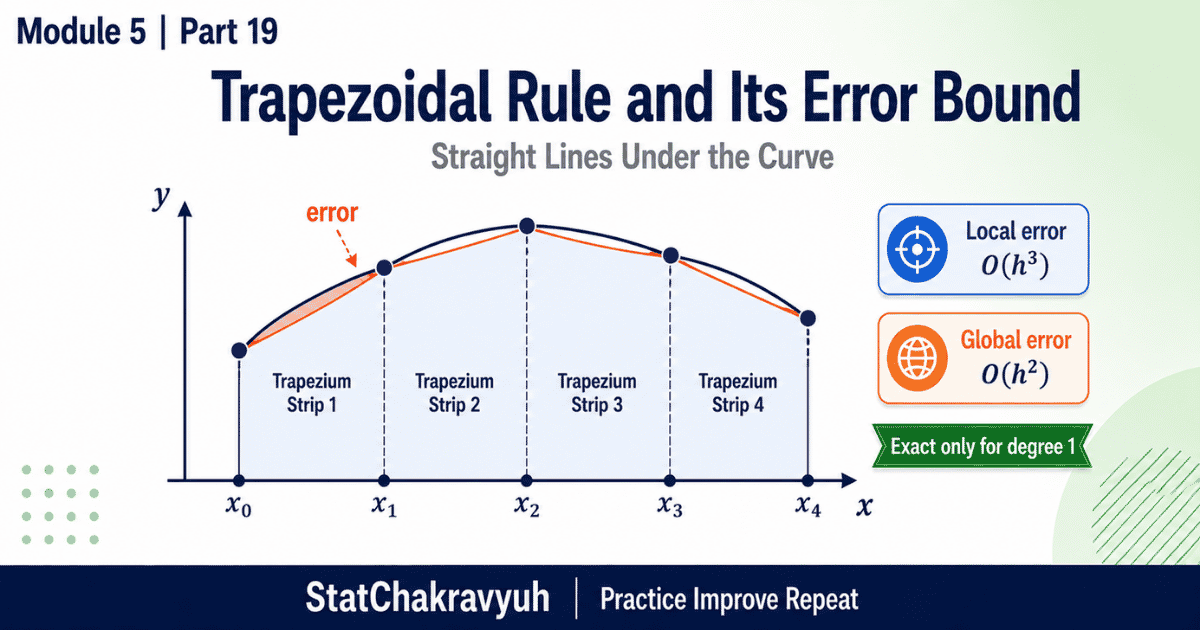
Welcome back to Part 19 of Module 5, updated for the UPSC ISS 2026 to 2027 cycle. In Part 18 we met the mother of all integration rules and watched give birth to its first child. Today we study that child in full depth: the Trapezoidal Rule, and more importantly, the concept UPSC actually traps students on, its error bound.
The composite formula is . The rule assumes straight lines between points, carries a local error of order per strip and a global error of order overall, and is exact only for polynomials of degree one.
Exam context as always: 80 questions, 200 marks, 2 hours, 2.5 marks per question, about 0.83 deducted per wrong answer. Error bound theory questions from this exact page appeared as recently as the 2025 cycle.
This post is Part 19 of the Numerical Calculus Guide (Module 5), inside our UPSC ISS Numerical Analysis Complete Guide. Roadmap at the UPSC ISS hub.
The Story of Rahul and the Riverbank Property
Rahul, a government civil engineer, must compute the area of land bordered by a straight highway on one side and a winding river on the other. No formula of length times width can help with a curvy boundary.
So Rahul walks the highway and measures the land’s width at equal 10 metre intervals. Then he stretches straight ropes from each width point to the next, replacing the curvy riverbank with straight segments. Each strip between two widths and a rope is a trapezium. He sums their areas, and the total is his estimate. That physical act is the Trapezoidal Rule.
The Core Formula
Dividing the range from to into equal sub intervals of width :
In simple words: half the interval gap, times the sum of the first and last entries plus twice the sum of all the middle entries.
A tiny worked check: for , , with , the rule gives .
The Geometric Assumption and the Freedom of Intervals
The fundamental assumption: between any two consecutive points, the function is a linear polynomial, of the form . Since a straight line needs only 2 points, the rule accepts any number of equal sub intervals. No even number condition, no multiple of three condition. That freedom is itself a tested fact.
The Trap: Local Versus Global Error
Rahul’s ropes miss area where the river bulges outward and add area where it curves inward. That mismatch is the truncation error, and it comes in two flavours.
Local error, one strip:
Global error, the whole range from a to b:
The local error is of order ; adding up strips costs one power of , leaving the global error at order , written .
StatChakravyuh Pro Tips
- The degree 1 exactness hack. The error carries , the second derivative. If the integrand is linear, like , its second derivative is exactly zero, so the error vanishes and the rule is perfectly exact. Exact for degree one, and only degree one.
- The sub interval freedom answer. Asked how the interval must be divided, the answer is any finitely many sub intervals of equal size.
- The accuracy ranking. Because straight lines approximate curves crudely, the Trapezoidal Rule is generally the least accurate member of the Newton Cotes family. Simpson’s rules almost always beat it.
Solved PYQ Masterclass
PYQ (UPSC ISS 2025 cycle, as recorded in our PYQ archive): Consider the statements:
I. The Trapezoidal rule for evaluating gives an exact result for a linear polynomial. II. The Trapezoidal rule for evaluating gives an exact result for a quadratic polynomial.
Which of the above is or are correct?
The 5 second logic. The error term contains . For the error to vanish, the second derivative must be identically zero, which happens only for linear polynomials. A quadratic has a constant, non zero second derivative, so a residual error survives. Statement I is true; Statement II is false.
Final Answer: Statement I only. Two and a half marks, zero numbers computed.
Common Traps to Avoid
Trap 1: Quoting the local error order for a global error question, or the reverse. Local is , global is .
Trap 2: Granting the rule exactness for quadratics. It never has it; that is Simpson’s territory in Part 20.
Trap 3: Inventing an even interval condition. That constraint belongs to Simpson’s 1/3, not to the Trapezoidal rule.
Frequently Asked Questions
-
What is the Trapezoidal Rule used for?
It approximates the area under a curve by dividing it into strips whose tops are straight line segments, forming trapeziums whose areas are summed.
-
How many sub intervals does the rule need?
Any number of equal sub intervals. Unlike Simpson’s 1/3 rule, there is no even number restriction.
-
What is the geometric assumption of the rule?
That the function between any two consecutive points is a linear polynomial, a straight line.
-
What is the order of the global error?
, with the expression . The local error of a single strip is .
-
When is the Trapezoidal Rule perfectly exact?
Only when the integrand is a polynomial of degree one, because only then is the second derivative in the error term identically zero.
Take the Next Step with StatChakravyuh
Join the Free UPSC ISS WhatsApp Community. All parts of this series plus the Module 5 Practice PDF with 60 MCQs arrive there first. 👉 Join the WhatsApp Community now
Enroll in the Free UPSC ISS Course. Structured lessons and practice sets on the Practice Improve Repeat system, completely free. 👉 Enroll in the Free Course
Coming up in Part 20, the most important part of this module: Simpson’s 1/3 Rule and the famous Degree 3 Exactness trick that solves PYQs in 5 seconds.