
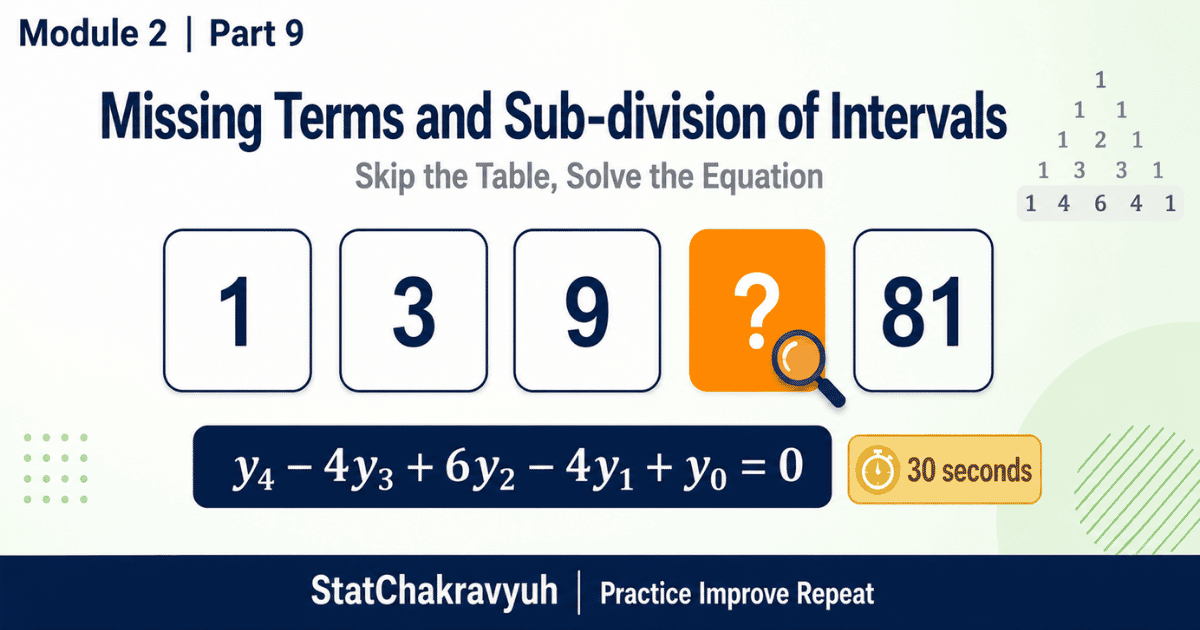
Welcome to Part 9, the final part of Module 2, updated for the UPSC ISS 2026 to 2027 cycle. The forward and backward formulas need a full difference table. But when a question asks for one missing value from a small dataset, there is a far faster route.
The hack: assume the known values come from a polynomial of degree , so the th forward difference vanishes, , that is . Binomial expansion turns this into one linear equation, , which hands over the missing value directly.
Why speed matters here: Statistics Paper 1 gives you 80 questions in 120 minutes, roughly 90 seconds per question, with 2.5 marks for a correct answer and a deduction of about 0.83 marks for a wrong one. A missing term question solved in 30 seconds buys you a full extra minute for a harder question elsewhere.
This post is Part 9 of the Interpolation with Equal Intervals Guide (Module 2), inside our UPSC ISS Numerical Analysis Complete Guide. Full roadmap at the UPSC ISS hub.
The Story of Sunil and the Corrupted File
Sunil, a senior researcher on a health census project, has hospital counts for the years 2000, 2005, 2010, 2015, and 2020. His computer crashes and the 2010 figure is wiped out. The director wants the number for a press release in five minutes.
Sunil has 4 known values. Instead of building a Newton interpolation from scratch, he recalls the golden rule: with 4 known values, the 4th forward difference is zero. He writes one equation, solves it mentally, and delivers the figure in 30 seconds. Here is the mathematics behind his calm.
The Core Concept: Finding Missing Terms
The golden assumption. Given exactly known values of a function at equally spaced arguments, assume the function is a polynomial of degree . From Module 1 we know the th difference of such a polynomial is strictly zero, so .
The derivation, by separation of symbols. Substitute :
Expand by the Binomial Theorem and reattach using :
One linear equation, one unknown, no table.
StatChakravyuh Pro Tips
- Pascal’s triangle trick. Never compute binomial coefficients in the hall. Recall the Pascal rows with alternating signs. For 4 known values: , giving . For 5 known values: . For 6 known values: .
- Two missing terms. With 5 known values and 2 unknowns, you need two equations. Use and , then solve the pair simultaneously.
- Sanity check against the trend. If the known values are clearly exponential, like powers of 2 or 3, the polynomial estimate will land close to but not exactly on the exponential value. Do not panic when the answer is 16.5 while the pattern whispers 16; the polynomial assumption is doing its honest job.
Concept 2: Sub-division of Intervals
Sometimes data comes at large intervals, such as decennial census values , and the question asks for unit year values in between. This is Sub-division of Intervals.
Let be the difference operator for the large interval of units and the operator for the unit interval. Through the shift operator, one large step equals unit steps:
Expanding with the Binomial Theorem for fractional indices:
The first term alone, , settles many objective questions.
Solved PYQ Masterclass
PYQ pattern (missing term type, one of the most repeated question categories in ISS Paper 1): Estimate the missing term.
: 0, 1, 2, 3, 4 : 1, 3, 9, ?, 81
Step 1: Count the knowns. Four values are known (1, 3, 9, 81), so assume a degree 3 polynomial: .
Step 2: Write the equation with Pascal coefficients 1,−4,6,−4,1.
Step 3: Substitute and solve.
Final Answer: , with no table and no calculator.
Note the built in lesson: the data whispers powers of 3, so instinct says 27, but the polynomial assumption gives 31. Both 27 and 31 will sit among the options. The finite difference method demands 31.
Common Traps to Avoid
Trap 1: Counting the missing value as a known value. The degree assumption uses only the number of known entries.
Trap 2: Dropping a sign in the alternating coefficients. Write the Pascal row first, then attach signs strictly alternately.
Trap 3: Choosing the pattern answer, like 27 in the example above, instead of the finite difference answer. The examiner plants the pattern value as a distractor.
Frequently Asked Questions
-
What is the main assumption behind equating Δny0 to zero?
That known values come from a polynomial of degree , whose th difference is strictly zero by the fundamental result of finite differences.
-
Why is this hack faster than a Newton Gregory formula?
Newton Gregory needs a full difference table, a step value , and a long fractional formula. The hack gives one direct linear equation solvable mentally.
-
What if two terms are missing?
Base the degree on the known values, then write the vanishing difference condition twice, at and at and solve the two equations simultaneously.
-
What is Sub-division of Intervals?
A technique to convert differences at a large interval into differences at a smaller unit interval using , useful when yearly values must be filled between decennial data.
-
Why convert Δ into E while finding missing terms?
Because maps operators directly onto the tabulated values, so expanding instantly produces an equation in .
Take the Next Step with StatChakravyuh
Join the Free UPSC ISS WhatsApp Community. The Module 2 Practice PDF with 50 MCQs, a formula sheet, and the PYQ pattern collection releases in the community this Sunday. 👉 Join the WhatsApp Community now
Enroll in the Free UPSC ISS Course. Structured lessons and practice sets on the Practice Improve Repeat system, at zero cost. 👉 Enroll in the Free Course
Module 2 is complete. Next stop, Module 3: Central Difference Operators, and the Gauss, Stirling, and Bessel formulas for targets in the middle of the table.