
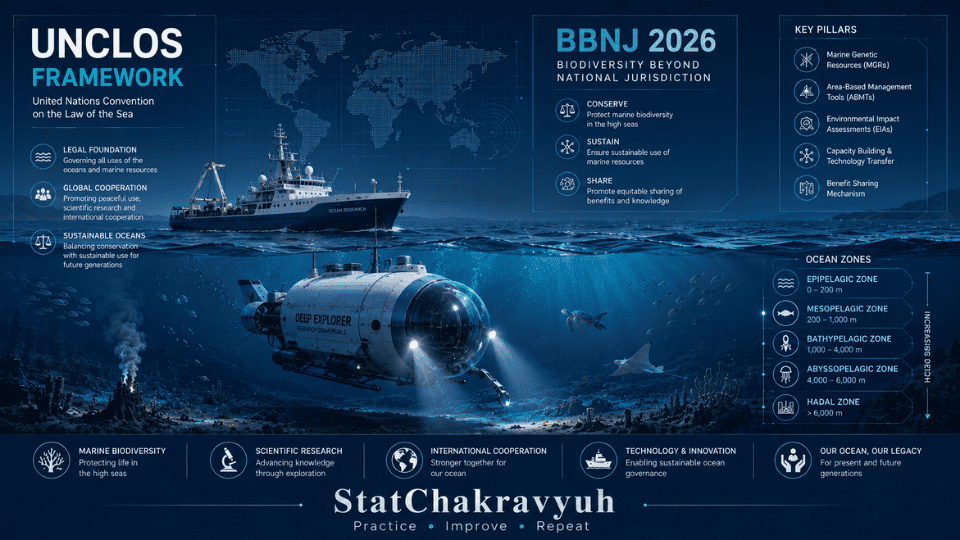
Strategic partnerships matter, and so do global rules. The High Seas Treaty, formally known as the BBNJ Agreement, is one of the most important environmental agreements of the decade.Strategic partnerships matter, and so do global rules. The High Seas Treaty, formally known as the BBNJ Agreement, is one of the most important environmental agreements of the decade.
The Agreement on Biodiversity Beyond National Jurisdiction, popularly called the BBNJ Agreement or High Seas Treaty, was adopted at the United Nations in 2023 after nearly two decades of negotiations. It governs the conservation and sustainable use of biodiversity in marine areas beyond national jurisdiction, which together cover nearly half the planet. India signed the Agreement and is part of the wider implementation conversation.
Why this Treaty was needed
Earlier, the United Nations Convention on the Law of the Sea, or UNCLOS, regulated the broad framework for the oceans. However, biodiversity beyond national jurisdiction lacked specific binding rules on conservation, marine genetic resources, environmental impact assessments, and capacity building. The BBNJ Agreement fills this gap and provides modern tools to manage these areas.
Four pillars of the Agreement
First, marine genetic resources, including questions of access and benefit sharing. Second, area based management tools, including marine protected areas. Third, environmental impact assessments for activities that may affect the high seas. Fourth, capacity building and transfer of marine technology, especially for developing countries. These four pillars together create a comprehensive governance framework.
India’s stance
India has supported the spirit and substance of the BBNJ Agreement and signed it as part of its broader commitment to sustainable ocean governance. India also seeks to ensure that the Agreement does not impose disproportionate compliance costs on developing countries and that genuine technology transfer happens. India’s vast coastline, blue economy ambitions, and dependence on the Indian Ocean for trade make this Agreement directly relevant to national interest.
Implications for India
Once the Agreement enters fully into force, India will need to align certain domestic processes, including environmental impact assessments for activities affecting the high seas, and participate in international cooperation around marine protected areas. The Agreement also supports India’s longstanding position on equity in international environmental regimes, especially around access and benefit sharing of genetic resources.
BBNJ Agreement Quick Reference
| Aspect | Detail |
| Adopted | UN, 2023 |
| Other Name | High Seas Treaty |
| Scope | Biodiversity beyond national jurisdiction |
| Pillars | Genetic resources, MPAs, EIA, capacity building |
| Linked Framework | UNCLOS |
| India Status | Signatory and active participant |
A Real Aspirant Story
Imagine a marine biologist named Dr. Iyer working at a research institute in Goa. Earlier, exploring deep sea genetic resources beyond Indian jurisdiction was a legal grey zone. Under the BBNJ framework, she now operates under clearer rules of access, benefit sharing, and environmental responsibility. Her research can both advance science and respect international equity, which is the spirit of the new Treaty.
Bridge to the Next Topic
Global environmental rules will only mean something if domestic populations are healthy and able to engage. That brings us to one of India’s most overlooked stories, the steady decline in fertility and what it means for our future. Read here