
Welcome back, future Indian Statistical Service (ISS) officers!
In our previous article, we successfully transitioned from the internal hardware of a computer to the concept of networking, exploring Local Area Networks (LANs) and the physical arrangements of Network Topologies. However, the modern digital landscape relies on computers communicating far beyond a single building or city. This brings us to the global sphere of data communication: The Internet, Protocols, and Cybersecurity.
In the UPSC ISS Paper I examination, this segment is highly targeted by the commission. Every year, candidates face direct questions regarding the layers of the TCP/IP model, specific IEEE standards for wireless communication, and the exact functional definitions of network security tools like Firewalls.
Today, we will systematically decode these concepts to ensure you have the absolute professional clarity required to secure full marks in this module.
Distinguishing the Internet from the World Wide Web
Before diving into complex protocols, a professional must understand the fundamental difference between the Internet and the World Wide Web (WWW), as these terms are often incorrectly used interchangeably.
- The Internet: The Internet is a massive, global network of networks that links together thousands of independent networks, bringing millions of computers onto a single communication system. It is the physical infrastructure—the cables, routers, and satellites—that facilitates the exchange of information globally.
- The World Wide Web (WWW): The Web is simply a service that operates over the Internet. It is a collection of web servers containing interconnected web pages formatted in HTML. While the Internet is the physical “road network,” the WWW represents the “goods” being transported across those roads.
The Rules of Communication: Network Protocols
When data is transferred between computers globally, it does not travel as one massive file. Instead, the data is divided into small modules known as packets or datagrams. For these packets to successfully reach their destination and reassemble correctly, computer networks follow strict sets of rules known as Protocols.
To manage these protocols efficiently, they are arranged in a layered architecture. The UPSC predominantly tests candidates on the TCP/IP Model.
The TCP/IP Reference Model (High-Yield Topic)
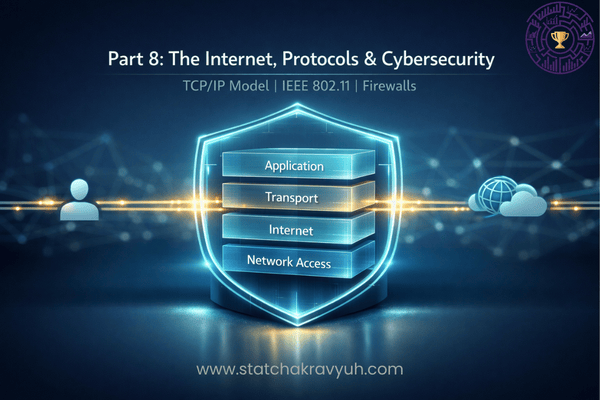
Initially developed by the US Defence Advanced Research Projects Agency (DARPA), the TCP/IP model is the foundational communication standard of the Internet. It consists of four distinct layers, each handling specific protocols:
A. Application Layer The application layer is responsible for managing all the user interface requirements and providing network services directly to the user’s software. The UPSC frequently asks candidates to identify protocols belonging to this layer. The most important application layer protocols include:
- HTTP (HyperText Transfer Protocol): Used for accessing web pages.
- FTP (File Transfer Protocol): Used for transferring files between computers.
- SMTP (Simple Mail Transfer Protocol): Used for sending email messages.
- DHCP (Dynamic Host Configuration Protocol) & DNS (Domain Name System): Used for network configuration and domain name resolution.
B. Transport Layer The transport layer is responsible for the reliable, end-to-end delivery of packets. It ensures that data reaches its destination without errors. The two primary protocols operating at this layer are TCP (Transmission Control Protocol) and UDP (User Datagram Protocol).
C. Network Layer (Internetworking / IP Layer) This is arguably the most tested layer in the UPSC ISS exam. The network layer is responsible for routing packets across different networks based on their IP addresses. It contains three critical protocols you must memorize:
- IP (Internet Protocol): A connectionless protocol responsible for the routing and delivery of packets.
- ICMP (Internet Control Message Protocol): Responsible for reporting errors, sending error messages, and controlling the flow of packets across the network.
- ARP (Address Resolution Protocol): Responsible for determining the hardware Media Access Control (MAC) address corresponding to a specific IP address.
D. Physical Layer The physical layer collects packets to form frames and interacts directly with the transmission medium (hardware). It operates using standards like RS-232C and IEEE 802.3 rather than traditional software protocols.
(Note: Another model, the OSI Model, consists of seven layers: Application, Presentation, Session, Transport, Network, Data Link, and Physical. However, UPSC questions primarily target the 4-layer TCP/IP framework).
Wireless Standards: The IEEE 802.11 (Wi-Fi)
While cables and optical fibres form the backbone of the Internet, end-users increasingly rely on wireless connectivity. To ensure that wireless devices manufactured by different companies can communicate seamlessly, the Institute of Electrical and Electronics Engineers (IEEE) establishes universal standards.
For wireless local area networking, the universally recognized standard is IEEE 802.11. In professional computing and networking, the term “Wi-Fi” is used as a direct synonym for the IEEE 802.11 technology standard. Recognizing this exact standard number is crucial, as the UPSC has tested it directly.
Cybersecurity & Firewalls
Connecting a computer to the global Internet exposes it to various external threats, including malware, viruses, and unauthorized hackers. Therefore, implementing robust Security Management is a fundamental requirement of modern operating systems and networks.
To protect networks, professionals rely on several mechanisms and concepts:
A. Security Services
In data communication, security must guarantee several parameters. One of the most important concepts is Non-repudiation. Non-repudiation is a security service that guarantees that a transmitted message was sent and received, strictly preventing either the sender or the receiver from denying their involvement in the transmission.
B. The Firewall
A firewall is a specialized software or hardware system designed to prevent unauthorized users or malicious programs from gaining access to a private network.
The UPSC specifically tests knowledge on the Packet Filter Firewall. A packet filter firewall operates by inspecting the data packets entering or exiting a network. It checks all IP packets against a set of predefined security rules; if a packet is found to be valid and safe, it is allowed to enter or exit the network. If it violates the rules, the firewall instantly blocks it.
Professional Analysis of UPSC ISS Previous Year Questions (PYQs)
To solidify your preparation and demonstrate exactly how the commission frames its options, let us professionally analyze 6 official UPSC ISS PYQs directly related to the Internet, Protocols, and Cybersecurity.
Q. At which layer of TCP/IP do ICMP and ARP function?
(a) Network layer (b) Application layer (c) Transport layer (d) Physical layer
Professional Analysis: As defined in the standard TCP/IP reference model, the Internet Control Message Protocol (ICMP) for error reporting and the Address Resolution Protocol (ARP) for MAC address determination both operate strictly within the Network layer (also known as the IP layer).
Correct Answer: (a) Network layer.
Q. In TCP/IP reference model, consider the following protocols belonging to various layers:
1. SMTP
2. FTP
3. DHCP
4. IP
TCP Which of the above are the Application Layer Protocols?
(a) 1, 2 and 3 (b) 1, 3 and 4 (c) 1, 3 and 5 (d) 3, 4 and 5
Professional Analysis: The Application layer manages user-facing network services. SMTP (mail), FTP (file transfer), and DHCP (configuration) operate at the Application layer. IP operates at the Network layer, and TCP operates at the Transport layer.
Correct Answer: (a) 1, 2 and 3.
Q. Which of the following is not an application layer protocol?
(a) ARP (b) FTP (c) DNS (d) SNMP
Professional Analysis: FTP, DNS, and SNMP are all standard application layer protocols that provide high-level services. ARP (Address Resolution Protocol) is responsible for hardware address mapping and functions strictly at the Network layer.
Correct Answer: (a) ARP.
Q. A packet filter firewall can:
(a) filter the specific users from accessing the services of the network.
(b) block all IP packets from entering the networks.
(c) check all IP packets and if found valid, then it is allowed to enter or exit the networks.
(d) block any kind of viruses from entering the networks.
Professional Analysis: A packet filter firewall does not blindly block all packets; otherwise, the network would be useless. Its exact structural definition is to examine incoming and outgoing IP packets against security rules and allow them to pass only if they are found valid.
Correct Answer: (c) check all IP packets and if found valid, then it is allowed to enter or exit the networks.
Q. A Wi-Fi is often used as a synonym for which IEEE technology?
(a) 802.1 (b) 802.5 (c) 802.9 (d) 802.11
Professional Analysis: The Institute of Electrical and Electronics Engineers (IEEE) designated the 802.11 standard exclusively for wireless local area networking. Today, this technical standard is universally referred to by its commercial synonym, Wi-Fi.
Correct Answer: (d) 802.11.
Q.Which of the following security services prevents either sender or receiver from denying a transmitted message?
(a) Authentication (b) Confidentiality (c) Non-repudiation (d) Integrity
Professional Analysis: In cybersecurity, Authentication verifies identity, Confidentiality encrypts data, and Integrity ensures data was not altered. The specific service that provides undeniable proof of the origin and receipt of data, preventing either party from denying the transmission, is Non-repudiation.
Correct Answer: (c) Non-repudiation.
What Lies Ahead?
In this eighth installment of our Computer Series for UPSC ISS, we successfully navigated the global digital sphere. You now possess a professional understanding of the TCP/IP layered model, the exact operational scope of protocols like ICMP, ARP, and SMTP, the IEEE 802.11 Wi-Fi standard, and the protective mechanisms of Packet Filter Firewalls.
Now that we understand how data travels globally and securely, a critical question arises: Once this massive amount of data arrives at its destination, how does an organization efficiently store, organize, and manipulate it?
In Part 9, we will transition into Database Management Systems (DBMS) & Data. We will dissect data models, the Client-Server architecture, transaction ACID properties, and the fundamentals of Structured Query Language (SQL). Ensure your notes on network protocols are thoroughly revised, and get ready to dive into the backend of computing in our next article!
(Have a specific doubt about the layers of the TCP/IP model, the IEEE 802.11 Wi-Fi standard, or how Packet Filter Firewalls protect a network? Drop it in the comments below!)
[…] our previous article, we explored the global digital sphere, understanding how the Internet operates, the protocols that […]