
Welcome back, future Indian Statistical Service (ISS) officers!
In our previous article, we successfully decoded the mathematical core of the computer system: Number Systems and Conversions. We learned how a standalone processor manipulates data in binary, octal, and hexadecimal formats. However, in today’s highly integrated digital era, a computer rarely operates in isolation. Computers must communicate, share data, and transfer resources across distances. This brings us to a highly significant and scoring segment of the UPSC ISS syllabus: Computer Networks and Data Communication.
Every year, the UPSC consistently tests candidates on the structural arrangements of networks (Topologies), the geographical classification of networks (LAN, WAN, MAN), and the specific hardware devices used to connect them (Routers, Hubs, and Bridges).
To master this module, we will align our concepts directly with standard reference books—specifically Chapter 14 of “Fundamentals of Computers” by E. Balagurusamy and Chapter 7 of “Computer Fundamentals and Programming in C” by Reema Thareja. Let us systematically break down the architecture of computer networks.
The Fundamentals of Data Communication
Before networking computers together, one must understand how data travels. Data communication is the process of transmitting data from a source to a destination. A complete communication system requires five basic elements: a sender, a receiver, a medium (the physical wire or wireless channel), a message, and a protocol (the strict set of rules governing the communication).
When multiple computers are interconnected to share these messages, applications, and resources, they form a Computer Network
Geographical Classification of Networks
UPSC frequently tests the operational scope of different networks. Depending on the geographical area they cover, networks are classified into the following categories:
- Local Area Network (LAN): A LAN is a group of interconnected computers confined to a small geographical area, such as a single room, a building, or a campus.
- Metropolitan Area Network (MAN): A MAN is a regional network that typically connects computers within a specific city or a large metropolitan area. Its size generally lies between that of a LAN and a WAN.
- Wide Area Network (WAN): A WAN connects computers across a large geographical area, such as across states, countries, or entire continents. The Internet itself is the ultimate example of a global WAN.
- Intranet: This is a highly tested concept. An Intranet is a private, secure network of computers usually contained within a single organisation. It allows only the internal users of that organisation to share resources, strictly blocking external access.
Network Topologies: The Physical Architecture
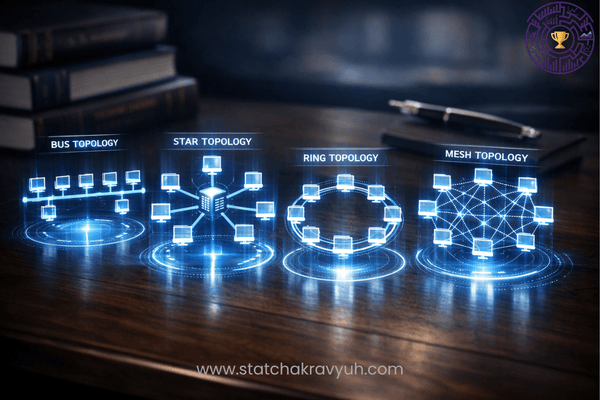
A network topology refers to the physical or logical arrangement of computers (nodes) and cables in a network. Understanding topologies is critical, as UPSC repeatedly targets the structural definitions and failure points of these architectures.
A. Bus Topology
In a Bus topology, all the computer nodes are connected to a single, continuous backbone cable. Data transmitted by any computer travels along this single wire to reach its destination. If a single computer fails, the rest of the network can usually continue functioning; however, if the main backbone cable breaks, the entire network crashes.
B. Star Topology
In a Star topology, all the computers are connected to a central connecting device, typically a Hub or a Switch. All data traffic must pass through this central hub before reaching its intended destination. The failure of one computer does not affect the others, but if the central Hub fails, the entire network goes down.
C. Ring Topology
In a Ring topology, computers are connected in a closed-loop or circular pattern. Data travels in one direction from node to node. The major disadvantage here is that the failure of a single computer or a single cable break can disrupt the entire network loop.
D. Mesh Topology
In a Mesh topology, every single computer is directly connected to every other computer in the network with dedicated cables. It provides high reliability and excellent fault tolerance, as the failure of one link does not affect the rest of the network. However, it is the most complex and expensive topology to install.
E. Hybrid Topology
A Hybrid topology is simply a combination of two or more different topologies (such as Star and Bus) to leverage the benefits of each.
Networking Devices: The Hardware Bridge
To establish these topologies and allow networks to communicate, specific hardware devices are required. You must understand the distinct operational function of each:
- Repeater: Signals degrade over long distances. A repeater is a device used to regenerate and amplify the incoming analog or digital signals so they can travel further without losing data.
- Hub: A hub is a central connection point used extensively in Star topologies. When a hub receives a data packet, it simply broadcasts that packet to all other connected ports.
- Bridge: A bridge is a device used to connect two similar LAN segments, essentially acting as a filter to manage network traffic.
- Router: A router is a highly intelligent, special-purpose computer used to interconnect different networks. When a router receives an IP packet, it examines the destination address, determines the best outgoing link, and forwards the packet to the next router or final destination.
Professional Analysis of UPSC ISS Previous Year Questions (PYQs)
To solidify your preparation and demonstrate exactly how the commission frames its options, let us professionally analyze 6 official UPSC ISS PYQs related to networks and topologies.
PYQ 1 In which of the following topology, all the nodes are connected to a single backbone cable?
(a) Mesh (b) Star (c) Hybrid (d) Bus
Professional Analysis: As structurally defined, the Bus topology utilizes a single, central backbone wire to which all other computer nodes are attached. Mesh connects all nodes directly, and Star utilizes a central hub device.
Correct Answer: (d) Bus.
PYQ 2 Which device is used for connecting the computers in a star topology?
(a) Router (b) Hub (c) Repeater (d) Bridge
Professional Analysis: While routers connect entire networks, the specific central connecting device utilized to tie individual computers together within a local Star topology is the Hub (or a Switch).
Correct Answer: (b) Hub.
PYQ 3 Which of the following are network connecting devices?
I. Repeater II. Bridge III. Hub IV. Bluetooth
(a) I, II and III (b) I, II and IV (c) I, III and IV (d) II, III and IV
Professional Analysis: Standard network hardware devices utilized to physically connect cables and route data include Repeaters, Bridges, and Hubs. Bluetooth is a wireless communication technology standard, not a dedicated physical networking device.
Correct Answer: (a) I, II and III.
PYQ 4 Consider the following in respect of working of router in computer networks:
I. It is used for the purpose of interconnecting computer networks.
II. It determines on which outgoing link an IP packet is to be forwarded.
III. The destination address of the IP packet is examined, and it is routed to the next router.
Which of the statements given above are correct?
(a) I and II only (b) II and III only (c) I and III only (d) I, II and III
Professional Analysis: A router is explicitly designed to interconnect distinct networks (I). It operates at the network layer, reading the destination IP addresses on data packets (III) to determine the most optimal outgoing link to forward the traffic (II). All three statements perfectly describe a router’s function.
Correct Answer: (d) I, II and III.
PYQ 5 Consider the following network topologies: 1. Bus 2. Star 3. Ring 4. Mesh. In which of the above does the failure of one computer not affect the other computer in the network?
(a) 1, 2 and 4 (b) 1, 3 and 4 (c) 3 and 4 only (d) 1 and 2 only
Professional Analysis: In a Bus topology, one computer failing does not break the backbone cable. In a Star topology, one computer failing does not break the central Hub. In a Mesh topology, one computer failing does not disrupt the independent links between other computers. However, in a standard Ring topology, data travels sequentially through each node; if one computer fails, the loop breaks, affecting the entire network. Thus, Bus, Star, and Mesh are resilient to a single node failure.
Correct Answer: (a) 1, 2 and 4.
PYQ 6 Consider the following statements:
1. Intranet is a wide area network, using TCP/IP protocol like the Internet.
2. Intranet is a private network of an organisation.
3. Hackers are known to have logged on computers breaching password security.
Which of the above statements are correct?
(a) 1 and 2 only (b) 2 and 3 only (c) 1 and 3 only (d) 1, 2 and 3
Professional Analysis: Statement 2 is the textbook definition of an Intranet: a private network confined to a single organization. Statement 3 is a general factual statement regarding cybersecurity vulnerabilities. However, Statement 1 is incorrect because an Intranet is primarily a Local Area Network (LAN) or a collection of local networks bounded by an organization’s firewalls, not a public Wide Area Network (WAN) like the Internet.
Correct Answer: (b) 2 and 3 only.
What Lies Ahead?
In this seventh installment of our Computer Series for UPSC ISS, we successfully expanded our understanding from isolated computers to interconnected systems. You are now equipped with professional clarity on geographical networks (LAN, WAN, MAN), the distinct architectural layouts of topologies (Bus, Star, Ring, Mesh), and the roles of vital hardware like Hubs and Routers.
However, local networks and physical cables are only one part of the connectivity equation. How do these networks communicate globally without wires? What are the exact protocols that govern the World Wide Web, and how do we protect these systems from malicious cyber attacks using Firewalls?
In Part 8, we will transition from local networking into the global digital sphere: The Internet, Protocols & Cybersecurity. We will decode high-yield exam topics such as TCP/IP layers, the IEEE 802.11 Wi-Fi standard, and the specific functionalities of Packet Filter Firewalls. Revise your notes on topologies, practice the provided PYQs, and prepare to secure the network in our next article!
(Have a specific doubt about Network Topologies like Bus and Star, or the operational differences between Hubs, Bridges, and Routers? Drop it in the comments below!)
[…] our previous article, we successfully transitioned from the internal hardware of a computer to the concept of […]