
Welcome back, future Indian Statistical Service (ISS) officers!
In our previous article, we explored the global digital sphere, understanding how the Internet operates, the protocols that govern data transmission, and how firewalls protect our networks from cyber threats. Now that we understand how data travels securely across the globe, we must address the next critical question: How do we effectively store, organise, and manipulate this massive amount of data once it arrives?
This brings us to one of the most practical and heavily tested topics in the UPSC ISS Paper I syllabus: Database Management Systems (DBMS) and Data Architecture.
As future statistical officers, your entire career will revolve around handling massive datasets. Naturally, the UPSC expects you to have a professional-level understanding of how databases operate, the structural difference between the frontend and backend, and the fundamental properties of the Structured Query Language (SQL). Today, we will dissect the DBMS ecosystem to ensure you are fully prepared for the examination.
The Fundamentals: Data vs. Information
Before diving into complex software, it is vital to understand the fundamental difference between data and information.
- Data refers to the raw, unorganised facts, figures, or details that need to be processed. For instance, a list of random survey numbers or dates of birth is simply data.
- Information is the processed, structured, and meaningful output derived from that data. Calculating the exact age, average income, or demographic distribution from those raw dates and numbers provides actionable information.
In modern computing, handling this transition from raw data to structured information requires specialized software known as a Database Management System.
What is a Database Management System (DBMS)?
A Database Management System (DBMS) is a highly sophisticated system software that helps users create, store, maintain, and secure records in a database. A database itself is a collection of records stored in a highly structured and logical manner.
To organise these records efficiently, a DBMS uses specific Data Models. UPSC frequently tests candidates on the structural definitions of these models:
- Hierarchical Model: In this model, data is arranged in the form of a tree structure. Each record is attached to one parent node and can have one or more child nodes.
- Network Model: Data is arranged in a complex network where each node can be connected to multiple parent and child nodes.
- Relational Model: This is the most common model, where data is organised into standard two-dimensional tables consisting of rows and columns.
Frontend vs. Backend and Client-Server Architecture
When a software project or application is developed, it is conceptually divided into two distinct parts: the Frontend and the Backend.
- Frontend: This is the user interface. It is what the user sees, interacts with, and clicks on. It is designed to be user-friendly and intuitive.
- Backend: This is the invisible powerhouse of the application. It consists of the database where all the records are stored, and the server that processes the user’s requests.
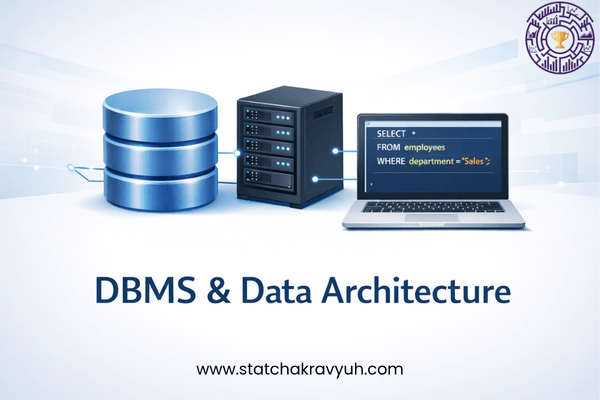
This separation is perfectly demonstrated in a Client-Server Architecture. In a client-server network, the Client (the frontend user’s computer) sends a request for data. The Server (the backend system) receives this request, processes it, and sends the information back. From an exam perspective, it is critical to note that the Server is primarily responsible for managing database access, ensuring data security, and maintaining data integrity.
Transaction Mechanisms: The ACID Properties
When a database is updated (for instance, transferring money from one account to another), the transaction must be flawless. A partial update can destroy the integrity of the data. To prevent this, standard database systems rely on strict transaction mechanism properties, universally known as ACID:
- Atomicity: A transaction must be an “all-or-nothing” operation. If an operation consists of multiple steps, either all steps must be executed successfully, or none of them should be executed at all.
- Consistency: The database must remain in a consistent state before and after the transaction.
- Isolation: The intermediate results or data of one transaction must remain invisible to other transactions until the entire operation is fully completed.
- Durability: Once a transaction is successfully completed, the changes made to the database must be permanently saved and not lost, even in the event of a system failure.
Structured Query Language (SQL)
To communicate with a relational database, administrators use a specific database query language known as SQL (Structured Query Language).
SQL enables a user to perform various crucial operations, such as executing complex search queries, inserting new data, and updating or deleting existing records in the database.
Important Note for UPSC: While SQL is highly powerful for managing data, it does not automatically eliminate duplicate records when you run a general query. To remove duplicates from your search results, a programmer must explicitly use a specific keyword known as DISTINCT. UPSC has historically tested candidates on this exact limitation.
Professional Analysis of UPSC ISS Previous Year Questions (PYQs)
Let us apply this professional knowledge to 5 official UPSC ISS PYQs to understand how these concepts translate into actual exam questions.
Q. In a client-server Database Management System architecture, which one of the following is primarily responsible for managing database access, security, and data integrity?
(a) Query processor (b) Client (c) Server (d) Database administrator
Professional Analysis: In the client-server architecture, the client acts as the requester interface, while the backend Server is the centralised powerhouse structurally responsible for processing queries, managing concurrent access, and ensuring the absolute security and integrity of the database.
Correct Answer: (c) Server.
Q. In which of the following data models are the records arranged in the form of a tree?
(a) Entity model (b) Relational model (c) Hierarchical model (d) Network model
Professional Analysis: Standard DBMS architecture classifies data models based on their structural layout. The Relational model uses two-dimensional tables, the Network model uses a multi-parent web, and the Hierarchical model strictly arranges records in a top-down, parent-child tree structure.
Correct Answer: (c) Hierarchical model.
Q. Consider the following statements in respect of SQL:
1. SQL can execute queries against a database.
2. SQL can update records in a database.
3. SQL query automatically eliminates duplicates.
Which of the statements given above are correct?
(a) 1 and 2 only (b) 2 and 3 only (c) 1 and 3 only (d) 1, 2 and 3
Professional Analysis: SQL is the standard language used to execute queries and update database records (statements 1 and 2 are correct). However, statement 3 is factually incorrect because SQL does not automatically eliminate duplicates; a user must explicitly apply the DISTINCT keyword in their query to filter out redundant data.
Correct Answer: (a) 1 and 2 only.
Q. Which of the following properties of transaction mechanism in a database system are correct?
1. Atomicity
2. Durability
3. Isolation
Security Select the correct answer using the code given below:
(a) 1, 2 and 3 (b) 1, 2 and 4 (c) 1, 3 and 4 (d) 2, 3 and 4
Professional Analysis: The universal transaction mechanisms in database management are defined by the ACID properties: Atomicity, Consistency, Isolation, and Durability. While “Security” is a broader database feature, it is not classified as a core transaction property.
Correct Answer: (a) 1, 2 and 3.
PYQ. Consider the following statements regarding Database Management System (DBMS):
I. It helps the user in maintaining data integrity while performing the various operations on the database values.
II. It helps the user in maintaining consistency in the information stored in the database.
III. It allows the user to maintain the security of the confidential information by password-protecting the database.
Which of the statements given above are correct?
(a) I and II only (b) II and III only (c) I and III only (d) I, II and III
Professional Analysis: The primary objective of a robust DBMS is to prevent data corruption. It achieves this by maintaining data integrity during operations (I), ensuring system consistency (II), and providing access control mechanisms, including password protection and user authentication, to secure confidential information (III). All statements accurately describe the functions of a DBMS.
Correct Answer: (d) I, II and III.
What Lies Ahead?
In this ninth article of our Computer Series for UPSC ISS, we successfully demystified the storage backend. You now possess a professional understanding of Data Models (Hierarchical, Network, Relational), the critical role of the Server in a client-server architecture, the indispensable ACID properties of transactions, and the basic querying capabilities of SQL.
At this point in our series, we have covered hardware, memory, software, networks, number systems, and database management. The final frontier of the UPSC ISS computer syllabus dives into the very logic that creates software in the first place: Basics of Programming.
However, do not worry – you will not be asked to write code! The UPSC simply wants you to understand the structural logic behind programming. In Part 10, we will begin our final three-part module with Programming Foundations I: Algorithms & Flowcharts. We will learn how complex problems are broken down into diagrammatic steps and decode crucial exam terminology like “Space Complexity” and “Time Complexity.” Keep reviewing your notes on DBMS and get ready to explore the foundational logic of programming in our next session!
(Have a specific doubt about the ACID properties of a transaction, Client-Server architecture, or how to use the DISTINCT keyword in SQL? Drop it in the comments below!)
[…] our previous article, we mastered the backend, thoroughly exploring how Database Management Systems (DBMS) structure and […]