
Cyber and economic threats often cross borders. Multilateral platforms therefore matter more than ever. The 25th SCO Summit at Tianjin, China, was one of the major events of 2025.
The 25th Meeting of the Council of Heads of State of the Shanghai Cooperation Organisation was held in Tianjin, China, from 31 August to 1 September 2025. Prime Minister Narendra Modi attended along with Chinese President Xi Jinping, Russian President Vladimir Putin, and over 20 other leaders. The Summit ended with the adoption of the Tianjin Declaration. For ISS aspirants, this Summit is a goldmine of International Relations content.
India’s three pillar approach
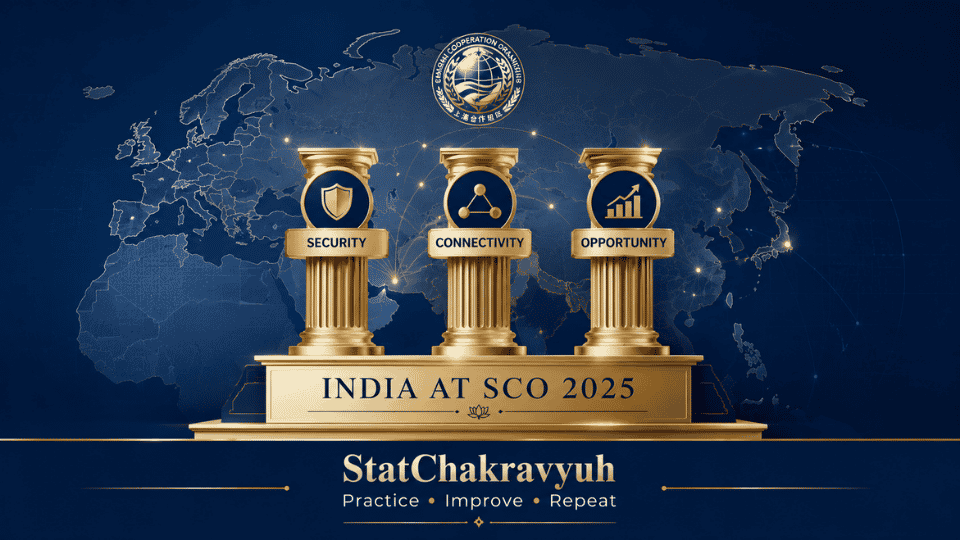
Prime Minister Modi articulated India’s approach through three pillars, namely Security, Connectivity, and Opportunity. He called for firm and decisive action against terrorism, including coordinated action on terror financing and radicalisation. He also proposed a Civilizational Dialogue Forum within the SCO to deepen people to people ties and cultural understanding.
Other key outcomes
China announced an SCO Development Bank, an energy cooperation platform, and pledged around 1.4 billion US dollars in loans and grants. Xi Jinping invited members to access China’s BeiDou navigation system and promoted AI and lunar cooperation. Russia endorsed a multipolar Eurasian security framework. Centres for organised crime, drug trafficking, cyber security, and information security were announced.
Symbolic and strategic moments
Modi and Xi held their first meeting on Chinese soil in seven years, signalling a reset in India China relations. Modi also reaffirmed the special and privileged partnership with Russia. The visuals of Modi, Putin, and Xi together drew global attention, especially against the backdrop of US tariff pressures. India clearly wanted to signal that strategic options are diverse, not dictated by any single capital.
What India did and did not endorse
India did not sign on to certain Belt and Road Initiative references that conflict with its position on sovereignty, particularly regarding the China Pakistan Economic Corridor through Pakistan occupied Kashmir. India also avoided endorsing positions that could conflict with its own engagement with Western partners. The Summit therefore showcased India’s ability to balance partnerships rather than choose sides.
SCO Tianjin Summit 2025: Quick Reference
| Aspect | Detail |
| Dates | 31 August to 1 September 2025 |
| Venue | Tianjin, China |
| Outcome Document | Tianjin Declaration |
| India Pillars | Security, Connectivity, Opportunity |
| Major Initiative | SCO Development Bank announced |
| Next Presidency | Kyrgyzstan |
A Real Aspirant Story
Imagine a foreign policy aspirant named Ankit who used to memorise SCO as a one line group of Eurasian countries. After the Tianjin Summit, he can now describe India’s three pillars, name the Tianjin Declaration, and explain why India did not endorse certain BRI references. The same aspirant suddenly becomes capable of writing a layered International Relations answer in ISS Mains.
Bridge to the Next Topic
The most watched bilateral relationship at the Summit was, of course, between India and China. After years of border tensions, both countries worked through 2025 on what some call a new reset. Read here