
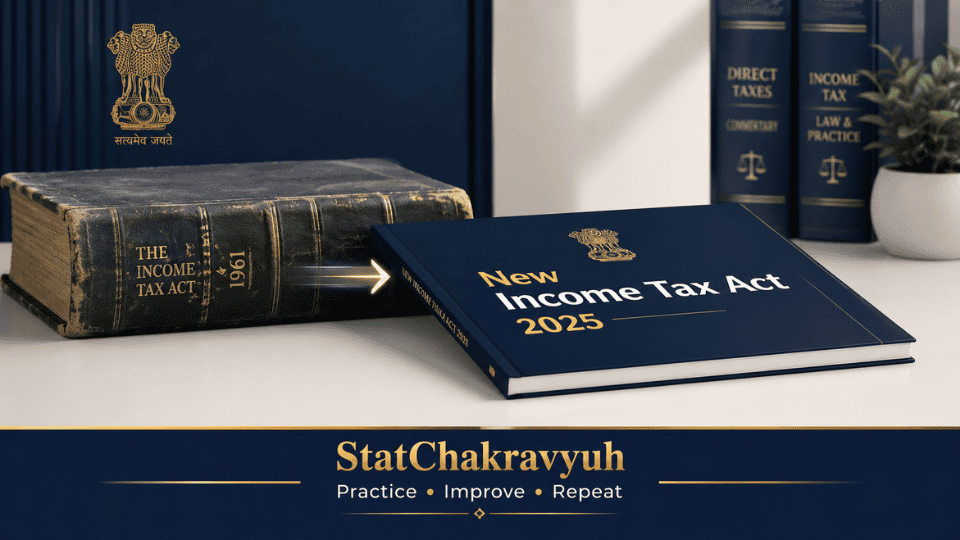
The Budget 2025-26 set the stage for a much bigger change in direct taxation. The Income Tax Act of 1961 is finally being replaced after more than six decades.
The Income Tax Act of 1961 grew so complicated over the years that even seasoned chartered accountants needed flowcharts to interpret it. The New Income Tax Act 2025 is an attempt to clean up that mess. It comes into effect from 1 April 2026, replaces the 1961 Act, and tries to make the law shorter, simpler, and more readable. For an ISS aspirant, this is a guaranteed exam topic for the next few cycles.
Why a new Act was needed
The 1961 Act had grown to about 298 sections, 14 schedules, and thousands of amendments. Cross references, provisos, explanations, and circulars made it extremely hard to read. The new Act follows a Direct Tax Code style approach. The language is plainer, the structure is more organised, and many redundant provisions are removed.
Key structural changes
The most important conceptual change is the introduction of a single Tax Year, replacing the older confusion between Previous Year and Assessment Year. The new Act runs into roughly half the page count of the old one. Tables are now used instead of long paragraphs, and definitions are placed closer to the chapter where they are used. The intent is clarity, not concession.
What stays the same and what shifts
Tax rates and slabs are still announced through the Finance Act, so the new Act itself does not directly cut rates. The Minimum Alternate Tax structure is being made the final tax in some cases. Capital gains, business income, and house property heads remain conceptually the same, but the way each is presented becomes more reader friendly. Faceless assessment, search and seizure provisions, and dispute resolution mechanisms continue with refinements.
Why ISS aspirants must care
The Indian Statistical Service General Studies paper regularly tests reforms in taxation, fiscal policy, and the relationship between law and economy. The shift from a 1961 Act to a 2025 Act is exactly the kind of historical pivot that examiners love to ask. Even one well written paragraph on simplification, codification, and tax certainty can lift your answer.
Comparison: Old Income Tax Act vs New Income Tax Act 2025
| Feature | Income Tax Act 1961 | New Income Tax Act 2025 |
| Year of Enactment | 1961 | 2025 (effective April 2026) |
| Approximate Sections | Around 298 | Significantly fewer |
| Drafting Style | Long paragraphs, many provisos | Tables, plain language |
| Tax Year Concept | Previous Year and Assessment Year | Single Tax Year |
| Targeted Outcome | Compliance heavy | Clarity and reader friendly |
A Real Aspirant Story
Think of an MBA student named Arjun who tried to read the 1961 Act for an internship. He gave up at Section 10 because of its long list of exemptions. The 2025 Act presents the same exemptions in a tabular form. The same student is now able to read it without help. That illustrates the spirit of the new law much better than any technical explanation.
Quiz: New Income Tax Act 2025
Q1. The New Income Tax Act 2025 replaces which earlier law?
(A) Income Tax Act 1922
(B) Income Tax Act 1961
(C) Direct Tax Code 2010
(D) Finance Act 2024
Answer: (B) Income Tax Act 1961. The New Income Tax Act 2025 replaces the Income Tax Act of 1961 after more than six decades.
Q2. From which date does the New Income Tax Act 2025 come into effect?
(A) 1 April 2025
(B) 1 January 2026
(C) 1 April 2026
(D) 1 April 2027
Answer: (C) 1 April 2026. The Act comes into effect from 1 April 2026.
Q3. What is the most important conceptual change introduced by the new Act?
(A) Abolition of income tax
(B) Introduction of a single Tax Year
(C) Removal of capital gains tax
(D) Flat 10 percent tax rate
Answer: (B) Introduction of a single Tax Year. The new Act introduces a single Tax Year, replacing the older confusion between Previous Year and Assessment Year.
Q4. How does the new Act improve readability compared to the 1961 Act?
(A) By adding more provisos
(B) By using tables and plain language
(C) By increasing the number of sections
(D) By removing all definitions
Answer: (B) By using tables and plain language. The new Act uses tables and plain language instead of long paragraphs and complex provisos.
Q5. How are income tax rates and slabs announced even after the new Act?
(A) Through the new Act itself
(B) Through the Finance Act
(C) Through RBI notification
(D) Through a Presidential order
Answer: (B) Through the Finance Act. Tax rates and slabs continue to be announced through the Finance Act, so the new Act itself does not directly cut rates.
FAQs: New Income Tax Act 2025
What does the New Income Tax Act 2025 replace?
The New Income Tax Act 2025 replaces the Income Tax Act of 1961 after more than six decades of use.
When does the New Income Tax Act 2025 come into effect?
The New Income Tax Act 2025 comes into effect from 1 April 2026.
What is the single Tax Year concept in the new Act?
The new Act introduces a single Tax Year, replacing the older and more confusing distinction between Previous Year and Assessment Year.
Does the New Income Tax Act 2025 change tax rates?
No, tax rates and slabs continue to be announced through the annual Finance Act, so the new Act mainly simplifies the structure and language of the law.
How is the new Act simpler than the 1961 Act?
The new Act uses tables and plain language instead of long paragraphs and complex provisos, making it far easier to read.
Bridge to the Next Topic
Direct taxes are only one half of the story. On the indirect tax side, the GST regime itself underwent its biggest overhaul since 2017. That brings us straight to GST 2.0. Read here
[…] The Budget also signalled the arrival of a brand new direct tax law, replacing the six-decade-old Income Tax Act of 1961. Let us understand that next, because every ISS interview panel and Mains paper is now likely to touch it. Read here […]