
Welcome back, future Indian Statistical Service (ISS) officers!
Over the course of this series, we have journeyed through the entire landscape of the UPSC ISS Computer Applications syllabus. We started from the physical hardware and the Central Processing Unit, moved through memory management, explored the vast networks of the Internet, decoded complex number systems, and structured massive databases. In our recent articles, we transitioned into the theoretical logic of software development, mastering flowcharts, iterative loops, and control structures.
Today, we reach the grand finale. In this concluding chapter, we will explore the highest level of programming logic: Functions, Modular Programming, and Sorting Algorithms.
As a future Statistical Officer, you will handle immense datasets that require sorting, categorisation, and complex mathematical calculations. The UPSC frequently tests your understanding of how software handles these exact tasks – specifically focusing on how large programs are divided into “modules,” how mathematical libraries are linked, and the critical concept of “Sorting Stability.”
Let us professionally decode these final concepts and secure those last crucial marks in Paper I.
The Power of Modular Programming: Structural Language
In the early days of computing, software was written as one massive, continuous block of code. If a program had 10,000 lines, the computer read it sequentially from top to bottom. This monolithic approach made finding errors (debugging) incredibly difficult and updating the software almost impossible.
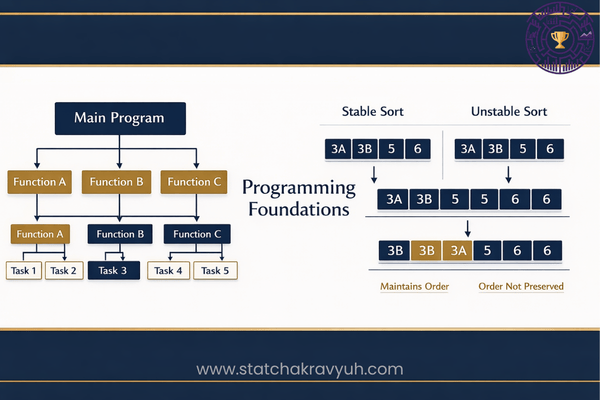
To solve this, computer scientists introduced a revolutionary paradigm: Modular Programming. Instead of writing one massive block of code, the program is divided into smaller, independent, and manageable blocks called Modules. Each module handles a specific, dedicated task.
From an examination perspective, you must know that the division of a computer program in terms of functions and modules is the defining, vital feature of a Structural Language. High-level structural languages, such as C, C++, and Java, employ this paradigm to make software development efficient, readable, and highly organised.
Inside the Modules: Understanding Functions
Within these modules, the actual logic is executed using Functions. A function refers to a specific set of statements designed to perform a well-defined task.
When a program is executed, it does not just run linearly; it “calls” different functions as needed. Functions enable developers to break a complex problem into smaller parts, which are executed as separate, independent units.
Functions are broadly classified into two categories:
- User-Defined Functions: These are custom functions created by the programmer to perform a unique task specific to their software.
- Built-in (Library) Functions: These are pre-written functions provided by the programming language itself.
The Mathematical Library (A UPSC Favourite Concept)
As statisticians, mathematical calculations are your primary domain. In programming, if you want to calculate an exponential value, you do not need to write the complex mathematical logic from scratch. You simply use a built-in function like exp(). How does the computer understand this? When a program uses the exp() function, the object code of this specific function is brought directly from the pre-existing ‘math’ library of the system. The Linker then permanently links this mathematical object code to your main program to generate the final executable file.
Software Development and Operating Systems
A common misconception among beginners is that writing software for Windows requires a completely different logical approach than writing software for Linux. The UPSC actively tests this conceptual clarity.
You must understand that the fundamental logic of software development—analysing the problem, designing the algorithm, drawing the flowchart, writing the code, and debugging the errors—is universal. Therefore, the steps for developing a software program remain exactly the same irrespective of the Operating System.
While the final compiler might translate the machine code differently for Windows versus Linux, the human-driven steps of software development (the logic, the modular division, the functions used) do not change based on the platform.
Sorting Algorithms and “Stability” (High Yield Concept)
Sorting data—arranging records in a specific ascending or descending order—is arguably the most common operation performed on databases. Computer scientists have developed dozens of sorting algorithms, each with its own time and space complexity.
However, the UPSC ISS examination focuses heavily on a specific property of these algorithms: Sorting Stability.
What is a Stable Sort? Imagine you have a database of citizens, and you want to sort them by age. In your original, unsorted database, there are two individuals, “Amit” and “Zoya,” who are both exactly 25 years old. In the original list, Amit’s name appears before Zoya’s name.
- A Stable Sorting Algorithm guarantees that if two elements have the exact same key (both are 25), they will remain in their original relative order after the sorting is complete. (Amit will strictly remain above Zoya in the final sorted list).
- An Unstable Sorting Algorithm makes no such guarantee. It might blindly swap them, placing Zoya above Amit, destroying the original secondary order.
The Professional Classification for UPSC: You must memorise the classification of standard algorithms based on their stability:
- Stable Sorting Algorithms: Bubble Sort, Merge Sort, and Insertion Sort.
- Unstable Sorting Algorithms: Quick Sort. (While Quick Sort is incredibly fast, its methodology inherently destroys the original relative order of identical elements).
Professional Analysis of UPSC ISS Previous Year Questions (PYQs)
To conclude our series, let us rigorously analyse 5 official UPSC ISS PYQs that directly target today’s concepts. Notice how perfectly the theoretical structures align with the examination options.
Q. Which of the following algorithms are stable?
1. Bubble sort
2. Quick sort
3. Merge sort
4. Insertion sort
Select the correct answer using the code given below:
(a) 1, 2 and 3 (b) 1, 2 and 4 (c) 1, 3 and 4 (d) 2, 3 and 4
Professional Analysis: As defined in standard computer science data structures, stable sorting algorithms preserve the relative sequential order of identical elements. Bubble sort, Merge sort, and Insertion sort are structurally stable. Quick sort is highly efficient but inherently unstable.
Correct Answer: (c) 1, 3 and 4.
Q. Consider the following statements:
1. Steps for developing software program remain same irrespective of the Operating System.
2. If the program is using exp() function, then the object code of this function should be brought from the ‘math’ library of the system and linked to the main program.
Which of the statements given above is/are correct?
(a) 1 only (b) 2 only (c) Both 1 and 2 (d) Neither 1 nor 2
Professional Analysis: Statement 1 is conceptually correct because the logical phases of software engineering (algorithms, design, coding) are independent of the underlying OS. Statement 2 accurately describes the role of standard libraries and the Linker; mathematical functions like exp() are pre-compiled in the math library and linked during execution.
Correct Answer: (c) Both 1 and 2.
Q. Division of a computer program in terms of functions and modules is one of the vital features of: (a) Assembly language (b) Machine language (c) Structural language (d) Low level language
Professional Analysis: Machine and Assembly languages (low-level languages) operate close to the hardware without advanced modular boundaries. The ability to divide complex logic into distinct, manageable blocks (functions and modules) is the defining architectural feature of high-level Structural languages.
Correct Answer: (c) Structural language.
Q. What is the main purpose of the linker in the compilation process of the programming languages? (a) To perform optimization of compiled code
(b) To translate source code into machine code
(c) To check syntax of the program
(d) To combine object files and libraries into an executable program
Professional Analysis: Translating code is the job of the compiler. Checking syntax is done during the editing and compilation phase. The exclusive role of the Linker is to gather the various compiled object files, pull required functions from system libraries (like the math library mentioned in PYQ 2), and seamlessly combine them into one final, executable program.
Correct Answer: (d) To combine object files and libraries into an executable program.
Q. Consider the following fragments:
1. Replication of a bug
2. Understanding the bug
3. Testing the bug
4. Fixing the bug
Which of the above are parts of debugging process?
(a) 1, 2 and 4 only (b) 1 and 2 only (c) 1, 2, 3 and 4 (d) None of the above
Professional Analysis: The lifecycle of debugging requires a methodical approach. A professional must first replicate the error to confirm it exists, understand its underlying cause, test the parameters surrounding it, and finally apply the code fix. All four steps are integral fragments of debugging.
Correct Answer: (c) 1, 2, 3 and 4.
Conclusion of the Computer Series
Congratulations! You have successfully completed the 12-Part Computer Series for UPSC ISS.
From mastering the physical architecture of the CPU to decoding the stability of sorting algorithms, you are now equipped with a professional, highly targeted understanding of the Computer Applications syllabus. You have learned to bypass unnecessary programming complexities and focus strictly on the logical frameworks, hardware concepts, and numerical conversions that the UPSC explicitly tests.
Remember the golden rule of this section: It is about “Awareness,” not “Coding.”
Keep your notes organised, consistently revise the “Elimination Techniques” for number systems, and regularly test yourself against Previous Year Questions. The 20 questions in the Computer section are your most reliable asset in Paper I – approach them with confidence and clarity.
Thank you for joining us on this extensive journey. Keep practicing, keep improving, and we wish you the absolute best for your UPSC ISS examination!
(Have a final doubt about the syllabus or need a quick revision on any topic? Drop it in the comments below!)