
Healthy rural and MSME enterprises need a healthy banking system behind them. That brings us to one of the most discussed legal reforms of the year, the Supreme Court ruling on the SARFAESI Act and the wider NPA framework.
The Securitisation and Reconstruction of Financial Assets and Enforcement of Security Interest Act, 2002, popularly called SARFAESI, allows banks and financial institutions to recover non performing assets without court intervention in many cases. A recent Supreme Court ruling clarified key procedural and constitutional questions around its use. For ISS aspirants, this is a clean intersection of banking, law, and economics.
What SARFAESI is meant to do
SARFAESI gives banks and notified financial institutions the power to take possession of secured assets of defaulting borrowers, sell them, and recover dues without going through normal civil court litigation. It also enables the creation of Asset Reconstruction Companies and the Central Registry, which prevents fraudulent multiple borrowings against the same asset.
Why the Supreme Court ruling matters
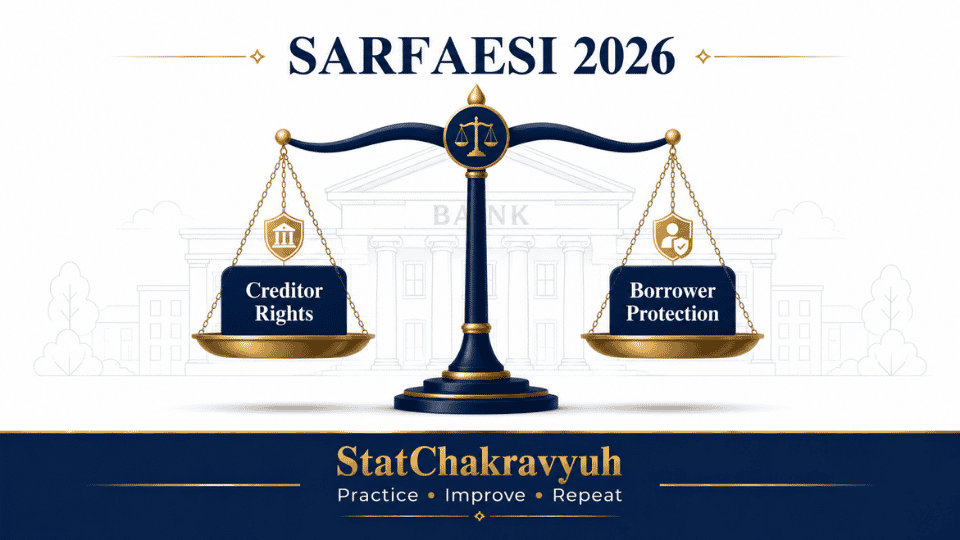
Over the years, several questions had been raised on borrower rights, due process, and the interaction between SARFAESI and the Insolvency and Bankruptcy Code 2016. The latest Supreme Court ruling clarified the balance between the rights of secured creditors and the protection of borrowers. It reinforced that timely action under SARFAESI must follow the procedure in the Act, including notice and opportunity to be heard.
Linking SARFAESI with the wider NPA framework
Indian banking has seen multiple layers of reform on bad loans. The Asset Quality Review by the Reserve Bank of India in 2015-16 forced honest recognition of stressed assets. The IBC 2016 created a time bound resolution framework. SARFAESI continues to handle non IBC cases. Together, these tools have brought the gross NPA ratio of scheduled commercial banks to multi year lows.
Why ISS aspirants must know this
Banking sector reform questions are recurring favourites in ISS Mains. A good answer should mention SARFAESI, the IBC, the Asset Quality Review, the Insolvency and Bankruptcy Board of India, and recent Supreme Court interventions. Quoting the latest gross NPA ratio and a one line on credit growth makes the answer crisp and complete.
Key Tools in India’s NPA Framework
| Tool | Year | Function |
| SARFAESI Act | 2002 | Out of court enforcement of secured assets |
| Asset Quality Review | 2015-16 | Honest recognition of stressed loans |
| IBC | 2016 | Time bound resolution and liquidation |
| Bad Bank (NARCL) | 2021 | Aggregation of stressed assets |
A Real Aspirant Story
Picture a banker named Anita in Hyderabad managing a stressed loan portfolio. Earlier, every recovery case dragged through civil courts for years. With SARFAESI in her toolkit, the IBC for larger cases, and clearer Supreme Court guidance on procedure, her recovery timelines have shortened dramatically. The same bank is now lending more confidently to new MSME customers, and that is exactly how a healthy NPA framework supports the real economy.
Bridge to the Next Topic
The strength of any banking or economic decision depends on the quality of underlying data. India’s statistical bodies and surveys have been quietly modernising. Their reports are crucial for any ISS aspirant. Read here