
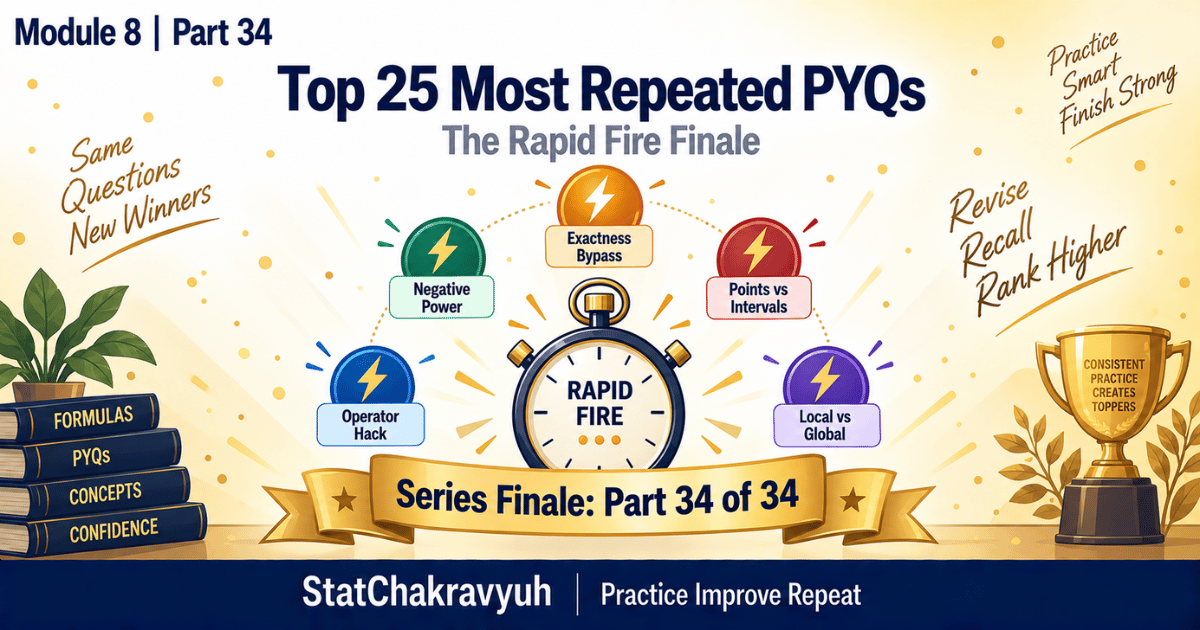
Welcome to Part 34, the grand finale of the entire StatChakravyuh Numerical Analysis series, updated for the UPSC ISS 2026 to 2027 cycle. The concepts are mastered, the cheat sheet is pinned, the master tables are memorized, and the decision tree is hardwired. What remains is the ultimate test of reflexes.
Across the past decade, the examiners have recycled a handful of conceptual traps through 25 and more questions. Solved traditionally, each costs ten minutes; solved with the one line shortcuts, each costs ten seconds. Our archive distills them into five master themes, and today we drill the flagship question of each. Grab a stopwatch.
This post is Part 34 of the Last Minute Revision Guide (Module 8), inside our UPSC ISS Numerical Analysis Complete Guide. Full roadmap at the UPSC ISS hub.
Theme 1: The Operator Shift Hack
PYQ pattern (UPSC ISS 2021 cycle, as recorded in our PYQ archive): What is the value of for ?
(a) (b) (c) (d)
The 10 second shortcut. Do not expand into a bracket storm. Bring upstairs: , since shifts back by . For a cubic at , the second difference is , so shifting the argument gives .
Answer: (a) .
Theme 2: The Negative Power Shortcut
PYQ pattern (UPSC ISS 2025 cycle, as recorded in our PYQ archive): What is the value of at , with the interval of differencing unity?
(a) (b) (c) (d)
The 10 second shortcut. The universal direct formula:
Substitute , , : numerator ; denominator . So the value is .
Answer: (d) .
Theme 3: The Integration Bypass (Exactness)
PYQ pattern (UPSC ISS 2020 cycle, as recorded in our PYQ archive): The integral is evaluated by Simpson’s 1/3 rule with . What value is obtained?
The 10 second shortcut. Ignore the bait entirely. The integrand has degree 2, and Simpson’s 1/3 rule is completely exact up to degree 3, so the numerical value equals the analytical one:
Answer: 26, with zero tables built.
Theme 4: The Points Versus Intervals Illusion
PYQ pattern (UPSC ISS 2016 cycle, as recorded in our PYQ archive): Consider two statements. One: Weddle’s rule requires at least six consecutive values of the function. Two: if is a polynomial of fourth degree, Weddle’s rule gives the exact result. Which are correct?
The 10 second shortcut. Statement one: Weddle’s rule needs intervals in multiples of 6, and six intervals demand exactly 7 consecutive data points, through , not six. False. Statement two: Weddle’s rule is exact up to degree 5, and degree 4 sits safely below that ceiling. True.
Answer: Statement two only.
Theme 5: The Local Versus Global Order Trap
PYQ pattern (UPSC ISS 2021 cycle, as recorded in our PYQ archive): The Runge Kutta method of fourth order means that its local truncation error, denoted , is:
(a) (b)
The 10 second shortcut. The keyword is local. RK4 matches the Taylor series through the term, so the first error of a single step begins at the next power, . Had the question said global, the answer would drop to .
Answer: (b) .
The Series Is Complete
With this rapid fire drill, the StatChakravyuh Numerical Analysis Survival Guide closes: 8 modules, 35 posts, and a free practice PDF for every module. You began with 90 seconds per question and a banned calculator; you now hold the formulas, the tables, the trees, and the shortcuts to convert that constraint into an advantage. From here, the work is repetition: revise Parts 30 to 34 on the cycle laid out on the Module 8 hub, and take timed mocks weekly.
Frequently Asked Questions
How should I drill these five themes in my final weeks?
Once a week, solve all five under a stopwatch in a single 10 minute sitting, then re-derive by hand any theme you hesitated on. Reflex, not recall, is the target.
Why do the same themes repeat across so many cycles?
Because the calculator ban forces the examiners toward conceptual filters: exactness properties, error orders, operator identities, and constraint rules. Those filters have a small vocabulary, so the traps recycle.
Where can I practice more questions built on these exact themes?
The Module 8 Practice PDF carries a Top 100 mix spanning all 8 modules, with an answer key and one line solutions, releasing free in the WhatsApp community on Sunday, September 13.
What should I do the day before the exam?
Re-read only Part 32, the common silly mistakes, and nothing else. The final day is for protecting marks, not adding topics.
Take the Final Step with StatChakravyuh
Join the Free UPSC ISS WhatsApp Community. The Module 8 Practice PDF, the complete Top 100 PYQ mix with the master formula sheet and exactness tables, releases there this Sunday, September 13. 👉 Join the WhatsApp Community now
Enroll in the Free UPSC ISS Course. Structured lessons and practice sets on the Practice Improve Repeat system, at zero cost. 👉 Enroll in the Free Course
Thank you for walking all 35 parts of this journey. The work is done. The execution is yours. Practice Improve Repeat.